

Friends,
When Maine senator-elect Troy Jackson first texted me in the dog days of July, he was gracious but firm. This was “not one of *those* fundraising texts” which claimed that the world would end if I didn’t give $5 in the next five minutes. Those were “b$%@shit,” he wrote. He hated to ask for money, but Susan Collins had millions to spend on attack ads.
Soon, things started to devolve. Jackson texted nearly every day in August. As the weather cooled, his use of emojis, bold and italics increased. He bombarded me with links, poll data, and photos, including one of himself bathed cozily in golden hour light, staring wistfully out his kitchen window, clutching a mug of coffee. In September, he sent his most bug-eyed text to date:
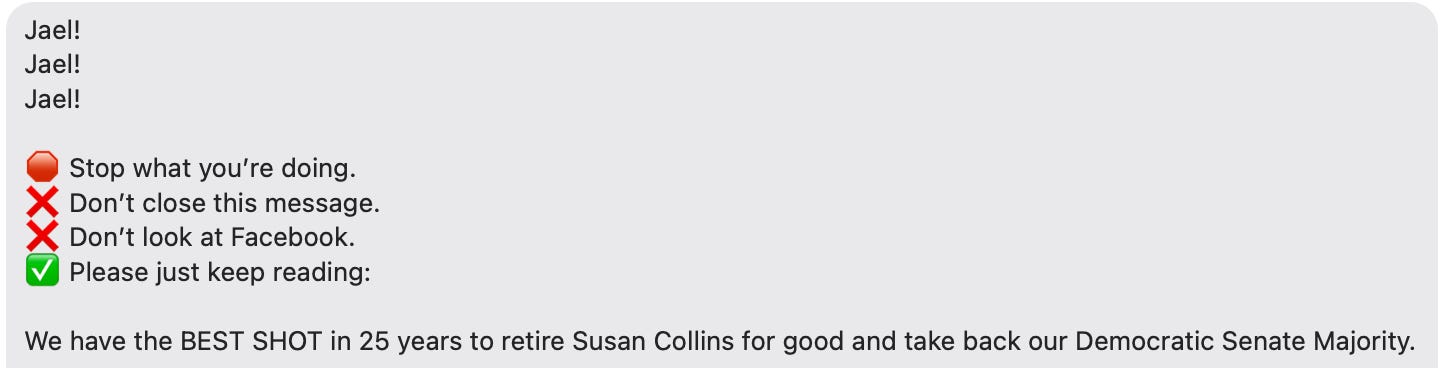
I curtly texted “stop” a few days later — I didn’t know yet that doing so can encourage the sender — but the texts kept coming. By October, Jackson did exactly what he promised not to: “We need to raise another $4,731 in 15 minutes. Is flipping the Senate worth $3 to you?”
In the aftermath of the midterms, this common sub-species of “spam,” which we’re attending to today on The Empty Cup, flooded our devices. It’s strange to sit down and closely read these messages. They are eerie in their ventriloquism, pitiful in their pandering. Yet, in recent months, I came to find the consistency of candidates’ messages almost soothing. Like chatbots, they are epic, voicey and stylized in their prose, yet profoundly empty and robotic, repeating the same themes and phrases. They are outrageously phony, in their personalization and confessional intimacy. Yet, they do not outrage me: spam is a feature of life I’m completely numb to, whether it’s “recruitment” texts from “Amazon,” an email from Lowe's®[email protected] telling me I’ve won a free 267-piece tool set, or a ghostly message, with inscrutable purposes, that simply reads: “Do you have a minute to spare?”
Spam is a sprawling, protean category that's expanding and shapeshifting at supersonic rates with the advent of A.I. The first spam email was sent in the late 1970’s, and after a failed fight to regulate commercial email in the 2000’s, spam has grown to represent around half of all email traffic. But if any unsolicited message sent in bulk is spam, the vast majority of what we encounter on the internet and on our phones is, in fact, spam.
At the heart of the issue is desire and consent. If you do not want the contents of a message, it is spam. If you do, or even if you might, it’s not. You subscribed to this newsletter, but if we sent you five posts a day, you might well consider The Empty Cup spam.
I’ll break the fourth wall here, and introduce myself. I’m Jael Goldfine and I’m the new managing editor of The Empty Cup. I’m a writer, editor, and a fact checker. Since becoming involved in the SoRA community, attention, media, and technology have become my focus. I once wrote mostly about music and popular culture, trying to decode the zeitgeist from hit songs and meme trends. I’ve come to the conclusion that attention is often the key to understanding what’s really going on in culture, in politics, and all around us.
I’m thrilled to be a part of building a home for readers and writers on the subject of attention, as well as a source of news and analysis about the pro-attention, tech-critical movement, which I see as the most important counter-culture and political front of our time. I hope to share writing with you that you do not experience as spam — messages you receive with pleasure, words that offer a playground for your attention, writing that “has things inside it,” as Graham put it, recently.
Today, I’m excited to share Eleanor’s thoughts on a new media artist who made art out of junk mail, a conversation with a chatbot about spam, and an upcoming lecture-workshop where you can make your own cyanotype and learn about atomic politics.
Solicitously yours,
Jael Goldfine
Managing Editor
Visions of Attention
An archive of images and mini-essays on the myriad modes of attention.
How to Spin Slop Into Gold
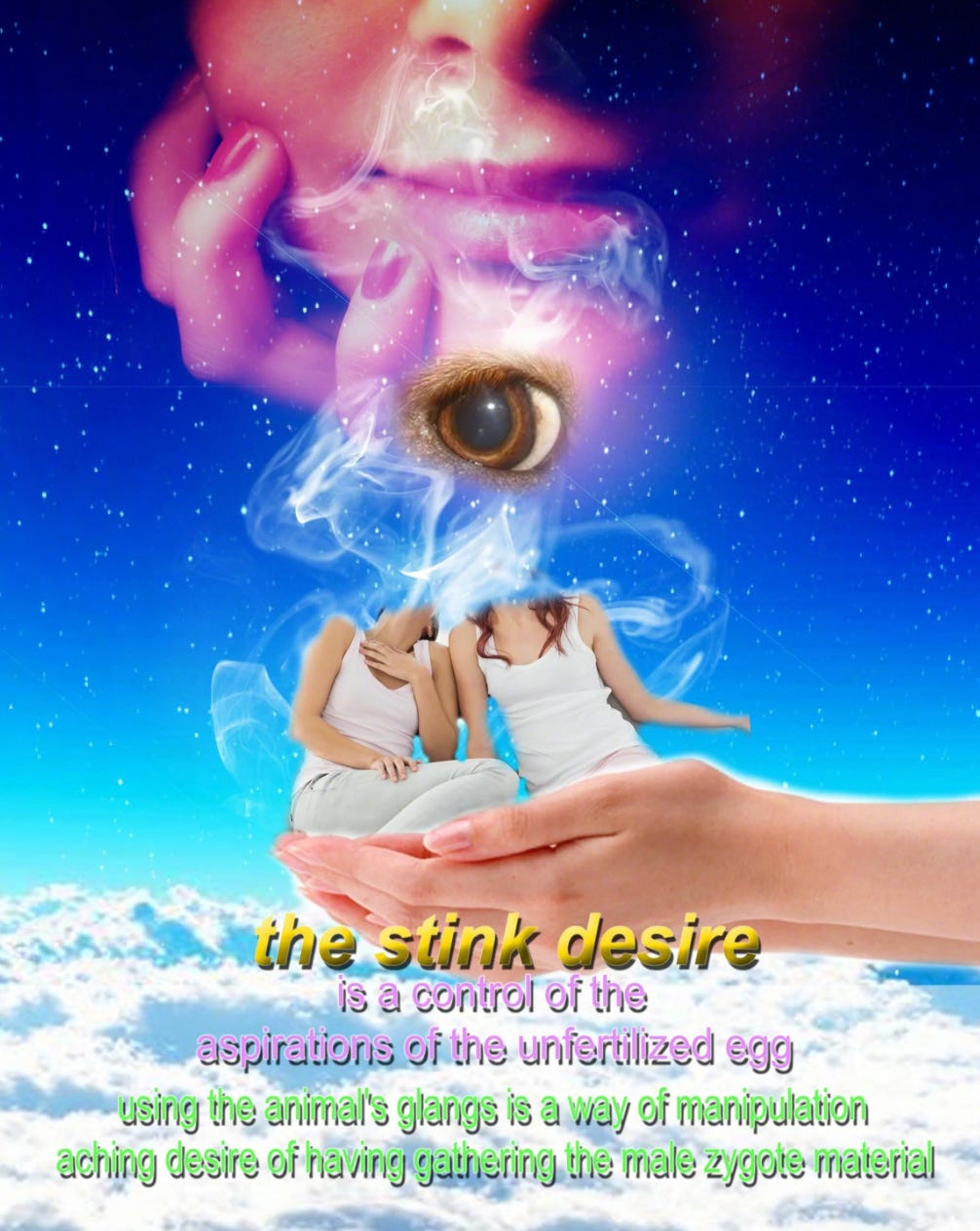
When spam first appeared in our lives, it was unmistakable. The slow drip of garish, misspelled offers for “miracle pills” and reimbursement for overpayment that reached our inboxes can hardly compare to today’s sophisticated ruses and near-daily “SPAM RISK” calls, reminders that the screens in our pockets are still, in fact, telephones.
When the English artist James Howard began making collage artworks out of snippets of spam mail, stock images, and dark web detritus in the late aughts (he was still in art school), he was heralded as “a new folk hero of the web.” It was a very different moment in digital life; Howard’s works, radical for their time, now look like a meme trying to evoke that neon, saccharine Web 2.0 aesthetic. (As you’ll see in our “Stuff for Study” section, Howard was not the first, nor the last artist to be inspired by spam). The Stink Desire, seen above, pairs photoshopped images with a scroll of nonsense phrases that, at the time, suggested bot-speak, a buggy attempt at human mimicry. A decade later, their imperfection telegraphs humanity. It’s hard to imagine modern chatbots producing such inane, grammatically disastrous argot — unless, of course, it was so prompted.
Howard was a teen hacker and had unique insight into how spam works: if not from direct hacking, spammers often glean our contact information from data leaks. He actually worried that data safety improvements would eliminate spam and he’d lose access to the shit that he spun into gold. In 2011, Howard told The Guardian that he’d had to switch from Gmail to Yahoo because of the former’s spam filter: “The systems we have now are still part of the wild west of the internet,” he remarked. “But eventually people will forget that spam ever existed.” Ha!
The west only became wilder. Technology has improved spam, rather than defeating it. For example, in 2024, A.I.-generated “robo-calls” mimicking Joe Biden’s voice were placed to thousands of households in New Hampshire. Howard’s work reveals a moment in time when the spam and the internet were absurd instead of scary, and the virtual and the human were distinguishable. As our feeds are inundated with ever-more slick internet detritus, we, too, must evolve. Like AI-hunting truffle pigs, our minds (and our tech!) are now tasked with the evermore challenging task of sniffing out what is human, and what is… slop 🐷.
— eleanor jasmine lambert
Stuff for Study: Spam Syllabus
Readings and other resources for continued learning on attention and politics
“Roar so wildly: spam, technology and language” (2010) — Finn Brunton, in conversation with a chatbot about spam, for Radical Philosophy
Brunton, a professor of science and technology studies at UC Davis, wrote the book on “spam” so we’ll also share that: “Spam: A Shadow History of the Internet” (2013) or you can check out Los Angeles Review of Books’ review
“A Plan for Spam” (2002) — Paul Graham, co-founder of Y Combinator and Hacker News, and the inventor of modern spam filtering, writes about how it works (plus, a sub-section of his blog is dedicated to spam)
“Spam lit: the silver lining of junk mail?” (2008) — Andrew Gallix for The Guardian, on how spammers began copying chunks of literary works into their emails to bypass filters, and the literary movement this inspired
Here’s a few spam poems by Judge Smith, Ben Myers, Sydney Stone, Brian Michael Murphy and a great interview with Myers, who published a collection of spam poetry, about the form
“Postcards from Another Planet” (2014) — Dan Piepenbring, on the art form of raw spam, arguing that human curation dilutes its literary powers, for The Paris Review
“How to stop the internet becoming a junk heap” (2023) — Ethan Zuckerman, the inventor of the pop-up ad, on solutions for fighting slop, spam and misinformation, for Prospect Magazine
“Spam Policy and the Myth of the Ungovernable Internet” (2026) — Rebecca Coyne on how policy efforts to address spam offer lessons for A.I. in Issues in Science and Technology
IRL
A rundown of what’s up at the Strother School of Radical Attention in Brooklyn
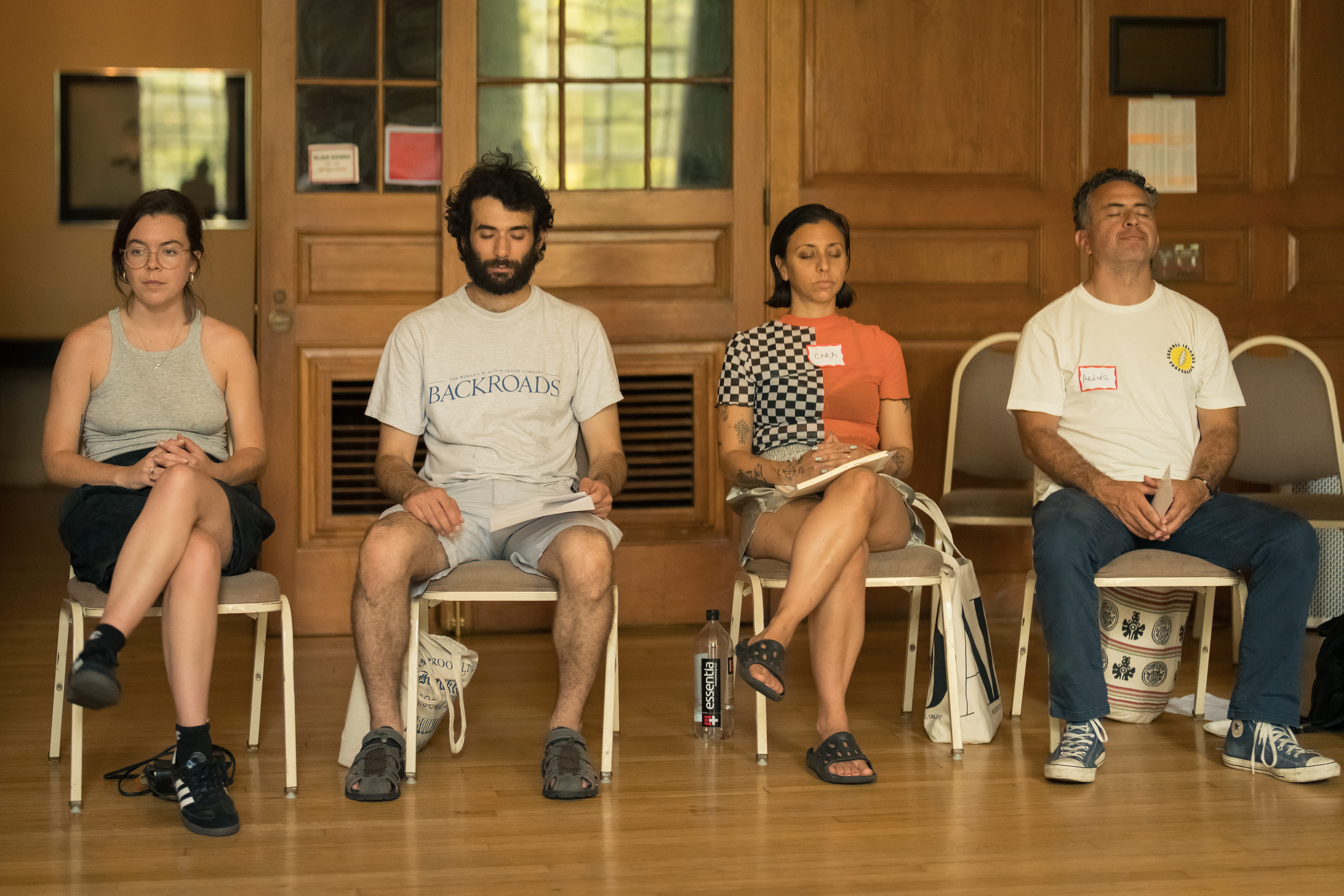
Thu, November 12: In this ATTENTION LAB: MASKS, we’ll play with masks (as metaphor) and with the forms of attention that unmask the world, revealing it for what it “really” is. Sign up HERE!
Sat, November 14: Join artist and activist elin o’Hara slavick for a lecture on atomic politics followed by a hands-on cyanotype workshop. RSVP HERE!
Thu, November 19: Step into the student seat in our upcoming ATTENTION LAB: FOR TEACHERS. Sign up HERE!
Find more workshops, events, and gatherings here!
Congratulations on your new position , Jael. What a great opportunity to contribute to the cause of attention activism. It’s the most important work of our time! Make your voice heard.
highly recommend the book Spam: A Shadow History of the Internet