

Dear friends,
Some icebreaker questions are better than others. “Would you rather be in a deep sea submarine, or in outer space?” is a personal favorite, as it’s a quick way to gauge a stranger’s appetite for the immensity of the unknown universe.
While space travel might be a traditional symbol of our pioneering spirit, I tend to campaign for the submarine voyage as the more foreign option. Scientists have mapped the topography and modeled the conditions for marine life, yet photographs have only been able to capture a fraction of the deepest ocean floors and a handful of its inhabitants. And with fewer depictions of deep sea voyage in pop culture, it seems harder to imagine ourselves in a submersible to the same degree as we envision suiting up as astronauts and boarding a spacecraft.
I don’t think you could go wrong either way; what I appreciate about the question is that both options lead one to conditions inhospitable to humans. If only from a brief glimpse, we can envision what transpires in worlds other than our own and give the human experience a backseat view — at least, to the best of our efforts. In Andrei Tarkovsky’s Solaris, the scientist Dr. Snaut laments humankind’s inability to see beyond ourselves. “We want to extend the Earth up to its borders. We don’t know what to do with other worlds.”
For this issue, we are attending to what is Beyond Our Reach. In Visions of Attention, Haena considers desire and withholding in the work of the ancient painter Parrhasius. In Practice in Practice, kyle attends to the familiar yet foreign world of plants. In Stuff for Study, I share writing on the imperceptible: ghosts, vibes, and heaven.
Read on!
Yours in the great beyond,
Czarina Ramos
Managing Editor
Visions of Attention
An archive of images and mini-essays on the myriad modes of attention
Veiled Meaning
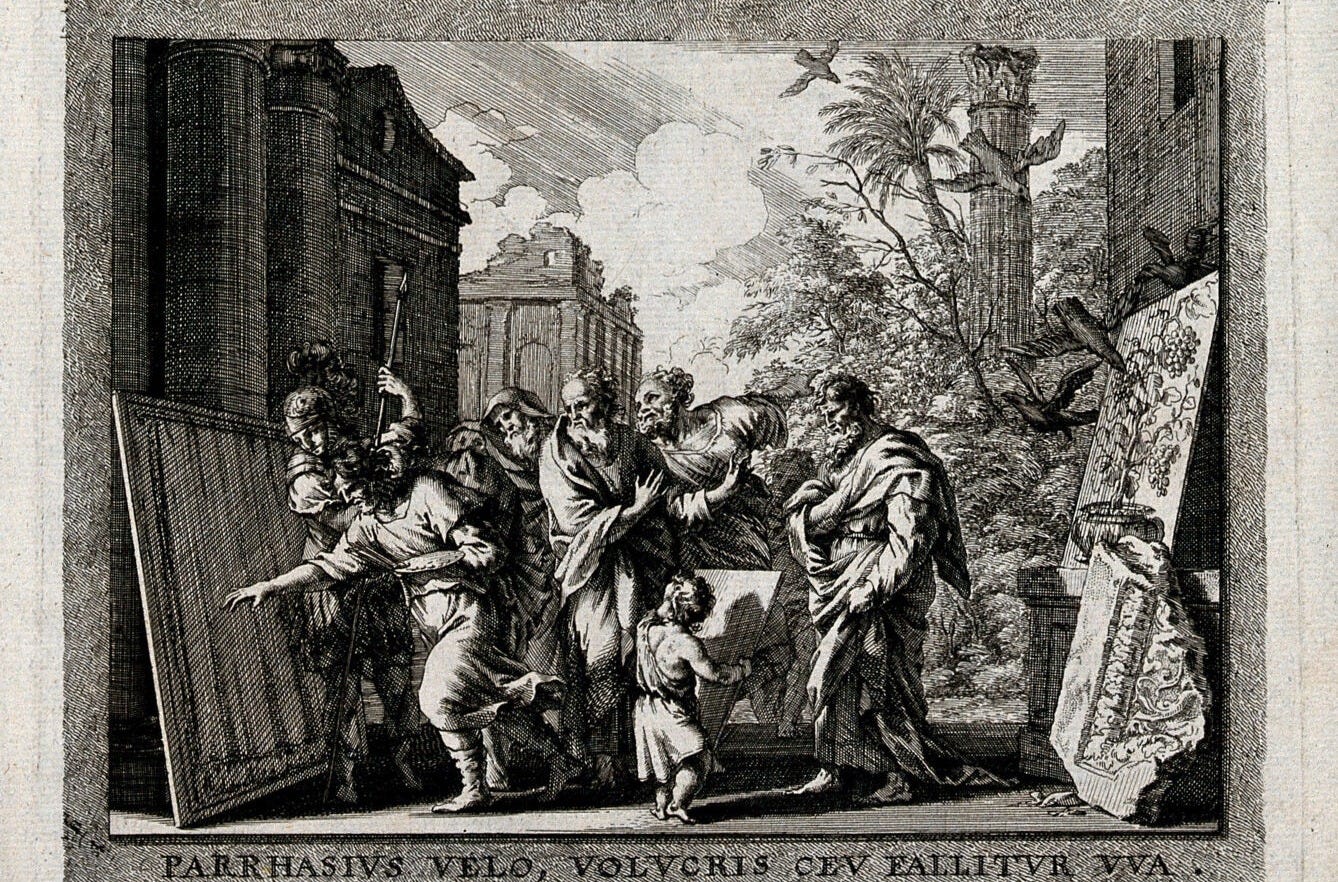
According to Pliny’s chronicle Naturalis Historia, the ancient Greek painters Zeuxis and Parrhasius were so skillful at rendering reality that one day they decided to test their abilities with a contest. Zeuxis painted an image of grapes so lifelike that hungry birds flew into it — an impressive feat of realism. Parrhasius countered with a painting obscured by a veil. Only when onlookers approached to uncover the image within did they realize the veil itself was painted.
If some see Parrhasius as the clear victor, is it simply because he managed to persuade human beings instead of birds? Psychoanalyst Jacques Lacan used this parable to point out a supposedly unique characteristic of human attention: the desire to uncover the hidden. This desire is what prompted onlookers to “buy into” Parrhasius’ visual trick. The act of uncovering the illusion itself was the source of their fascination. What does this tell us about our attention — and about the peculiar power exerted upon us by the unknown?
— Haena Chu
Practice in Practice
Reflections on experiments in Attention Activism
Plantsight
Somewhere in industrial Greenpoint, between the onion-domes of a wastewater treatment plant and the polluted waters of a superfund site, I am crouched, peering intently at a wildflower. Here is Kingsland Wildflowers, a rooftop garden and the venue for the latest Consumption Book Club, a literary + culinary event series I run with my friend Colette. I’m not the only one flower-gazing; some thirty humans are paused in contemplation throughout the meandering meadow of native paths, attending to the bright petals scattered throughout. Scattered about the grass, we humans seem part of the garden ourselves.
Inspired by our latest book selection, The Light Eaters by Zoë Schlanger, Colette and I prompted participants to freewrite from a place of childlike wonder toward the mysterious world of plants. I’m dutifully tuning out my industrial surrounds and giving my full attention to a Brown-eyed Susan.
But attention is not the same as access. Equipped with Schlanger’s reporting on plant senses and plant behavior, I can no longer see just a yellow flower with a dark center. To the bees working visiting this oasis among concrete behemoths, the petals fluoresce into a bullseye, a landing strip in ultraviolet. It’s a color I have for which I have no receptor (or word, either).
Which is to say the flower is not addressed to me. What I’m calling beautiful is a message co-evolved over millions of years for somebody else, and I am reading it over their shoulder. I crouch lower. I keep looking. The gap doesn’t close, and that turns out to be the point: my attention gets sharpest right where it fails.
This is what a good book can do: redirect the eye, then show the eye the edges of its vision. The Light Eaters was, for me, an invitation to attend more closely to plants by imagining the multifaceted worlds they make. Consumption Book Club takes that invitation literally; we ingest what we read, translating text into recipes so ideas arrive by mouth as well as by page. Here, we translated it into a meadow. Thirty people on a rooftop, crouched at the edge of a perception not our own, attending to the enchanting livelihoods of wildflowers.
— kyle barnes
SoRA Faculty
Stuff for Study: Out of Sight, In Mind
Readings and other resources for continued learning on attention and politics
With regards to the invisible — A. Kendra Greene for Nautilus
What are we writing about when we write about ghosts? — Lisa Kroger and Melanie Anderson for Reactor
How heaven became a place among the stars — Stephen Case for Aeon
Vibe, mood, energy, or bust-time re-enchantment — Mitch Therieau for The Drift
Metaphors can make you blind — Iain McGilchrist on Substack
— Czarina Ramos
IRL
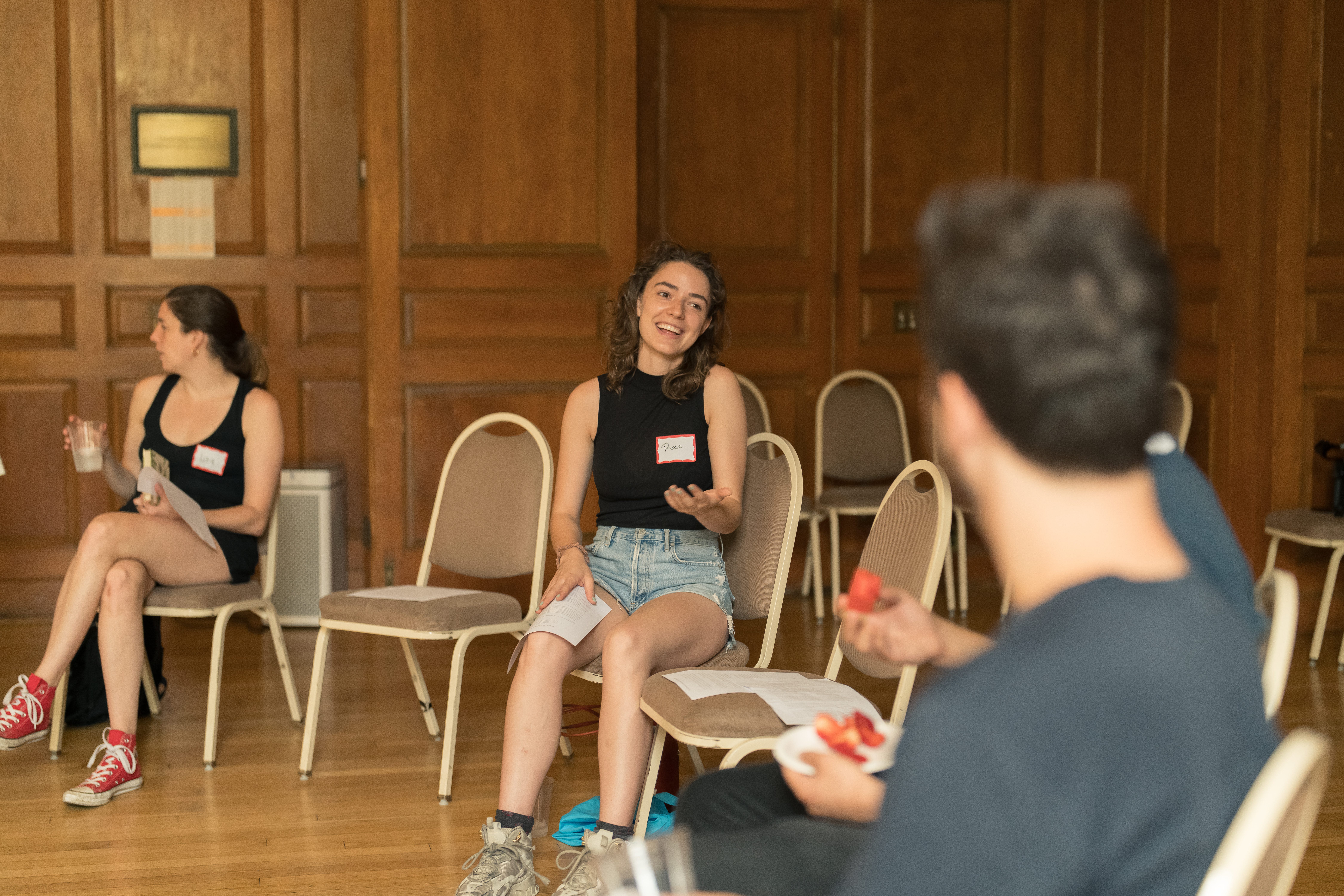
Thu, August 27: ATTENTION LAB: STUDY is a participatory workshop dedicated to the joint exploration of radical human attention. Sign up HERE!
Find more workshops, events, and gatherings HERE!
Would love to see some exploration of quality of attention and different neighborhoods and language, like ghetto, street vernaculars, and more office politics environments as contrast. How they’re interrelated, the different living environments and language and attention.
“The raw “ghetto voice” can be understood as a vernacular form of social analysis: its aggression, insults, and exaggerations reveal how attention, status, threat, and recognition become organized in everyday interaction. Language here does not merely communicate ideas; it occupies and reorganizes social space, establishing toughness, reversing surveillance, contesting status, and demanding that the observer become the observed. From a sociological perspective, different environments—street life, office politics, academia, hipster culture, online discourse—operate as distinct interactional fields with different currencies of attention, legitimacy, respect, and belonging. People moving between these spaces acquire multiple social grammars, and under stress they may revert to older or more defensive vernaculars rather than the explicit ideals they normally endorse. This helps explain how racial, gendered, class-based, or other stereotypes can become suddenly salient during conflict: threat compresses a complex individual into a familiar social category, revealing how fragile an integrated perception of others can be under duress. The ability to hear aggressive vernacular without immediately treating it as an exact representation of a person’s character is therefore a form of social and psychological literacy, because the language may express both genuine hostility and adaptations learned from a particular social environment. At the same time, the speaker’s own interpretations must be treated as hypotheses rather than revelations, since the desire to expose other people’s hidden motives can itself become another form of status performance or projection. The recurring demand to “include yourself” is consequently crucial: every interpretation of another person also contains information about the observer’s attention, affect, social position, assumptions, and limitations. What initially appears to be a chaotic stream of insults therefore becomes a study of how people compete over who gets to define reality, whose attention matters, and whose interpretation of the social world becomes authoritative. The deeper objective is not to eliminate these raw vernacular voices but to become sufficiently literate in them to translate across social spaces, distinguish observation from inference, and turn conflict, status competition, and aggressive language into material for sociological and psychological understanding.”
Two thoughts: 1) there’s a reason that it’s called artificial intelligence; 2) for the same reason this Substack is called the empty cup