

Sebastian Watzl is a German philosopher and professor at the University of Oslo. He leads an interdisciplinary European research group that focuses on the ethical, epistemic, and social dimensions of human attention. He is the author of Structuring Mind: The Nature of Attention and how it Shapes Consciousness (Oxford University Press, 2017). He sat down with SoRA co-founder D. Graham Burnett to discuss the normative analysis of human attention.
DGB: Hi Sebastian! You are one of the leading philosophers thinking about human attention. Would you start us off by giving a sense of how you conceptualize this feature of human being? What is “attention”?
SW: I think of attention as our active interface. Attention is the surface that structures how we – as minded beings – meet the world and meet each other. Attention consists of prioritizing information. It activates something in mind and organizes that information for access in our agency.
I like to approach attention with paradigms: looking at something, listening to a piece of music or to a friend or partner, or focusing on one's own breathing or bodily sensations in a yoga practice. Many of these paradigms are “perceptual.” But we also have cognitive attention in focused thinking about something, or emotional attention when we are emotionally engaged with something. What these have in common is that they all involve organizing one’s current mental state around particular items – those items are more or less prioritized. This organizing is something we can influence with various forms of voluntary control, but it also depends on our environment or our personal history, in ways we do not control.
My thinking about attention started by asking how it shapes our subjective experience or consciousness. What does it feel like to focus on one instrument in a piece of music or trace your own breathing? I first thought that attention could simply be defined as the structuring of consciousness. I have come to reject that view.
DGB: With what implications?
SW: I think we first grasp the concept of attention on the basis of our own experience – and how we experience the attention of others. This experiential part is really important. But it is then also, at least in part, a scientific endeavor to delineate what the concept of “attention” actually refers to, with precision, and based on empirical analysis. For instance, on the basis of the relevant research, I now think that attention can actually occur unconsciously – which is not “experiential” at all.
DGB: Interesting. Attention without experience?
SW: Yes! It may seem counter-intuitive, but I am convinced that this is a real phenomenon. We can have attention without consciousness (the phenomenon of attention in “blindsight” is evidence of this). On the other hand, I still stand with the view of my book Structuring Mind — that there is no consciousness without a form of attention (though not everyone agrees with this!).
In the end, I think that attention is at the heart of agency. With attention, primitive organisms began to adapt their sensory processes to their current needs and to respond selectively and flexibly to their surroundings. In current work-in-progress (one of the two books I am working on), I argue that the capacity for attention developed gradually in evolution as organisms developed more complex forms of acting, brought with it consciousness, and also the stable informational states (“beliefs”) and stable motivational states (“desires” or “intentions”) that play specific roles in how organisms prioritize information.
“Norms for attention, in the end, are about how we access and organize information together for inextricably linked lives.”
DGB: You run a pretty extensive research project that centers on attention. Could you tell us a bit about how that all works? What are the objectives of the whole research initiative, and how do you and your colleagues go about your investigations?
SW: Our aim is to figure out what good attention is and how attention can go bad.
Here are some questions we currently look at: is there really a market for attention, and what, if anything, is wrong with such a market? (Spoiler: it’s because it tends to alienate us from our own lives). Do some patterns of social attention marginalize others? Are some forms of public attention unjust? Are there some things that deserve my attention, independently of whether it is useful for me to attend to them? What is wrong with “flooding the zone”? Is distraction always bad? What role does attention play in epistemology? Is the attention system of people with depression or ADHD “broken” or do different people just attend in different ways? (Spoiler: the latter).
We have different people, postdocs, PhD students, researchers working on these and other questions. In addition, we organize workshops, talks, and conferences. We write both academic things and things for a broader public, and we work with others, from consumer rights organizations to teachers and clinicians.
When one looks at our body of work, it’s clear the question of good attention clearly covers a lot of ground. Attention can be more or less prudent, epistemically rational, democratic, and more. So, there is also an issue of how this all hangs together. I’m currently working on two books about that.
One is on the political dimension. It is about attention and power. It shows that influence over the attention of others is a way of having power over them. It then applies that to markets in attention, and political influence. In response we need a democratic way of organizing the attentional commons.
The other book is about the role of norms for attention in our human lives. It tells a naturalistic story of what makes us human and how attention is central to that. Norms for attention, in the end, are about how we access and organize information together for inextricably linked lives. I argue that what philosophers call “epistemic” norms and the significance of knowledge or rationality can be traced back to how we “landscape” our joint attentional environment.
“I’m actually concerned about too much valorization of attention. The good of attention often means the good of producing attention on demand.”
DGB: This is great stuff – super important stuff. The “Friends of Attention” coalition, and the folks involved with the Strother School of Radical Attention share your sense of the centrality of attention to any adequate account of our political lives – especially now. Our own forthcoming book, ATTENSITY!, takes up that very issue. It will be really interesting to see how our ideas fit together with the work you are doing, both individually and with your collaborators. Your overall focus on “Good Attention” brings out the “normative” dimensions of our attentional lives. Does attention have an inherent normative valence, in your view?
SW: The term “Good Attention,” as I am using it, refers to normatively positive ways of attending. I think there are also lots of bad ways of attending. If I am attending to the wrong features of another person (say, only, their looks or the fact that they “merely” are a woman), I am attending, but I am also, as the philosopher Ella Whiteley has argued, disrespecting the other. Social attention can also go bad. This, I think, is something we see a lot: instead of public attention to important issues, there is – often because of media coverage or political agitation – attention to the wrong issues. Public attention, as my colleagues Katharine Browne and Zsolt Kapelner argue, can also be unjust. Remember all the public attention received in 2023 by the failed rescues of the Titan, a submersible en route to the wreck of the Titanic? At the same time, another ship, the Adriana, capsized off the coast of Greece, killing more than 600 people. Browne and Kapelner argue that this pattern of public attention is unjust as it did not treat those on the Adriana with the same dignity and worth as those on the Titan.
On the other hand, I also think that there is nothing bad about distraction. I’m actually concerned about too much valorization of attention. The good of attention often means the good of producing attention on demand. Focus on the schoolwork, don’t chat with your friends. Do your work, don’t get distracted. Demanding “attention” in this way is often itself an exercise of power.
Now, one might ask: is some sense of “attending” intrinsically valuable? Some philosophers, like Simone Weil, clearly think so. Two of my PhD students, Ying Yao and Louise Clover, explore versions of that general idea. Maybe there is intrinsic value to direct attention to the world, rather than being trapped by the “ego.” And maybe certain patterns of attention are required to find meaning in life. I think there is something to those ideas. My own meta-normative inclination is that this question of whether attention has intrinsic value is something we ask and answer in our joint project of figuring out how to live together. There won’t be a final answer, I think. And that is not a bad thing. Figuring out how to attend together, after all, is – as I mentioned – what makes us human. So, let’s keep doing it.
“… philosophical work can help elucidate what the commodification of attention really consists of, and how our attentional capacity can be the site at which power is exercised over us.”
DGB: That’s a lovely framing. The Empty Cup is especially interested in “ATTENTION ACTIVISM” – the cultivation of forms of solidarity to push back against the exploitative commodification of human attention, which we think is at odds with human flourishing. What parts of a “philosophical” approach to attention are, in your view, most important to that work?
SW: Yes, much of what we have already been discussing connects directly to that issue. Let me pull out three specific things that I think are key.
First, philosophical work can help elucidate what the commodification of attention really consists of, and how our attentional capacity can be the site at which power is exercised over us. Philosophers can use our analytic toolbox to illustrate the role attention plays for autonomy and how it can be the site of domination or oppression. As philosophers, we often have one foot in the normative discussion of how things should or should not be, and also one foot in the discussion of what attention really is and what roles it plays in our lives. That’s where, I think, we can be helpful.
Second, we can also be helpful in thinking about the complex ways in which “flourishing” might happen and the role attention might play in this. Much good philosophy (though not all of it) is able to look far into the past and also at different conceptions of “the good” in different forms of life. This can help us to expand our notion of flourishing - I would hope.
Third, I think that we can illustrate, as I suggested above, that this notion of “attention activism” actually has pretty deep roots. Negotiating norms for attention and the fight over good attention has always been with us. I hope that the work of my research group can help people see that, so that those who might, say, “oppose” attention activism actually have, in the end, an attention activism of their own!
It would be naïve to think that philosophers can look at the scene of the fight over attention merely from a distance. We are in the middle of it, and from that engaged perspective we can, as something more than just academics (perhaps in the richer tradition of the “organic intellectuals”), hopefully contribute arguments, terminology, or ways of thinking that can be helpful.
DGB: That sounds so right! Sebastian, thank you for your time, and good luck with all your important work!
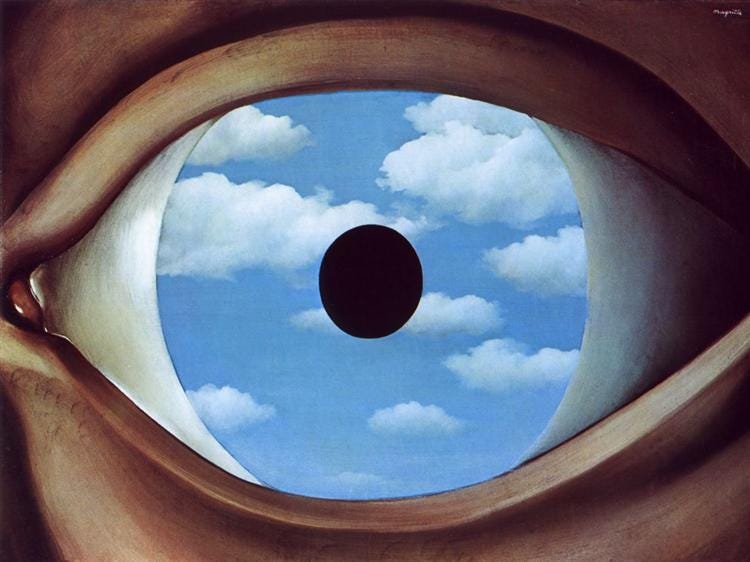
I find it very interesting that the illustration "Le faux miroir" by Magritte, looks deep into the transcribed interview with Sebastian Watzl, about attention. Indeed, Magritte questioned appearances in the heart of life, and paid a lot of attention to how deceitful they can be. Attention seems to be the most important prize to get, nowadays. Everyone wants our attention. "Good attention" only. Attention is what makes us human and loved. And conscious. The link the author makes with consciousness seems paramount to me. The "unconscious attention" appeared a bit weird at first, then I remembered the series " Colombo". In one of his investigations, Colombo learns about "subliminal cuts", ads that were inserted into a film in order to trigger some reactions. The cuts were so short that they did not have time to reach consciousness, but triggered the required behaviour. Hence, for instance, the will to look for a fresh drink after a short film featuring fresh drinks, in a very hot room.
In this case, this kind of unconscious attention would probably not qualify for "good attention", according to Sebastian Watzl.