

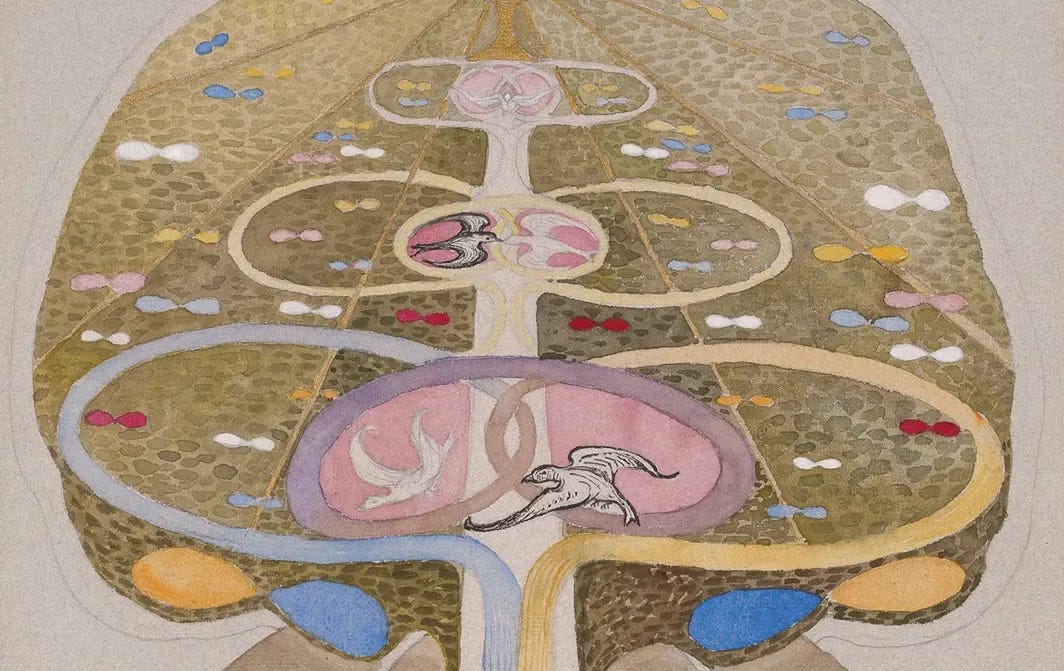
You may have noticed that our forthcoming collectively-authored book has an unusual title: Attensity! A Manifesto of the Attention Liberation Movement. Friends of SoRA will be familiar with the spirit of that second part — the idea that the so-called human fracking of the attention economy requires new forms of collective action — but the first word will be new to basically anyone. What is attensity?
As we have written, the word emerges from the dusty archives of early twentieth-century psychology. It was coined by the English-born psychologist Edward Titchener (who introduced the term “empathy” to the English language), a so-called structuralist who sought to understand the vexing phenomenon of human attention through acts of introspection. Attensity was Titchener’s neologism for the dynamics of attention that could be perceived by attending to one’s own subjective experience.
This is attention to attention. And it’s an approach to attention that quickly fell out of fashion as other, more systematic empirical methods began to dominate the field of psychology. Titchener’s attempt to squeeze perfectly satisfying “scientific” knowledge from the slippery strangeness of the self-directed mind never quite materialized. But for those of us living in a world shaped by the subsequent confluence of experimental psychology, military research, and scientific advertising, the spirit of his quest offers a much-needed reminder:
Attention is about what it means to BE HUMAN.
It’s not about productivity. It’s not about attention spans. It’s not even about focus or flow. Attention is a way vaster thing — so vast, in fact, that it can only be expressed in the most intimate (or perhaps even cosmic) terms. Attention is important because it is the stuff of experience. It’s how it feels to be alive, in this body, right now.
When we invoke attensity in the title of our book, we are recovering that more capacious and vital understanding of attention. Like any form of true understanding, it comes with a responsibility: to protect our attention, and to create conditions for shared life that allow it to thrive. If that sounds like a lot of work, that’s because it is. There is much to do. But attensity reminds us that all this work, all this doing, is, after all, about nothing less than being — the beautiful, ineffable task of being human.
In anticipation of the release of ATTENSITY! A Manifesto of the Attention Liberation Movement, we’ll be publishing a series of short reflections on what, exactly, we mean by “attensity,” and why we hoist it aloft as a banner for the gathering of Attention Activists far and wide.
This part is critical: all of our proceeds from ATTENSITY! will support the work of the non-profit Strother School of Radical Attention, so every purchase you make goes back to our community-facing programming. Which is to say…
Attention to attention has been practiced by Buddhists of all lineages (Tibetan, Indian, Zen, Theravadin, etc.) for 2500 years. Yes, in the Europe and America, the work of James and others was original. It has been curious to me how little the Buddhist tradition is mentioned in Friends of Attention posts (and in the book, Attensity). Is it a desire to appear "secular"? At any rate, might be a good idea to offer some experiential courses based in aspects of the Buddhist tradition of becoming acquainted with the mind in all its confusion and wisdom? Or even courses in Buddhist meditation? Going to the source, etc.