

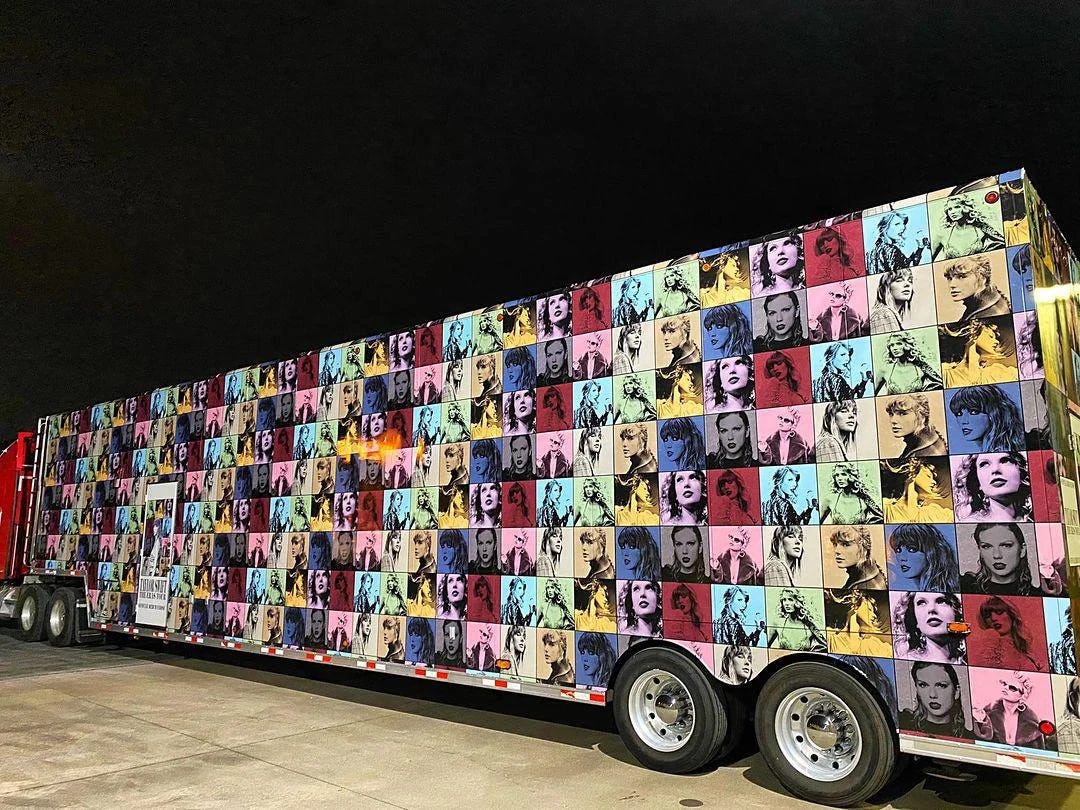
Beyonce has the Beyhive; Taylor Swift has the Swifties; Lady Gaga has the Little Monsters; Cardi B has the Bardigang; Nicki Minaj has the Barbz, Justin Bieber has the Beliebers. How did these fandoms emerge and what do they reveal about our attention in the current media landscape?
We live in an era defined, above all else, by consumption (and not because of a thriving middle class with expendable income, mind you). The ethos of trickle-down economics — a doomed experiment in the downward transfer of wealth and power — seems to characterize how we interact with music as well. The relationship between pop stars and fans is a top-down structure: many of today’s biggest musicians are billionaires who parlay their fame into business empires and push products onto fans (think Dr. Dre’s headphones, Rihanna’s lingerie, Lady Gaga’s makeup — the list goes on). Even on a musical level, the Age of Information has replaced “listening” — an act of concentrated attention, facilitating communion between fan and musician — with “consuming”. We now interact with musicians through channels devised by shrewd business strategists, including revenue-generating viral videos, branded social media, and, of course, slick products sold under the label of celebrity. The consumption patterns of the biggest fandoms can even be seen on a macroeconomic scale: Swifties influence national GDP with their spending habits.
If this level of influence and devotion appears quasi-religious, that's because it is. The place of organized religion is less central in American society than it was even fifty years ago, but what’s taken God’s place? In the US, the answer is probably the almighty dollar. After all, the famed and increasingly mythical American Dream promises us that if we pull ourselves up by our bootstraps, we can find nothing short of salvation in the form of wealth. Our pop stars have successfully transcended the mundane realities of making ends meet, thereby becoming de-facto deities of the capitalist belief system — and buying their products makes us feel closer to our own salvation.
So while Kanye West was less subtle when he declared himself a God on Yeezus, Jay-Z’s verse on “Diamonds from Sierra Leone” evokes Max Weber’s vision of the spirit of capitalism and corporatized transubstantiation with little ambiguity: “I’m not a businessman / I’m a business, man.” Following suit, many pop fandoms worship and protect their gods with the fierce energy of a holy war, this time fought through the keyboard. Meek though their monikers may seem, these groups are not to be messed with: Nicki Minaj (and Beyonce’s publicist, for that matter) had to explicitly remind her fans to not harass people on her behalf.
Of course, fandoms are not new phenomena; the Beatles, Elvis Presley, and even The Monkees caused stirs of historical proportion in their heydays. But what I find curious is that, now, neither the industry nor the fans question this odd, contemporary mix of capitalist enterprise and self-effacing hero worship – even in publications that used to explicitly celebrate musical counterculture, instead of pandering to the hive (and not just Beyonce’s). Rolling Stone went so far as to criticize Doja Cat — calling her behavior “bizarre” — for losing hundreds of thousands of followers over an Instagram Threads post saying, “If you call yourself a ‘Kitten’ or fucking ‘Kittenz’ that means you need to get off your phone and get a job and help your parents with the house.”
Hey Rolling Stone: whatever happened to encouraging people to claim their individuality? Or raging against the machine? What about the music, man? (For the record, I think Doja Cat is right on — but who knows, maybe Rolling Stone is scared of losing followers, too).
I’m all for community formation, but as I explore in my book JAPANTHEM (and in my doctoral thesis in ethnomusicology that inspired it), not all music communities are equal. J-pop fandoms (for instance, the culture around megagroup AKB48), which are largely brought together through passive consumption, are surface-level phenomena, like a hash tag — whereas the underground and “traditional” (indigenous, 900 year-old) music worlds I researched were deeply personal, and resembled each other in terms of mutual effort, collaboration, and creation. To be sure, the ancient Buddhist dance I practice and the basement clubs I raved in were very different experiences on a sonic level, but what they shared was an ethos of community: a sense of rallying together to make this music heard (which led me to think of aesthetics as social, rather than sonic, phenomena – and the “underground” as an attitude, or a gestalt against mainstream sensibilities, rather than merely bloop-blorping on a synthesizer in some Bushwick basement). In other words, these musics wouldn’t exist without active participants — whereas Taylor Swift could retire tomorrow and alienate all of her admirers, and still have enough money to build her own spaceship company if she felt like it. Fans need their idols, but idols don't need their fans.
Case in point: after all the bullshit he's pulled, Kanye’s still a billionaire.
In a late-capitalist world fueled by runaway technological development preying on human attention (coupled with good ol’ fashioned class disparity), it is a radical act of reclaiming selfhood truly to listen to music. This may not mean deleting digital music collections, if you have one (although there are excellent cases against Spotify); it means seeking out musical experiences beyond the shallow connections afforded by the internet, or the algorithm. It means daring ourselves to detach from the lifestyle brands of celebrities. It means listening to physical artifacts (records, tapes, even the awkward in-between technology that were CDs) that require our active participation to enjoy. Of course we can respect the business acumen of today’s pop stars, but I challenge readers to separate the art of capitalistic enterprise from the art of sound. We can dare ourselves to remember that pop stars are not gods, but flawed human beings like the rest of us. Most of all, we can dare ourselves to leave behind our devices in search of new music.
In the end, the act of searching (and the attention it requires) is what gives our musical lifeworlds deep meaning — and the joy of finding a musical community, beyond the true and simple pleasures of sharing sensations in time, is that we work, as individuals, to find it for ourselves. Take out the earbuds, and watch your world expand.
Jillian Marshall, PhD, is an educator, author, musician, and visual artist based in Brooklyn. Her SoRA seminar on POP FANDOMS starts Monday, July 14th.