

Dear friends,
If you've ever spotted a phalanx of people staring intently into the reflective black surface of their upheld smartphones, you might be witnessing a cohort of Attention Activists engaged in the Practice of the Claude Glass.

The Practice is named for Claude Lorrain, the 17th century French painter whose dramatic and characteristically scumbled landscapes inspired generations of imitators. In order to capture Lorrain’s coveted style, clever fans devised the so-called Claude glass, a small convex mirror of dark glass whose reflective surface would both frame and darken a landscape.
The Claude glass is a 17th-century technology, and originals are hard to come by. But if you’re squeezed and in need of some Lorrain action, your 21st-century tech will do. Smartphones make for a great Claude glass. Hold it up, power down the pesky display, and behold a twilit world over your shoulder. Quelle vue!
In this issue, we’re talking about mirrors. In Visions of Attention, Haena reflects (ahem) on one of the most famous mirrors of art history in Velasquez’s Las Meninas. In Stuff for Study, Czarina shares a collection of mirror essays. And in IRL, we invite you to spend some time in front of your looking glass (gotta make sure the fit is fitting) before joining us for SoRA’s inaugural fashion show and party: EYE-CATCH!
,sruoy yldnoF,
Peter Schmidt
Editor-in-Chief
Visions of Attention
An archive of images and mini-essays on the myriad modes of attention
Entering the Picture
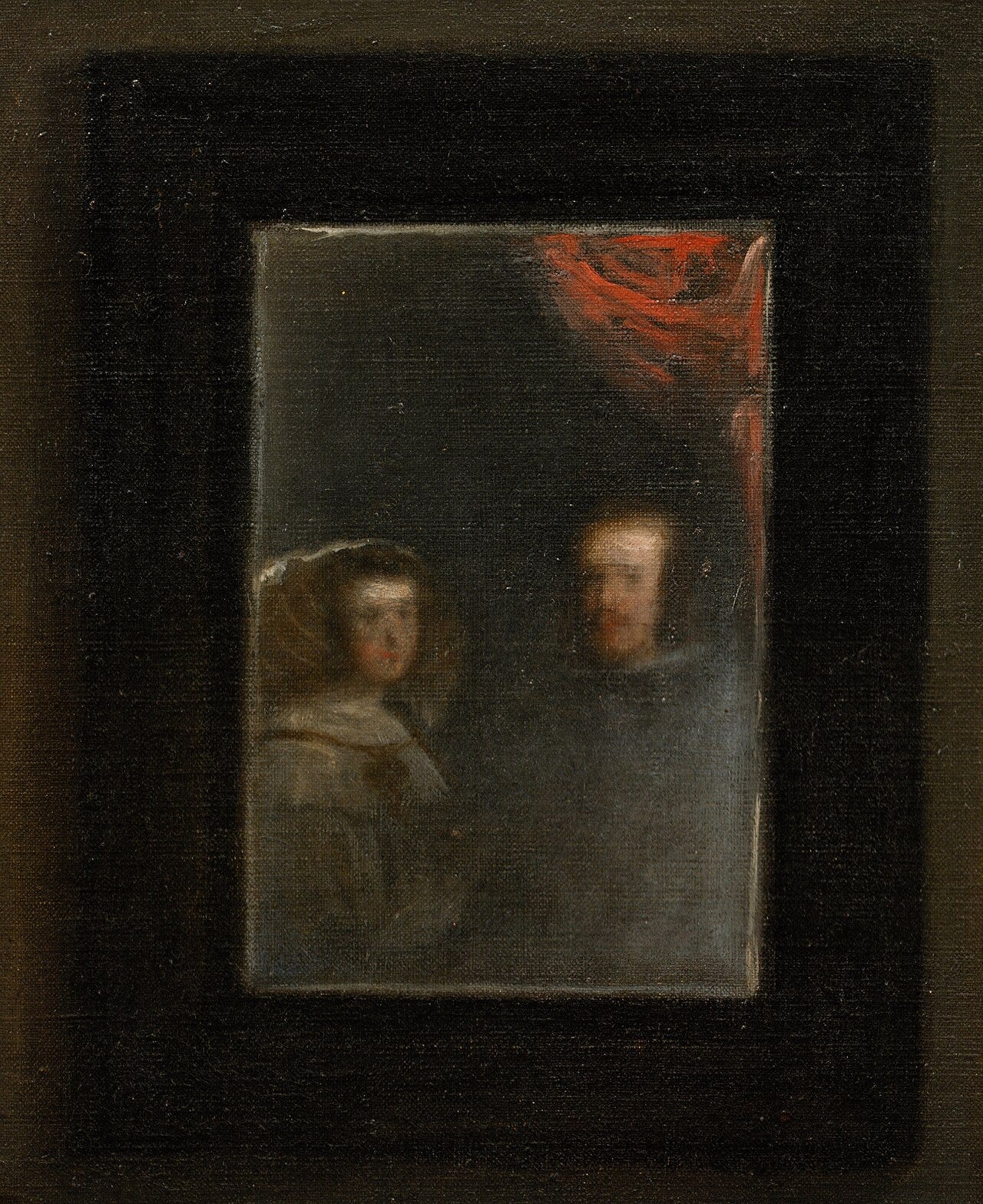
At first glance, Las Meninas is just another court painting.
But let your gaze move further into the high-ceilinged room, and you’ll realize that our line of sight’s terminus is not with the little princess and her attendants, and not even the painter Velázquez himself, standing next to an easel, but with a small mirror on the wall. The mirror reflects a tiny image of the king and queen.
Questions arise: are we, as viewers, the king and queen, or are we standing next to them? Is Velázquez preparing to paint the princess or is he currently painting the king and queen? How could he possibly have beheld a scene of which he was one element? The pictorial space of Las Meninas faithfully obeys the rules of perspective — but as soon as we the viewers enter the picture, we are mired in a paradox.
Michel Foucault famously analyzed Las Meninas in his The Order of Things (1966) as the manifestation of an “episteme,” or a system through which knowledge is produced and legitimized. Although the details of Foucault’s argument have been contested, his point remains that the instability of our own position in this pictorial space exposes the mechanisms by which a painting engages and sustains our attention. This attentional “regime” of painting is driven by the triangular exchange between the position of the painter, ourselves in the present, and the anonymous seat of the imaginary viewer projected by the postures and glances of the characters in the painting (and perhaps even by the objects or forms themselves). Every time our sight makes a full cycle between the three points, the painting creates new relationships — and a new reality.
In the end, the small mirror recomposes the entire painting surrounding it. Las Meninas becomes a huge mirror — the full canvas measures close to 10 feet — that continues to produce its own shifting image in the eyes of the beholder.
— Haena Chu
From the Cup
Archived essays from our community of thinkers
Where Are Your Horses?

“For me, the experience is of hovering, of overhearing one’s own thoughts and sensations as if they are a conversation going on in another room. Sometimes I think of it as equalizing the pressure between inside and out. A feeling in my knee, a sound from outside, the fragment of a thought, light entering my pupils, an emotion rising in my chest.”
— “Pastures of the Mind” by Sal Randolph, writer and Friend of Attention
Stuff for Study: Flipping the Script
Readings and other resources for continued learning on attention and politics
What is a world without mirrors? — Alexandra Kleeman for The New Yorker
The Mirror and the Mind: A History of Self-Recognition in the Human Sciences — Katja Guenther, Princeton University Press
A full-length mirror! — B.D. Clay for the Paris Review
Doorbell cameras and the rise of “surveillance chic” — Kate Lindsay for Embedded on Substack
Feral mirrors: changing the context of an everyday object — Joni Tevis for Orion Magazine
— Czarina Ramos
IRL

Sun, September 13: Stop by Second Sundays at Pioneer Works, a free monthly open house, where SoRA founder D. Graham Burnett and SoRA faculty and multimedia artist Julian Chehirian are current artists-in-residence.
Wed, September 16: Join our IRL seminar SEEING, DRAWING, UNSEEING, where we will consider how drawing can help us develop a different relationship with the body. Sign up HERE!
Sat, September 19: Join SoRA for our inaugural fashion show: EYE-CATCH! will showcase looks inspired by the aesthetics and counter-aesthetics of the Attention Economy. RSVP HERE!
Find more workshops, events, and gatherings HERE!
Is this attention discourse leaving out some people’s experiences? Would love to see something like a sociology of attention, that cover more diverse people’s experiences. Attention and neighborhood, class, race, etc.
wonderful work!