

Friends!
When I was in fifth grade, Glenridge Elementary’s reigning cool kid, Gabe Remshardt, taught all the other boys in my year how to fold a $20 bill so that it appeared to depict the Twin Towers going up in smoke. We halved it lengthwise, then curled the corners upward at a 45º angle until the edges aligned: Suddenly, the innocuous shrubbery of the White House lawn became that morbid plume from the apocalyptic TV broadcasts that had imprinted on our young brains.
We huddled in the corner of the blacktop, passing around the two Jacksons in our possession and performing the magic reveal one by one. I recall suspecting, even at that age, that we were kidding ourselves — that the suggestion of some enormous conspiracy was nothing more than a bit of visual coincidence and some wishful thinking.
Picture us: gazing down at the cash in our hand, quietly awed by the suspicion that we were seeing past the veil of everyday life to the secret inner workings of the world. And we were, in a sense. It just wasn’t in the way we thought. The secret driver of the universe wasn’t some message hidden in the money; it was the money itself.
In this issue, we’re attending to money — and to the ways that money deflects, eludes, and transforms our attention. In Visions of Attention, Haena examines the kago cults of post-WWII Melanesia. In Stuff for Study, Czarina shares contemporary writing on the strange dynamics of money in the age of human fracking.
And in IRL, we issue a special invitation to our upcoming (Fri, May 8th) panel on AI, ATTENTION ACTIVISM, AND ENVIRONMENTAL JUSTICE — featuring Capri LaRocca, Henry R Kramer, Julia Luz Betancourt, and Amirio Freeman. Join us!
Remuneratively yours,
Peter Schmidt
Editor-in-Chief
Visions of Attention
An archive of images and mini-essays on the myriad modes of attention
Cargo Thinking

Following World War II, visitors to the Melanesian islands in the South Pacific would have been greeted by airplanes and landing strips surrounded by processions of men in a militaristic parade — except the men were made from straw, bamboo, and wood. With the withdrawal of colonial and military bases at the end of the war, movements like the Tuka Movement in Fiji, Taro Cult in Papua New Guinea, and the John Frum (a mystical figure depicted as a U.S. military serviceman) Cult on Tanna supplicated for the arrival of goods-laden cargo planes through rituals that mimicked the appearance and movement of their former settlers.
First appearing in 1945, the term “cargo cult” as a catch-all for these various beliefs has since come under criticism for its implication of the desire for better life through the favors of Western powers. But Melanesian kago signified more than literal cargo and wealth. And neither were they seen as gifts from the European settlers — rather, charismatic prophets promised favor from ancestors or hybrid-Christian spirits which would bring about a new social order.
With time, more nuanced analyses began to highlight the abrupt transition from the indigenous system of exchange where one accrued social status through gifts to a system of exchange based on money. As anthropologists like Marcel Mauss have pointed out, gifts are tied to specific individuals and their continued exchange creates a complex, cumulative chain of moral obligation within the community. From such a relational perspective, the impersonal, quantified behaviors of money creates a moral vacuum. In addition to this, the quantities of manufactured goods suddenly rushing into the islands were simply unimaginable at the scale of native communities. These fashioned a new narrative to safely position the extraordinary influx of stuff in a cosmology already disrupted by Christian missionaries.
Modern business-lingo has adopted “cargo thinking” as a warning against wanting results without understanding the underlying process by which those results are produced. Still, the effigies created by the Melanasian devotees feel strangely relatable as attempts to invest some semblance of meaning into what is inherently an empty signifier.
— Haena Chu
Stuff for Study: Balancing the Books
Readings and other resources for continued learning on attention and politics
The reality-distortion of the markets – Aris Komporozos-Athanasiou for Aeon
Everyone is gambling and no one is happy – kyla scanlon on Substack
An economics lesson from Tolstoy – Nick Romeo for The New Yorker
Time is money is work is virtue – Colette Shade for The Baffler
The privatized internet has failed us – Paris Marx for Jacobin
The bonds of catastrophe – D. Graham Burnett for Cabinet
— Czarina Ramos
IRL
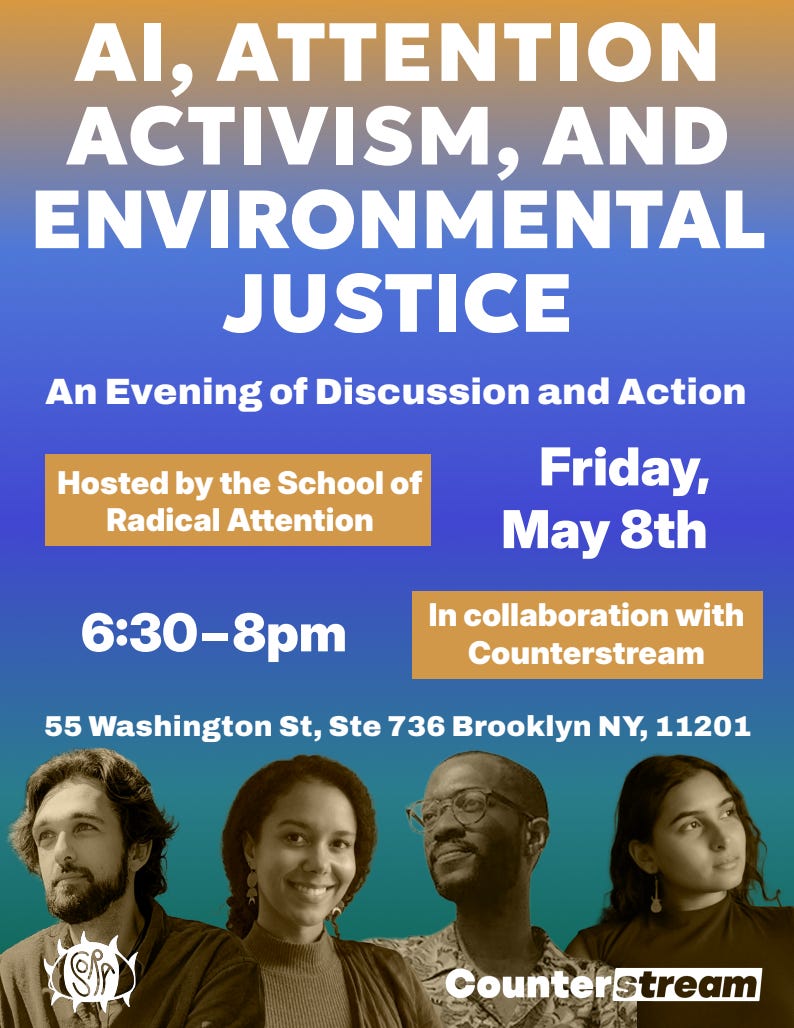
Fri, May 8th: Join us for an evening of discussion and practice at the nexus of Attention Activism and environmental justice in collaboration with Counterstream. Sign up HERE!
Sat, May 9th: What you Attend to Grows: A Special Earth Month Attention Lab is an experiential free workshop exploring the relationship between attention and the natural world in Prospect Park. Sign up HERE!
Thu, May 12th: ATTENTION LAB: SANCTUARY is a participatory workshop dedicated to the joint exploration of radical human attention. Sign up HERE!
Find more workshops, events, and gatherings HERE!