

The words we choose to characterize human attention, technology, and the interactions therein are consequential; scientists often rely upon metaphors to conceptualize complex new processes. Indeed, before the brain was compared to a computer, it was imagined as a loom by Nobel prize-winning physiologist CW Sherrington in 1942. In describing the arousal of the cerebral cortex after sleep, he wrote:
“The great topmost sheet of the mass, that where hardly a light had twinkled or moved, becomes now a sparkling field of rhythmic flashing points with trains of traveling sparks hurrying hither and thither. The brain is waking and with it the mind is returning. It is as if the Milky Way entered upon some cosmic dance. Swiftly the head mass becomes an enchanted loom where millions of flashing shuttles weave a dissolving pattern, always a meaningful pattern though never an abiding one; a shifting harmony of subpatterns.”
- CW Sherrington, Man on his nature (1942)
The loom, as Sherrington perceptively surmised, might offer an alternative view of attention: instead of a linear process involving mastery of one’s attentional flow, as a spotlight shines or a telescope points, the loom metaphor describes attention as dynamic and rhythmic. It produces an attentional path which cannot be followed like a laser-beam, but which must instead be interwoven with the attention of others. I want to propose that weaving — as practice and as metaphor — models an alternative relationship between attention and technology.
The intensity of the attentional crisis facing us today may inadvertently mischaracterize all forms of discontinuous or episodic attention as pathological and symptomatic of today’s technological ills. Craft might be imagined as an antidote to such flighty attentions, for the deep focus or “flow state” which it can often engender. Yet, as a craft practitioner and theorist, I would warn against this utopian proposition; not least because deep focus is only one of craftwork’s many temporal signatures.
“At its heart, “craft” denotes how a human attends to and with technology in order to produce something.”
Textile work, in particular, is especially cyclical, in that it can be picked up and put down, occupying a discontinuous attentional thread — the anthropologist Judith Brown described how textile labor can accommodate interruptions experienced by individuals with caring responsibilities (such as picking up and putting down a child or watching over a cooking pot). In this sense, she showed how textile work is often characterized as gendered labor not because of some biologically essential female capacity for repetitive work, as was previously assumed by misogynist theories, but for its ability to allow for lulls and spikes in attention. Its repetitive nature also makes textile craft the perfect complement to another act of attention: conversation. As we take turns listening and speaking, we can also attend to the up-and-down rhythms of weaving or stitching; perhaps this is why the stitching circle has long been a font of storytelling, speculation, and good gossip.
The metaphor of weaving can transform a linear view of time and attention into one marked with intersections and rhythmic repetitions. You might test its efficacy on your own attention: rather than focusing linearly, try stitching without a pattern in mind, taking a picture without visualizing a social media post, or walking through the city without a destination. The experience of craft, when practiced outside of a commodified realm, can feel like this.
Beyond its ability to embody a flexible thread of attention, however, textiles give us a different view of the relationship between the two terms “attention” and “technology.” Where they are found in the same sentence today, they frequently suggest a doom-riddled technological determinism — the fallacy that technology alone is responsible for eroding our attention, even though social forces create, profit from, propagate, and regulate these technologies. The inevitability which tinges these prophecies hinges upon a view of technological progress as a linear laser-beam: new tech bursts onto the scene and makes everything in its wake obsolete. The stitching circle fashions a different relationship to technology: craftspeople are often quick to point to the term’s root, techne, from which we derive textile. At its heart, “craft” denotes how a human attends to and with technology in order to produce something. Craft writer Rose Slivka succinctly defined it as “the act of attention with which the craftsman brings his body rhythm to the manipulable materials of his choice.” In this sense, much of what we do is craft: what is patiently composing lines of code but weaving a long tapestry, complete with errant threads (“bugs” in techspeak) in need of repairing?
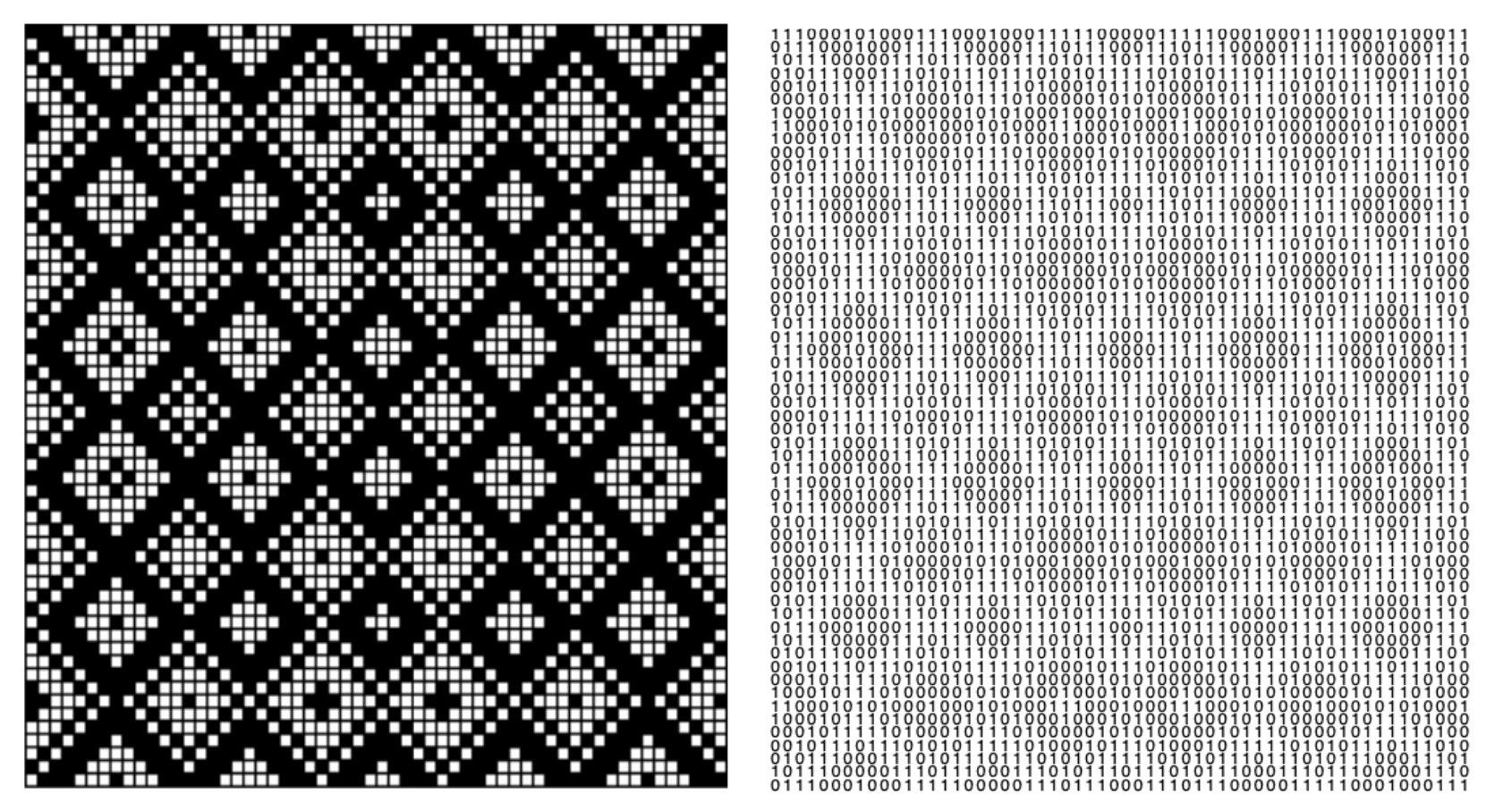
The metaphorical relationship between computation (which shoulders a good deal of blame for today’s attention crisis) and the practice of weaving is in fact literal: a woven grid is a fundamentally binary system. Each thread in a cloth can only go one of two ways: below or above the other threads it encounters within the vertical and horizontal lines of warp and weft. One might easily encode these two possible positions as 0s and 1s, as the computer scientist-turned weaving enthusiast Ralph Griswold illustrated in 2000.
For these similarities, the ancestor of the modern computer is often posited to be the Jacquard loom, a power loom from the nineteenth century that used punch cards to determine intricate textile patterns. In the twentieth century, the developers of early computers borrowed the punch card — this was how a young Bill Gates learned to code at the University of Washington.
“My suggestion to consider weaving is certainly no call to return to a time before the power loom. Rather, it is an invitation to imagine technological progress as less governed by such “befores” and “afters” – as something other than linear.”
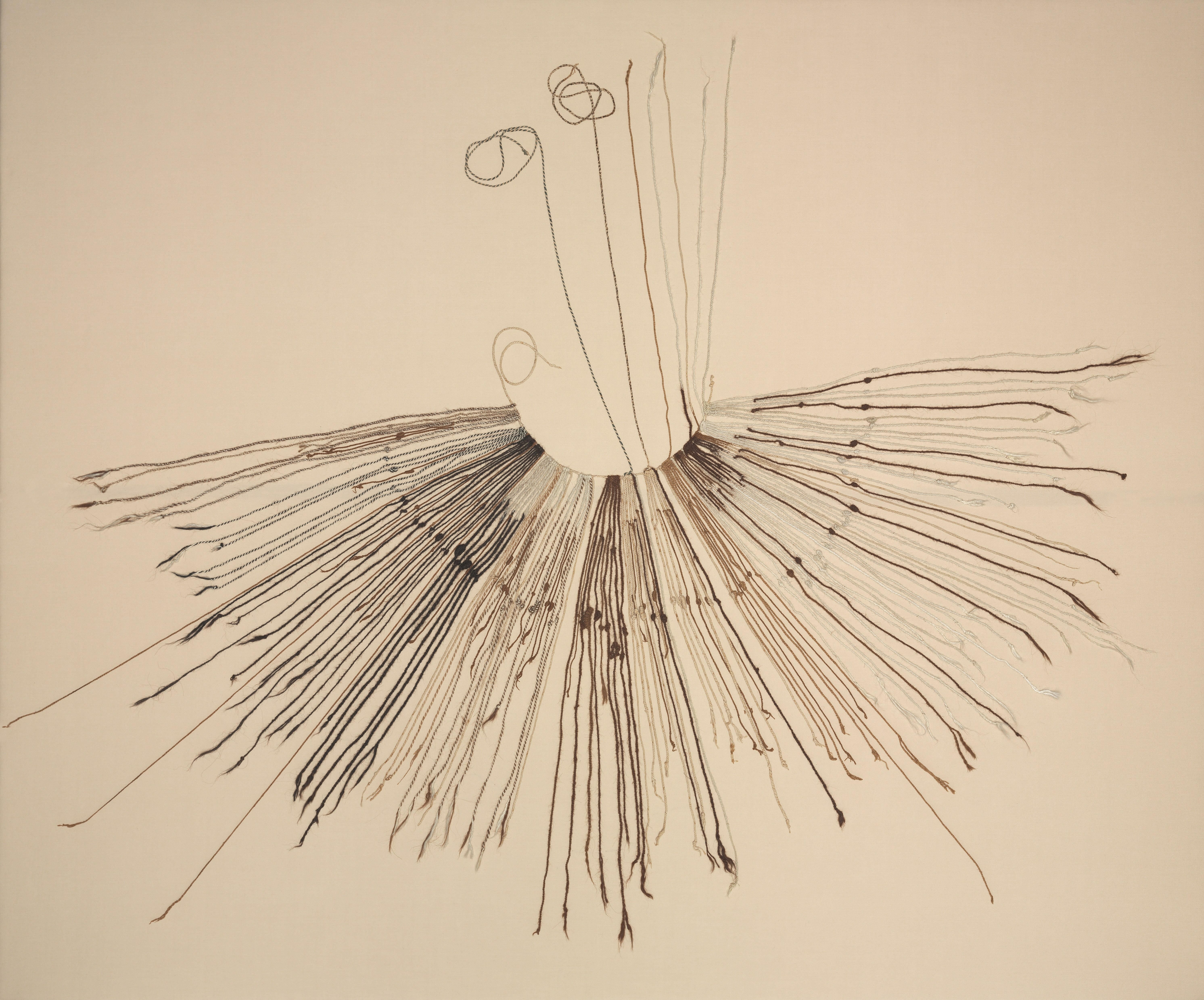
Yet the binary structure of weaving was fundamental to its information-storage capabilities far before the automated Jacquard system and its appropriation by the computer industry. Researchers studying Khipus — the networks of knotted thread used as information storage systems used for centuries by indigenous Quechua-speaking peoples — suggest that the Quechua also used binary encoding. This may not be surprising to hand spinners, who know that thread can be spun only one of two ways — clockwise or counterclockwise (or “S” or “Z” spun, in textile parlance) — hence, zero or one.
The longer history of weaving challenges the linear view of technological progress, which marks an “industrial revolution” beginning with the spinning jenny and the steam-powered loom. Although these new power looms could weave at an impressive clip, their products weren't necessarily an improvement on the quality of handwoven cloth. This much was apparent to the workers who were displaced by the advent of these first looms in the early 19th century. Many of them organized under the name “Luddite” to destroy the new machines under cover of night, threatened by the devaluation of their attention and labor. Today, “Luddism” is often used to mark the hesitant as bygone relics, soon to be consigned to worthlessness. But a new Luddism is arising, composed of thinkers and workers who are fighting to reclaim their attention from the grasp of Big Tech. Although the original Luddite rebellion was crushed in the second decade of the 1800s, their position remains represented by the position of this very publication: “We are not anti-tech; what we are is anti-exploitation.” As the attention movement swells, we might do well to return, at least for the sake of a good metaphor, to the textile work that the Luddites had mastered. Luddites did not reject the labor-saving loom on principle. Rather, they correctly suspected that it would lead to exploitative labor practices.
My suggestion to consider weaving is certainly no call to return to a time before the power loom. Rather, it is an invitation to imagine technological progress as less governed by such “befores” and “afters” — as something other than linear. As a historian of textiles, I am resistant to typical narratives of obsolescence. You may be hearing plenty of them: soon, pundits warn, with the advent of AI, writing will be extinct — worse yet, attention itself may be extinct. But dire proclamations did not predict the extinction of handweaving: even though the power loom kick-started the so-called “industrial revolution,” it failed to master all textile techniques. Baskets and crocheted items, for two, are impossible to replicate with machinery even today. Next time you see a wicker basket, consider that it was made not by a machine, but by someone’s skilled hands, using ancient techniques.
A challenge to linear technological progress can be found within the structural form of weaving itself: the knotted net or plain-woven cloth, with its reliable grid, has not changed since it was first invented. Materials and processes change, of course: in addition to the advent of industrial machinery for textile making, the world has experienced a revolution in artificial fibers like nylon and polyester, with their own long-reaching consequences. The form, however, perseveres, as does the practice: countless people still weave by hand, long after the advent of the power loom. (I take heart in imagining that the same persistence will apply to writing, long after the advent of large language models.) The persistence of this supposedly “anachronistic” activity can inform us of the misleading nature of the dominant temporal metaphors for technological progress.
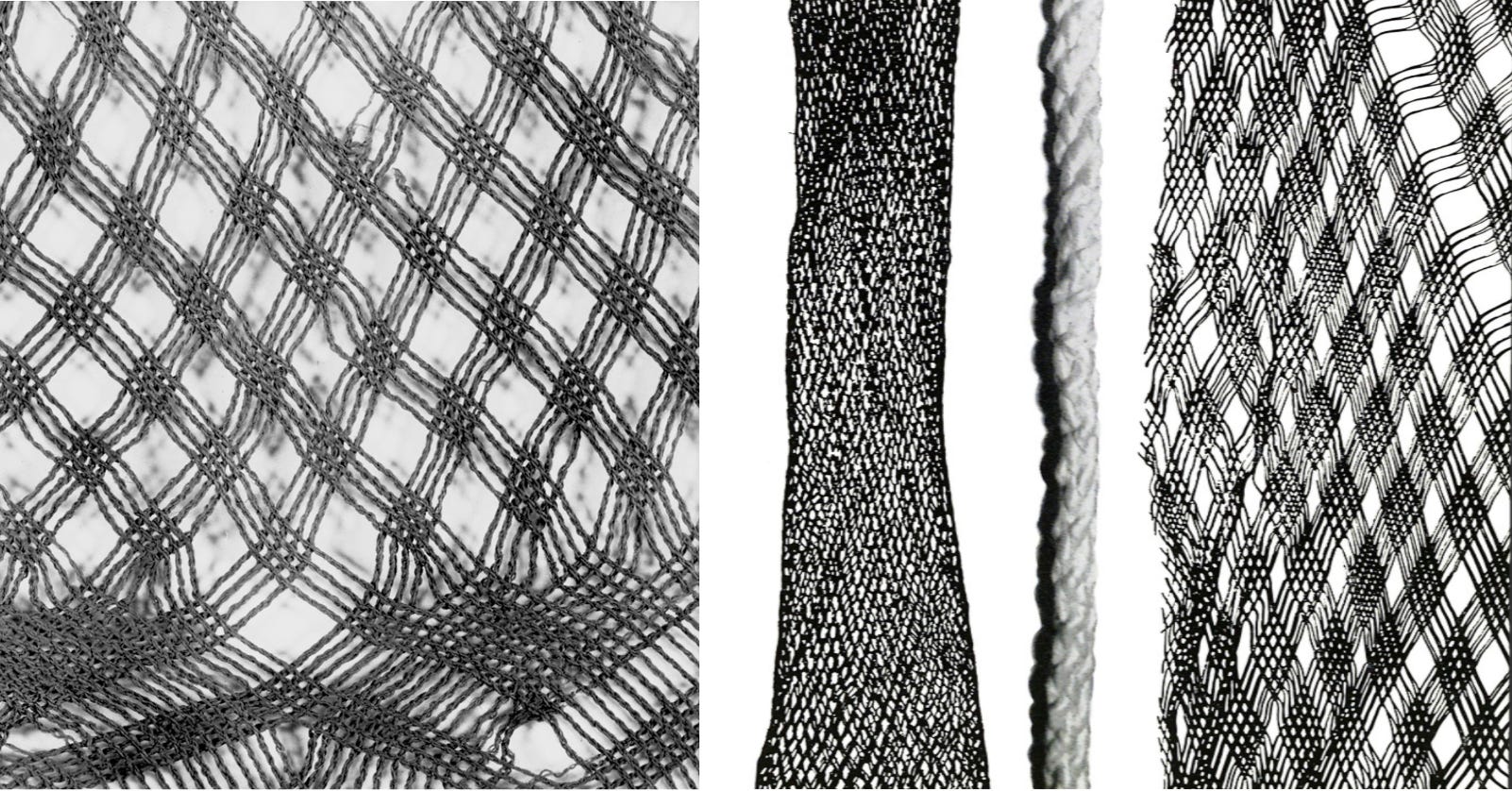
If we foreground weaving as the metaphor for human technology, the term “underwater basket-weaving” — a pejorative which has come to mean a useless educational activity — might need to change its connotation. (Craftspeople will know that it actually isn’t as preposterous as it might seem: basketmaking often requires reeds to be soaked underwater before they are pliable enough to weave with.) In reframing what kinds of activities are considered useless or obsolete, we resist patterns of commodification which require everything to adhere to the linearity of “progress.” Weaving Attentions, a seminar at the School of Radical Attention, interweaves the conviviality of the stitching circle with the exchange of ideas characteristic of conversation within the Socratic seminar format. The aim is not to produce finished products, but to experience the nature of attention that the process engenders. Our textile technology is not used to furnish a heroic utopian solution, but it may serve a slower communal mending of today's tattered social fabric.
Kathleen Quaintance is a PhD candidate in the history of art at Yale University and a practitioner and instructor of a range of textile techniques. She is interested in the history of technology, modern Luddism, and artisanal knowledge.