

Publisher’s Note:
Anthony Grafton is one of the very greatest humanistic scholars currently living on planet Earth. The solo author of about a dozen significant books on intellectual history, magic, astronomy, and the classical tradition, Grafton served as president of the American Historical Association, and has received numerous awards, including the Balzan Prize for the History of the Humanities, and the (million-dollar) Mellon Foundation’s Distinguished Achievement award. He is, quite simply, a legend — a teacher and researcher whose stupefying erudition and personal generosity have changed the lives of generations of students. Myself included, in that Tony was my undergraduate mentor, long before I became his colleague. He is the Henry Putnam University Professor, emeritus, at Princeton University. He lives in Bay Ridge, Brooklyn. We met to talk about attention and the liberal arts tradition.
– D. Graham Burnett, co-founder of the Strother School of Radical Attention

DGB: Tony, you know that I have been thinking about the history of “attention” now for a while, and you have a sense of what has been moving over the last few years among a growing cadre of folks who think of themselves as “attention activists.” One of the pillars of this movement is the idea of “study” – yes, the study of attention, but also all forms of study, since any kind of “studying” is an exercise of attention. Study is an attentional practice. You are, in some ways, a historian of “study.” You have studied studying, and those who study, from ancient Greece to contemporary paleographers. So I would love to think with you a bit about attention and study. But before we get there, let’s start with the core question of our title: the “liberal arts.” Could you set the scene for us a bit? What are the “liberal arts”? What have they been, and how did they come to structure so much of higher education?
ATG: The liberal arts grew up as the original “core curriculum”: a set of disciplines for free men who would take up places in public life, first of a city-state (like Athens or Rome) and then, later, of widening empires. These were rich, complex, and interrelated areas of study. Let’s start with the speech arts; grammar, rhetoric, and dialectic. Each of these taught essential skills. Grammar masters taught you to speak and write correctly. Professors of rhetoric taught you to speak and write effectively. Philosophers taught you dialectic so you could argue rigorously.
DGB: So these were the first three components of the classical “liberal arts”?
ATG: Exactly. And their functions were distinct – as teachers liked to explain by comparing rhetoric to the open hand that persuades, and dialectic to the closed fist that proves. Anyone who has attended a modern philosophy seminar will know what the latter feels like!
DGB: Been there.
ATG: At the same time, though, all three of these were, in a deep way, arts of attention. Grammar taught you to focus on the mechanisms that made a text work, from the rules governing semantic relations and syntax to metrics and vocabulary. You spent a lot of time in the grammarian’s classroom thinking about how to scan poetry, why the poet had chosen one word and not another, what made a text formally correct, and why the greatest classics — Homer, Virgil — weren’t always perfect and exemplary.
DGB: Attention to the words themselves…
ATG: Yes. And then rhetoric taught you to think about the kind of speech a given person should make – how an old man would speak differently from a young one, a woman (if she had the opportunity!) from a man, and what sort of impact those differences would have on an audience. But it also taught you more. Orators argued over criminal cases in court. That meant learning how to assess and criticize evidence, to argue over whether it was genuine or spurious, for example.
DGB: Maybe we could call rhetoric a kind of heightened attention to the social “matrix” of language? The people and personnae and the linguistic situations?
ATG: That’s an interesting way to put it. Yes, I think that feels right. These three components of the classical liberal arts – the “trivium” as they were called – treat attention in distinctive ways. The grammarian taught you to look very closely at the words of the text, in order to see how they fit the systems that governed literary language. Priscian, a grammarian who lived around 500 CE, wrote a massive work – fifty or sixty pages of questions and answers in a modern format – in which a pupil and teacher go through the first lines of each of the twelve books of Virgil’s Aeneid. They analyze each word from every imaginable point of view. How does it fit the meter? And what is the meter, and how is it different from others? What case is the first word of the poem (arma — an “accusative,” as it happens), and why? How does it differ from other words for arms? What words are derived from it?
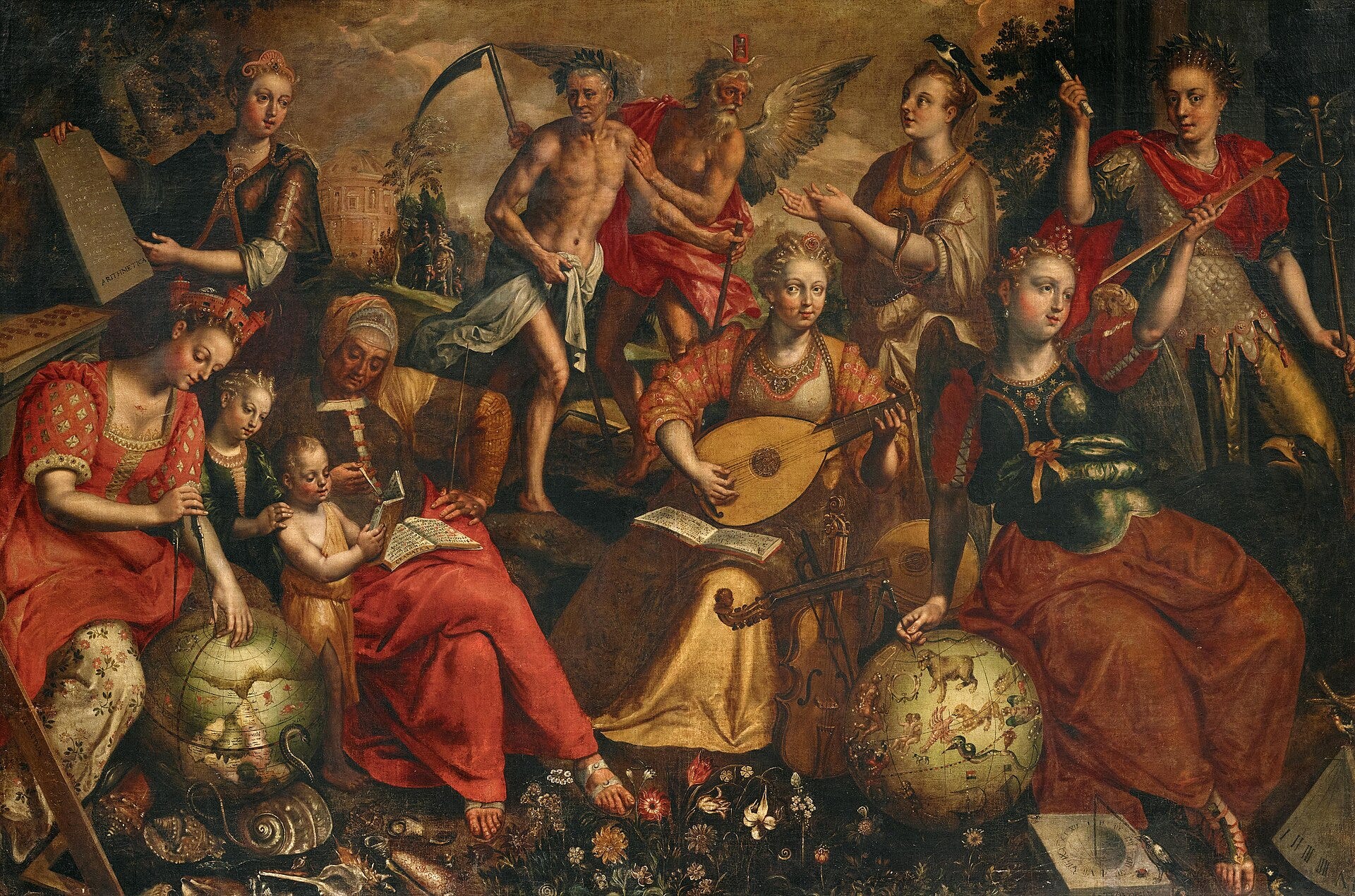
DGB: It is presumably endless stuff like this that caused the term “trivium” to drift, in common usage, to become our word “trivial” – as in “not the important stuff.” That was a way of signaling the mincing preoccupations of the grammarians and their pals, in contradistinction to the other four elements of the classic liberal arts: the mathematical ones, namely geometry, arithmetic, astronomy, and music.
ATG: Well, the quadrivium certainly had its “trivial” elements too. But it was all a single system of instruction, in ways that are hard for us to grasp today. Everyone is always kicking the pedants. But their language games were actually incredible. It’s as if the pupil has a thousand-piece jig saw puzzle in front of him. The teacher lifts up one piece at a time, shows it to the pupil, and they work to make sense of it. Then the teacher puts it back in the box.
DGB: Back in the box? That’s counterintuitive…
ATG: The point is not to see the picture the puzzle represents, but rather to know its actual pieces, one by one, and to be able to do the same kind of analysis as a teacher in due course.
DGB: A kind of “anatomy” of language, from the original Greek etymology of the term: ana/tome – CUTTING UP.
ATG: Yes, but that’s only one part of the education. The teacher also gives the student biographical background about the author and goes through the whole text, solving difficulties, quoting parallels from other texts, and explaining exceptions to the rules the student has mastered. Gradually, as the student works along, he becomes a grammarian.
DGB: And the “rhetorical” part of the education?
ATG: The rhetorician’s art of attention comes later and emphasizes different points – the student needs to think about a speech as not merely a “text,” but also as a performance. Working on classic speeches as texts involves seeing why the speaker chose to concentrate on certain points, how he laid them out, and the ways that his style makes the whole work vivid and impressive. But an orator also had to memorize his speech – every formal speaker was supposed to build a mental memory palace and use it to store his speech, bit by bit, and to work up a full performance of it, which involved everything from pronunciation to appearance and movement.
DGB: This part of the “art of memory” is so central to the attentional practices of the liberal arts in general. Mnemotechnics – all the strategies and techniques and habits and practices of memorization and memory-work… these were so central to the classical formation of a “liberal” education. But they have been hugely depreciated over the last century, in a way that has accelerated hugely since, say, 1960.
ATG: There’s some truth to that, for sure. At least I think so. These days the main thing I can remember is having had a great memory. Now it’s the laptop in the closet that won’t go on.
From the Moth to TED talks to a campaign rally, people love to hear someone who is speaking from personal knowledge and feeling. In those special circumstances, we can see that we need stuff inside us. But our educational structures have moved so far away from this understanding.
DGB: With the shifting power of AI, and all the new questions these systems raise, it is interesting to consider ways we may be returning to an emphasis on certain kinds of memory arts. The question, more and more, is not “can you find it?” (since just about everyone can now find just about anything out there in the interwebs); but more “do you HAVE it – inside you?” This idea of “retention” becomes so key. The French theorist Bernard Stiegler, using a lot of lingo borrowed from Edmund Husserl and phenomenology, really hits this point: as our technologies instantiate our “memory” outside our bodies (writing, archives, now the web and LLMs), that changes how our embodied retentions feel and work. But what we actually have in us is authentically inextricable from the richness of our attentional experiences in the world. If you want something more from your attention than some kind of whack-a-mole trigger response, you are gonna need to have some stuff inside you.
ATG: As something of a codger at this point, I’m profoundly grateful for the external memory I possess that my dad, who had a fabulous memory as a kid, didn’t have when he hit my current age.
DGB: You mean your phone?
ATG: Right! After 6 PM, I have no proper names at all – but I still have my phone.
DGB: People reading this are going to think you are a phone guy. But you are the book-guy extraordinaire.
ATG: I do have a lot of books. But on the question of memory and rhetoric: it’s perfectly clear in our society how much millions of people still very much value the ability to perform without a teleprompter, without a script, without file cards. From the Moth to TED talks to a campaign rally, people love to hear someone who is speaking from personal knowledge and feeling. In those special circumstances, we can see that we need stuff inside us. But our educational structures have moved so far away from this understanding.
DGB: I went to a quite formal Catholic school as a boy, and the memorization of catechism was a weekly exercise. It was archaic, but I do think it gave a particular shape to my mind. I have, in the last years, in my teaching, begun giving my undergraduates memorization exercises. It is a throwback. From the 1960s to the 1990s and beyond, Robert Hollander taught his celebrated course on Dante at Princeton; the gradual memorization of the first canto was a component of the course for decades.
ATG: “Having things inside” has long been central to the liberal arts tradition. Even memories of actual performances were key. To judge from Cicero’s works on oratory, he and his friends enjoyed nothing more than dissecting past performances (on the basis of what they could find out about them) and current ones which they watched. Imagine, that is, a world in which political speech was a highly valued form of both literature and performance, and analyzed in those terms by dozens of the speaker’s rivals and hundreds of ambitious young men who were studying his art. Note also the way in which oral performance continued to be a central method of delivering text. Historians and poets didn’t necessarily make speeches. But they did present parts of their work in public readings, eagerly attended by everyone from emperors to colleagues. Herodotus, one of the first historians, was said to have read his work aloud at the Olympics for a substantial payment. Now we have a halftime show. But it definitely isn’t oratory.
But the proof that you had studied the texts ultimately lay in your ability to deploy what you had read.
DGB: This idea of “having things inside” links back to the question of STUDY. Could you talk a bit about the way the classical liberal arts conceived “study” generally? And more specifically in relation to what my colleague Chris Higgins would call “formative” education — meaning the kind of education that gives shape to us as persons.
ATG: Study took multiple forms. People read – sometimes holding their own scroll and moving it, sometimes listening to “readers” (who could be slaves, held for this purpose). In the first case, the student, in the second, the reader, had to take a text in which words were connected (no spaces; and capital letters weren’t distinguished from small) and break it all down, parse it, see the actual words in the long string of characters, all run together. This is not like reading a newspaper.
DGB: You mean that the reading itself was a kind of study, because of challenges of “construing” a text?
ATG: Yes. But the proof that you had studied the texts ultimately lay in your ability to deploy what you had read. In fact, in plenty of cases, scholars deliberately misquoted sources that they knew well – precisely to show that they were quoting from memory, not the book.
DGB: That’s sort of perverse.
ATG: It’s certainly a problem for people who hunt for fragments of ancient philosophy and poetry in later quotations. But we are talking, here, about readers who held their texts deep and wide. Take Virgil. He read Homer in rolls, a whole lot of them. He also read commentaries on Homer. And somehow he mastered them so well that he could play with them, riff off them, even subvert them in the writing of his own epic, the Aeneid, which was radically different from his model – Homer’s Odyssey and Iliad. Virgil’s mastery of detail was astonishing. I once spent a summer evening with Noel Swerdlow, the great scholar of Ptolemy and Copernicus, working out exactly when during the lunar month Virgil thought the Greeks attacked Troy. We ended up finding out his date and its source (he got it from a relatively obscure Greek scholar). Noel and I wrote a fantastically pedantic article about it. But my point isn’t to brag about being a pedant — that’s clear to anyone who meets me. It’s to say that the mastery of texts and traditions in this world – as in ancient India, as in ancient China – was simply fantastic.
DGB: And it is also to say that reconstructing the forms of study from the past is its own form of study. Let’s pivot, though, and in the last part of this conversation let’s move from this older history of the liberal arts to their more recent life, and perhaps even to their future. We know that the modern liberal arts education has come under a lot of pressure over the last fifty years.
ATG: Liberal arts education was transformed in America, gradually, then suddenly. The colleges founded in the English-speaking colonies were originally designed to form ministers and then, soon after, to educate the future members of a social and political elite.
DGB: That sounds reasonably similar to the original project back in Rome…
ATG: If a Roman had come back to life in Cambridge, Mass., Williamsburg, or New Haven, in the eighteenth or nineteenth century – before, say, 1870 or 1880 – American college education would not have bewildered him too much. The curriculum was unified, planned, and basic. Rhetoric had a big place in these colleges – sometimes in the curriculum itself, sometimes in the student debating societies that dominated much of campus life. The student learned necessary elementary skills, and not always so elementary. When the royal governor of the Massachusetts Bay colony visited Harvard, one or two boys would greet him with Latin speeches: he responded in the same language, extemporaneously.
DGB: Latinity remained key.
ATG: Yes. After mastering the grammar and the rhetoric, a student moved toward philosophy. In Princeton and many other places, that meant Scottish Common Sense philosophy — a kind of pragmatic realism, aimed at providing guidance for life. All of this would have seemed familiar enough to a visitor from antiquity. But the American version of all this was also quite concerned with reconciling reason and faith – that would have made no sense to a Roman.
DGB: We are talking a lot here about teaching – but colleges and universities had become sites of research in a special way by the end of the nineteenth century.
ATG: It’s true. The wheels of change – big, toothed wheels – started turning. Harvard multiplied courses, offering electives and grouping them in what became majors, and that started a national trend.
DGB: Specialization.
ATG: American scholars began doing PhDs in Germany and coming home to preach the gospel of research as the best way to form the mind.
DGB: The pursuit of new knowledge, the making of knowledge, rather than merely the formation in relation to a set of inherited texts and traditions. This new ideal in education was tied to the wider dynamic of the period, which lionized progress.
ATG: American patrons and administrators began taking bike holidays in England in the summer, where they cultivated new dreams: perhaps quads with Gothic architecture would turn American teenagers into eloquent parliamentarians. Meanwhile, collegiate sports exploded, causing a certain number of actual deaths, and becoming another core activity at schools from tiny Center College, in Danville, Kentucky, to Harvard. It should be said that Center College’s Praying Colonels actually defeated Harvard on the gridiron in 1921!
DGB: Hmm. We are a long way from Priscian’s Institutiones Grammaticae.
ATG: Much of this happened without serious reflection. German universities were not just there to produce more professors. Their real job was to turn out well-trained scholars to teach in the rigorous elite high schools, the Gymnasien. No one in America really grasped this, even as the PhD became universal. Hence decade after decade of too many PhDs hunting too few university jobs, and American high schools that were far below the German (or French or Italian or Greek or Romanian) elite standard. More generally, no two schools mixed and matched first-hand research, collegiate living and muscular Christianity in exactly the same way.
Academic freedom definitely involves the freedom to give one’s attention freely – to study what one wants to study.
DGB: And the integration of science and engineering and then professional schools – including, even, soon, business schools (the subject of Steven Conn’s great book, Nothing Succeeds Like Failure) — changed the institutional landscape. All this left less and less room for the “liberal arts” in the forms we have been discussing.
ATG: Coordination across the curriculum was a problem. Although individual schools – Columbia and Chicago among the elite private universities, Wisconsin among the publics, Amherst and other liberal arts colleges – experimented successfully with devising modern courses that provided some of the classic liberal arts skills, none of the models they created won national acceptance. Rhetorical performance fell by the curricular wayside, becoming a minority interest rather than a vital skill.
DGB: And the ongoing codification of the disciplines had its own effects.
ATG: Philosophy moved in directions that made it hard to integrate with the old general education. Some parts of the curriculum took too much space, others were too hard, and as always the faculty did their dance, defending this, or advancing that. There was little general education to be found, and where it did exist, it was part of the branding of an individual college, a peculiar enterprise into which new faculty had to be initiated, rather than part of any shared inheritance.
DGB: They have done, and still do, so much good work, these colleges and universities. And we love them, and defend them, and work to take care of them and make them better. But there is a real way, I think, that if you think of “education” as the process of holding space for the taking shape of persons equal to the conditions of freedom, in community, then much of what happens on campuses cannot exactly be said to serve that project with perfect fidelity. As Christopher Newfield has argued in his remarkable trilogy on the history of higher education in the United States, Ivy and Industry, Unmaking the Public University, and The Great Mistake, the big story is the larger dynamics of business-oriented corporate capitalism. Servicing an ever-larger and ever-more-powerful finance sector does not require the “liberal arts” – in any form, really. And preparing oneself for such service is hard to fit together with my admittedly aspirational vision for “education.” In a lot of ways, it is precisely the sense that we desperately need to study real liberal arts — arts that let us take shape as free persons — that lies at the heart of our work to make the Strother School of Radical Attention. Since we think that real freedom is inextricable from the freedom of human attention.
ATG: Academic freedom definitely involves the freedom to give one’s attention freely – to study what one wants to study.
DGB: Yes, and I do think many of the folks who come to the Strother School have had experiences of freedom in study – in the special spaces that colleges and universities are to this day. What is moving for me is seeing the ways that the classical and modern “liberal arts” traditions can now feel like powerful resources in the work of “Attention Activism.” These traditions, that I learned in so many ways from you, now seem to me more and more as if they were, all along, a very special set of habits and practices of attention, ways of forming and sharing attention. I feel like the liberal arts are beautiful arts of attention – that are always brought forward with a little collection of proposed attentional objects, too. And if we are going to beat the human frackers, that is exactly the kind of thing we need!
Every Grafton encounter and appearance is an Event—truly occupies a special tier of scholar and human