

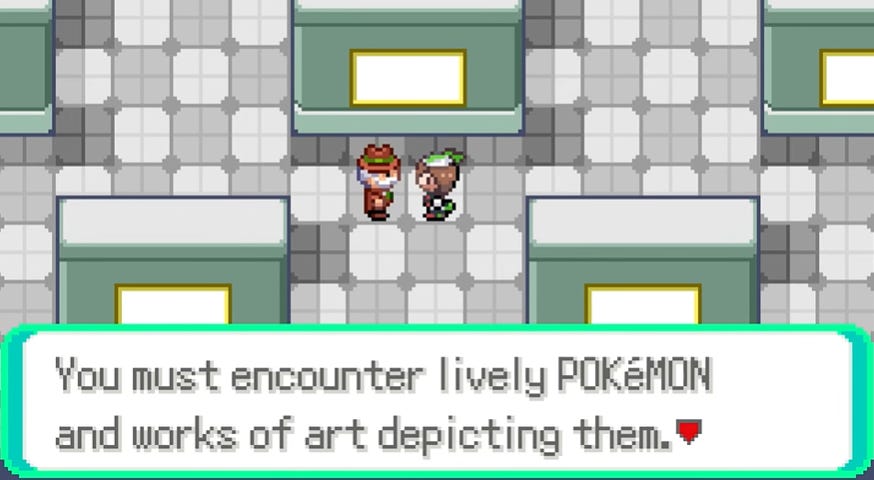
A twelve-hour and fourteen minute YouTube video entitled Pokemon Emerald playthrough ~Longplay~ on the channel FCPlaythrough has 1.3 million views. It consists of the player completing the 2004 Pokemon game in its entirety: going to every building, talking to every non-player character, and finishing every side quest – silently and with no commentary.
“Longplays” – comprehensive recorded playthroughs of video games – are created primarily for archival purposes. One can download an old video game’s game file, but longplays preserve the game experience. The resulting artifacts, as one might expect, are long. On YouTube, among the tens of thousands of longplays created by volunteer archivists, you can watch 9 hours of Minecraft, 23 hours of Super Mario Odyssey, or even 39 hours of Pokemon Black and White 2.
I gave it my full attention: six hours each day, no distractions except my notebook, each session broken up by a one hour lunch break.
Aside from the editors themselves, few people watch longplays in their entirety. I asked Alec Foster of the YouTube channel AL82Retrogaming about his audience retention stats, and he said that most viewers drop off after a few minutes, “looking for a quick fix of nostalgia.” Others, commonly, watch longplays as “second-screen content.” As one commenter writes, “I always use this video as background noise when studying. There’s something so soothing and calming listening to a game I played so heavily as a kid.” Other commenters mention watching them to go to sleep, or in the background on long car rides.
Longplays are, in some sense, films. Their construction is intentional, and they are heavily edited to demonstrate the entirety of a game as completely and efficiently as possible: usually random mishaps are removed from the final product. The result is intended to be, as distinct from raw gameplay footage, at least somewhat watchable. But broadly speaking, longplays don’t exactly seek to entertain, but rather, to exhibit a game.
I wanted to experience a longplay as, essentially, an incidental art film. To this end, I watched Pokemon Emerald playthrough ~Longplay~ in its entirety. I gave it my full attention: six hours each day, no distractions except my notebook, each session broken up by a one hour lunch break.
Broadly speaking, this “film” is uneventful. Most of Pokemon involves repetitive actions like battling or walking around that provide little interest to a passive viewer. It does not resemble a conventional narrative film, but rather the “durational cinema” of avant-garde artists, like Andy Warhol and his eight-hour long Empire, which consists of nothing but a static shot of the Empire State Building, or Wavelength, with its extended zoom of an artist’s loft. “Durational cinema,” like Pokemon Emerald playthrough ~Longplay~, gives little purchase to the viewer’s attention. In other words, it is a bit boring.
Boredom, however, is sometimes an essential, even fruitful aspect of a work of art. Andreas Elpidorou and John Gibson note in their essay “Really Boring Art” that people generally accept that a work of art can make us feel “negative” emotions such as fear, anger, sadness, or despair, but balk at the idea that art could be intentionally boring. But boredom has some interesting characteristics. It is, of course, broadly unpleasant, but can serve to transform our relationship to a piece. As they write, “the perceived meaningless or felt blahness of an experience can propel the bored subject to reappraise the object, look for occluded dimensions of significance, and, generally put, righten one’s relationship to one’s situation.” Boredom motivates a different kind of attention.
To intentionally seek boredom online is to rebel against the psychological demands of the attention economy, which seeks to hold our attention as much as possible, as quickly as possible.
My viewing of Pokemon Emerald playthrough ~Longplay inverted the regular experience of playing the game. The interactive components (battling Pokemon) became repetitive and uninteresting. My attention instead shifted towards the game’s “decoration” – the “unnecessary” parts: the beautiful pixel art scenery, the characters whose dialog does not advance the plot, but simply adds character to the world. I found myself, after long periods of boredom, genuinely excited when I simply got to see something new, or hear dialogue from a new set of non-player characters. The narrative crescendo, where legendary Pokemon battle to plunge the world into eternal sun or rain, became, genuinely, moving and impressive.
Unlike feelings of anger, irritation, or sadness, boredom is an emotion that platforms like YouTube generally seek to completely eliminate. “Doomscrollers” stay online, but bored users, who log off and do something else, are totally unacceptable to a business model based on sustained attention. To intentionally seek boredom online is to rebel against the psychological demands of the attention economy, which seeks to hold our attention as much as possible, as quickly as possible.
It was as if my mind, after struggling for hours in search of something to occupy itself, finally gave up and submitted itself to a lower base level of stimulation, a more open experience of time.
As Jenny Odell writes in “Who Has Time for Parsifal” about the four-and-a-half hour Wagner opera, marathon-length artistic experiences can transform our relationship towards time, allowing it to become, rather than a measurable resource that we worry about “spending” or “losing,” a succession of abundant moments to be experienced, savored. It is precisely because Parsifal is so long that it has this capability: it prompts us to let go of the idea that our time is something to be “used effectively.”
In order to experience marathon-length art, we must, as she says, let go of our mind’s tendencies of “working, grasping, and analyzing.” It was on the second day of my watchthrough that I found myself able to do this. It was as if my mind, after struggling for hours in search of something to occupy itself, finally gave up and submitted itself to a lower base level of stimulation, a more open experience of time.
In The Pale King, a novel about the IRS with no shortage of highly technical, boring passages about tax accounting, David Foster Wallace writes that boredom “is the key to modern life. If you are immune to boredom, there is literally nothing you cannot accomplish.” Some young people seem to agree, partaking in the social media trend of “rawdogging boredom,” where they perform various feats such as staring silently at a blank wall, or, in BWong’s account, doing nothing on an eighteen hour flight. After many hours of Pokemon Emerald, not only did the “film” itself start to be, as Odell puts it, “a reprieve, a gift, and an invitation,” it also did feel like, afterwards, this feat of endurance made smaller things somewhat sweeter. Washing dishes or making dinner, for example, after so many hours in a chair, became a pleasantly embodied experience.
The aesthetic rewards of Pokemon Emerald playthrough ~Longplay~ – a renewed appreciation for this twenty-year-old game, an acceptance of a different relationship with time, the satisfaction of psychological endurance, were only accessible after the endurance of large amounts of boredom, after letting go of my struggle for stimulation and entering a kind of submission to whatever simply is. Perhaps we can endeavor to seek out more experiences that might be boring with a bit more lightness and ease, experiences where, in the words of one of the characters in Pokemon Emerald’s Route 116: “We’ve got nothing to do but loll around here doing nothing.”
Alex Wennerberg is a software engineer who occasionally writes about technology, philosophy and culture.