

Christie George is a writer, activist and producer who has financed, produced and distributed media for 25 years. She is currently working on a series of projects about cultivating individual and collective creative attention. She recently released The Emergency Was Curiosity via Metalabel and writes a newsletter about creative practice called Practice Practice. Christie sat down with our Editor-in-Chief, Peter Schmidt, for a conversation about attention, community practice, and the future of books.
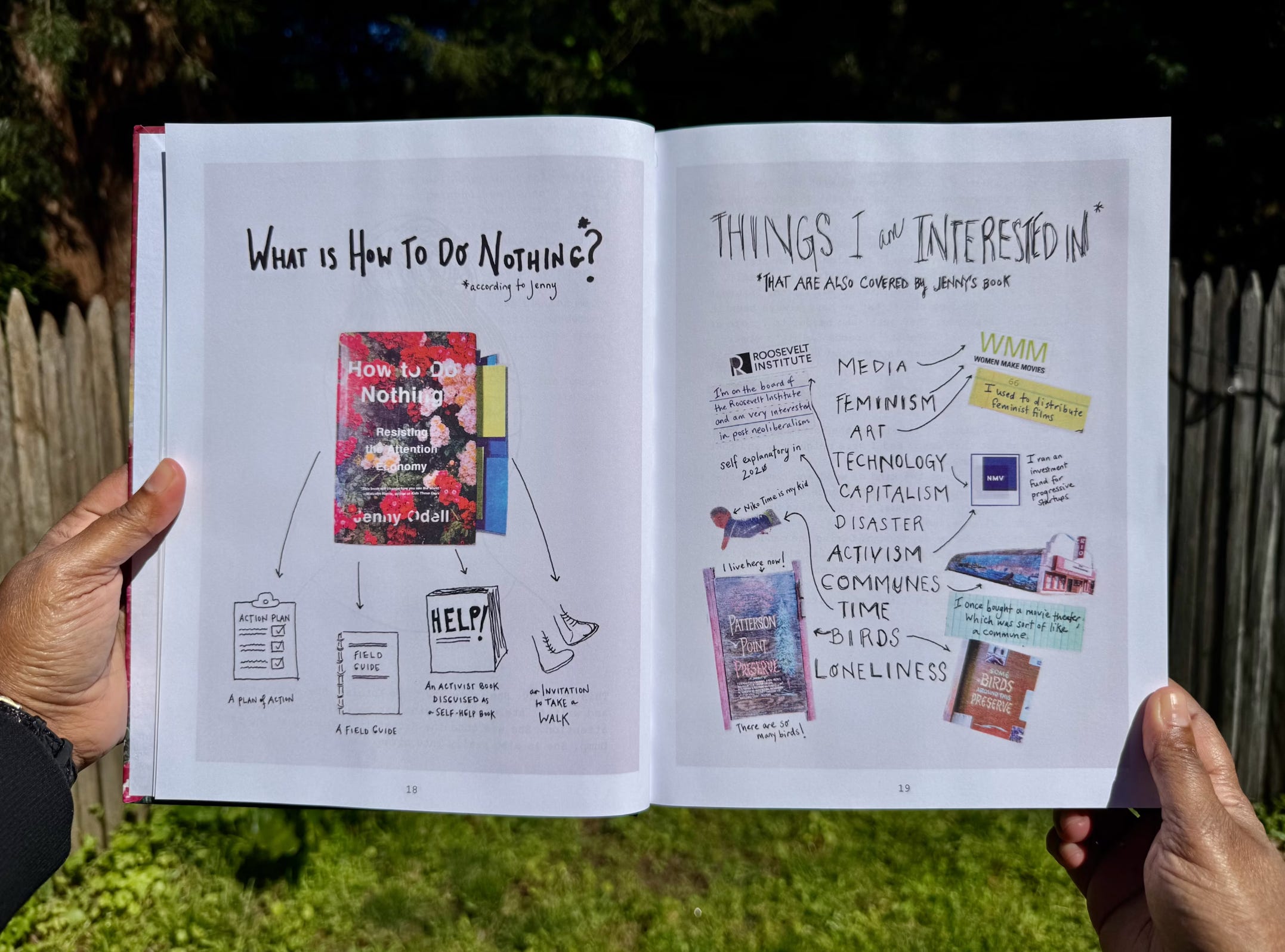
PS: Welcome, Christie! You just released a book entitled The Emergency Was Curiosity, which is based on the book How to Do Nothing by Jenny Odell. Can you tell me about that book and where it came from?
CG: Yes! The project started as purely a personal, creative response to Jenny’s book. I found myself thinking about How to Do Nothing at the beginning of the pandemic, and kept coming back to it. Because so much of what Jenny was writing about — in terms of interconnectedness and the importance of care and maintenance — felt so relevant, particularly in those early days of the pandemic. I remember feeling, How did this person write this book that was so meant for this moment?
I found myself copying passages from the book by hand that I wanted to remember. Physically writing out Jenny’s words was both a way to remember them — I tend not to remember things if I don’t write them down — and to internalize the ideas a bit better. Eventually, I started making drawings, watercolors, collages, and then writing little essays about the ways the ideas in How to Do Nothing were relevant in my life.
Around then, my family and I — my partner and two children — moved out of downtown Oakland up to the Russian River. It was my first time living in a rural place. It’s about two hours north of Oakland, on a river, in the redwoods, close to the ocean. While I was working on the project, I developed a much deeper relationship with nature than I ever had living in suburbs or cities.
The practice of copying quotes, making drawings, and writing essays became a respite from the rest of my work. I would come into my shed, close the door, and have no other responsibilities. It became a meditative practice. I just kept going with it, and four years later, I had 200 handmade pages — pages inspired by the book that were as much about metabolizing its ideas as they were about developing my own sense of time, place, and attention.
PS: Does your shed have a name?
CG: It doesn’t. We sometimes call it the cottage, which makes it sound fancier than it is. Its main characteristic, especially during that time, is that it had a door. Otherwise, we were in a very tiny space with a four-year-old and an 18-month-old. It was impossible to work on something like this without a physical separation from the rest of my life.
“What the big book world might see as “bugs” — smallness, intimacy — I see as features.”
PS: When you started out on this project, did you think of yourself as a writer or an artist?
CG: No, not at all, and I think that’s the main transformational value of the project — thinking of myself more expansively than I have before. Until then, I mostly identified as a producer. My background is in investing, social change work, and activism. I thought of myself as a curator of other people’s ideas rather than someone with original things to say.
Now I identify as a “creative person”, or a person who wants to live more creatively. That feels more accessible than the goal of being a capital-A Artist. I’ve shared the work publicly, and the response has led me to think that desire — to integrate creativity into life — is shared by a lot of people, even if they don’t aspire to be artists. I feel permission to identify that way now, and more freedom around those labels than before.
PS: You’ve now made a book, which puts you in a small category of people. And you’ve done it at a moment when the functions that books fulfill in our society are shifting pretty dramatically. Has this process changed your relationship to books and the process of making them?
CG: I’ve always been a book person. I buy and read a lot of books. But with this project, I produced and distributed it independently, so I had to learn every aspect of bookmaking — from digitizing 200 loose-leaf pages, to turning them into a physical book, to figuring out finances and distribution.
Historically, my work has always assumed that if something is good, it should reach as many people as possible. Scale was always the goal — whether with film, organizing groups, or startups. But with this project, I became much more interested in the opposite. I often say the opposite of scale is intimacy, and sharing this book almost one-on-one has been infinitely more valuable.
Originally, there were only a few copies — one for myself, one for my parents, one for Jenny. Then I started printing 20 copies at a time. Only recently did I decide to print 500. Even now, it feels like selling books out of the trunk of my car. And sometimes it literally is: I’ve sold books at the local coffee shop for cash out of my car. That intimacy feels so satisfying.
I’m more interested in the world of zines, pamphlets, art books, and small presses than trade publishing. What the big book world might see as “bugs” — smallness, intimacy — I see as features.
“… fan nonfiction is about sharing what you love in a way that influences others, not through critique, but through devotion.”
PS: We’ve inherited a view of books as maximally scalable ways of spreading information. But that’s no longer the case; the internet is even more scalable. Book sales are down. What if books shift from being technologies of scale to being technologies of intimacy?
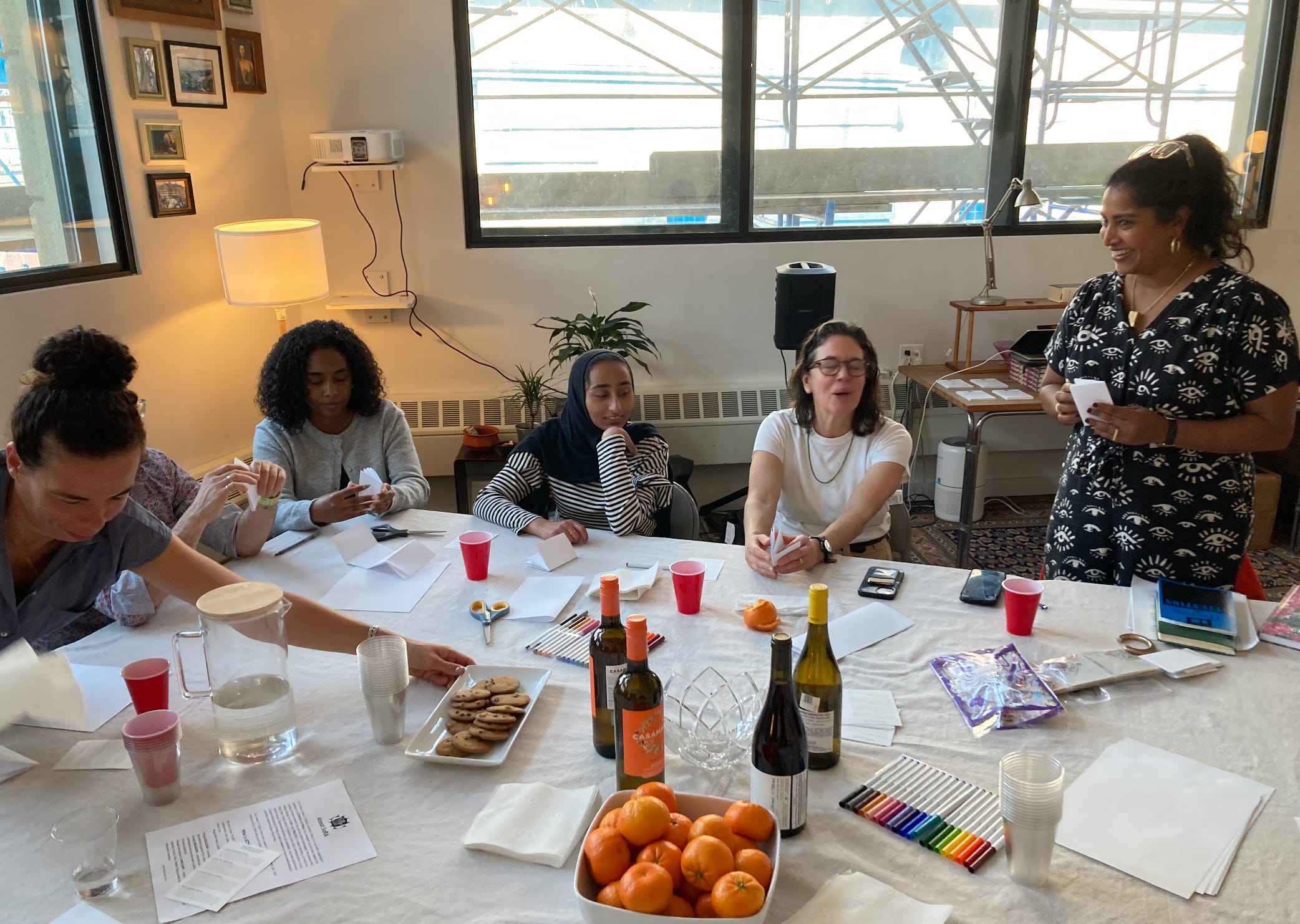
CG: I’ve been thinking a lot about this. While there’s anxiety about AI destroying attention spans and book sales being down, I think there’s also a movement around books that’s interactive, communal, and reciprocal. My book report felt hard to explain at first, but once I released it, I realized there are so many projects like it. There are projects around marginalia — notes people write to themselves or in conversation with authors. There are authors annotating their own past books. There are illustrators revisiting old journals with new art. There are study groups, silent book clubs, book parties in bars, your “Reading Party“ at SoRA. People are doing very interactive things with books that shift them from solitary experiences to shared ones.
PS: You’ve described your project as “fan nonfiction.” That’s a fun phrase. Can you tell me about that?
CG: I’m still working it out, but I use the term because this project sits between fan fiction and formal criticism. It’s not a critical project — I loved Jenny’s book.
I think of fan nonfiction as a way of processing your reading and sharing that with others in an accessible way. None of us will read all the books we want to. I think of a book report, or sort of more broadly, fan nonfiction, as a way to share your experience of a text in a medium that is accessible to other people. For example, I hadn’t read Naomi Klein’s Doppelganger until a friend wrote her own book report about it. That moved me to finally read it — and it turned out to be the best book on attention I’ve read since How to Do Nothing.
So fan nonfiction is about sharing what you love in a way that influences others, not through critique, but through devotion.
PS: Fan nonfiction is like a version of what Google’s new AI summaries do — except it’s a human synthesizing the book for us. It’s a record of experience, not of statistical analysis. My fiancée loves “romantasy“ novels, and listens to podcasts where people dissect these books in extraordinary detail. They’ll do an hour-long podcast on a single chapter, and I’m convinced that, short of devoted religious communities, that is the corner of the world that is giving the greatest devotional attention to books right now. And it’s very gendered; it’s almost all women.
CG: I could not agree with you more. In my search for other things that look like my book report, I went down the marginalia rabbit hole, and romance BookTok is, like, ground zero for marginalia. People have got these amazing color-coded systems to metabolize their reading of a book, but then they are on TikTok sharing that with other people. I think it’s very interesting, and we would probably know more about it if it weren’t feminized.
PS: A lot of our work at the School is about exploring what texts are for — how they create conditions for shared experience. Has that proven true for you?
CG: Definitely. Much of my project is less about Jenny’s book and more about the rabbit holes it led me down — other writers, other texts. Reading texts together with others has been transformative. For example, I was recently in a reading group for Art Monsters, about the intersection of motherhood and creativity. It made me realize how many creativity texts ignore parenting, and how discourse on mothering often erases mothers of color. Being in that group opened my eyes to the gaps and the possibilities that I wouldn’t have seen alone.
PS: What potential do you see for book projects like this in the Attention Activism movement?
CG: The two places I see potential are, first, having more voices of color in the conversation around attention activism. That’s important to me personally, and it contributes to a more polyphonic version of the conversation.
The second is around “care” as an attentional opportunity. So much of what I have read about attention tends to focus on technology; I think care is a form of radical attention. And that’s not just parenting, you know, that’s elder care, care for your community, care for your neighbors, siblings, chosen family. There’s so much attention work that happens when you’re using care as the lens, but I think it tends to be siloed in conversations about caregiving, rather than in conversations about attention. Book projects like these can bring in new voices, and can frame books — and the relationships that form around them — as opportunities for care.