

This past fall, schools across the country took desperate measures to solve The Phone Problem™. My peers and I watched as administrators implemented blanket bans, sealed devices into locked pouches, and begged us students to tuck away those little lightboxes and make some real connections. Bell-to-bell phone bans were enacted in public high schools across the state of New York, plunging us into this brand new phone-free utopia.
The effect? We gathered in hallways with card games and crafts. We documented our school days on old-school “cameras.” Some of us even turned up with bedazzled walkie-talkies to allow us to communicate with friends offline. We smiled at each other in the hallways, eyes no longer glued to an endless flow of digital media. We got creative. We got social. This, at least, was the vision for a phone-free school day – and, to some extent, it’s become reality. Over the course of the past year, I’ve learned a dozen new card games, and my screentime dropped to an all-time low – thanks in large part to the state-mandated seven hours I spent unplugged each day.
Teens emerged en masse from the front doors of my New York City high school, gazes fixed on their devices. Screentime skyrocketed in the late afternoon to make up for lost time.
Except, the idyllic image of low-tech teens immediately shattered when the clock struck three. As a witness from the front lines of twenty-first century adolescence, I can confirm that most students whipped out their phones at the sound of the final bell. Teens emerged en masse from the front doors of my New York City high school, gazes fixed on their devices. Screentime skyrocketed in the late afternoon to make up for lost time.
Legislation doesn’t fix addiction. Forcing kids to hand over devices from eight to three doesn’t teach sustainable habits that we can use in our daily lives. These bell-to-bell bans are slapping a Band-Aid on a bullet wound, failing to fix the core issue at hand: social media apps are designed to keep us hooked. They pump content into vulnerable minds, tweaking hidden algorithms to get just a few more minutes of our sweet, profitable attention. While these new phone policies take a step towards providing a safe space for teen attention, they don’t give youth the tools we need to function in this rapidly evolving digital world. Whether we like it or not, social media is here to stay; how can we learn to coexist with it while protecting our autonomy?
I see it firsthand – teens desperate to find a way to combat phone addiction. My friends and I have tried dozens of screentime-limiting apps and mindfulness tactics, but these efforts rarely suffice. The solution is twofold. First and foremost, we must educate ourselves on the forces at play that keep us craving content. Second, we must carve out sanctuaries of attention, places where we can protect and nourish our attention without the influence of tech corporations.
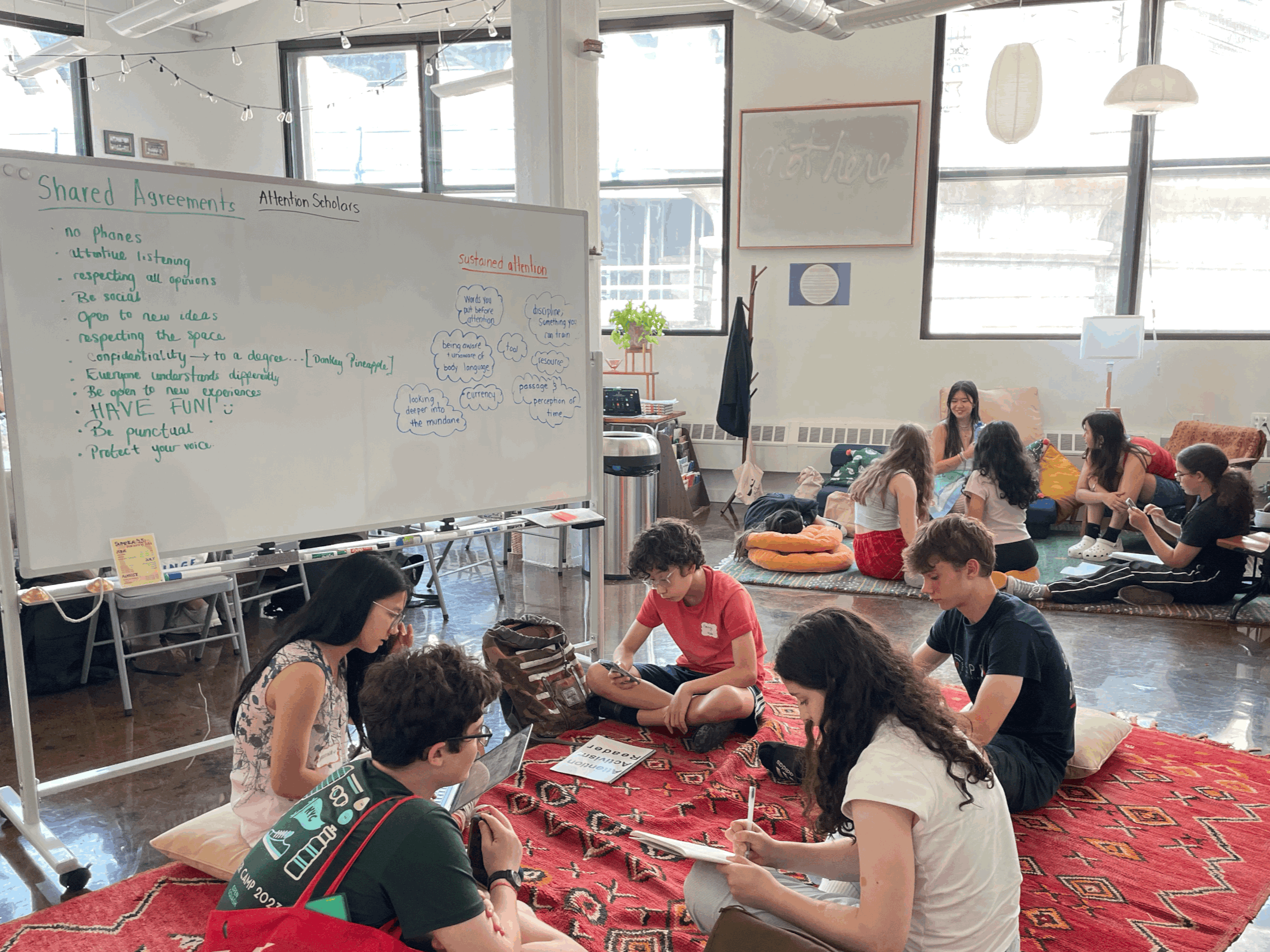
In the summer of 2024, a group of New York City teens – as well as students from across the country – came together at the Strother School of Radical Attention to do just that. The Attention Scholars Program, which I’ve attended for two years and counting, has served as a space for the cultivation of attention and the fostering of important dialogue surrounding the role of tech in our lives as teens coming of age in the digital era. Building this youth-focused coalition centered around activism and education is a vital step in safeguarding teen attention. An attention sanctuary is a safe haven for the nurturing of human attention. In the wake of phone bans, school became an attention sanctuary for many, but sanctuaries can also come in other forms. When my friends and I gather to cook and bake together on weekend evenings, the kitchen becomes a sanctuary. As my peers and I rehearse collaborative works of theatre, the stage is our haven. In the summer of 2024, I joined five other high schoolers in the School of Attention’s Dumbo space for an experimental and formative week. We analyzed texts, engaged in practices of attention, and learned how to reclaim the attention that corporations were (and still are) commodifying. That test run blossomed the following summer, expanding into a cohort of over twenty young attention activists eager to make change in our personal lives and the world at large.
For the first time, I had the education and the will to combat these patterns and take control of my attention alongside other passionate teens. We built a coalition; we created a sanctuary.
“By learning as a group about the mechanisms deliberately trapping our attention, I began to shift from thinking of my screen time as an issue of personal discipline to thinking of it as an issue that we can take collective action to improve,” Maeve Collins, who attended the program in the summer of 2025, attested. Clara Chen, a two-time Attention Scholars participant who also aided with recruitment and development of the program in its second year, shared that the diverse range of perspectives in the program’s discussions helped her “see how other people understand attention activism for themselves.”
The Attention Scholars Program inspired in me a sense of personal agency. Growing up in the digital age, I’d spent years feeling helpless, trapped in cycles of content engineered by tech companies in order to maximize profit and seize human attention – i.e., my eyeballs. For the first time, I had the education and the will to combat these patterns and take control of my attention alongside other passionate teens. We built a coalition; we created a sanctuary.
“My time at the Strother School snapped me back into reality,” Helina Lo, a 2025 Attention Scholars alum, shared. There’s still work to be done, she says. “There’s definitely a gap in our culture, and we collectively need to be having more conversations about how to regulate screens.”
This summer, a fresh crew will enter the Dumbo space, myself among them. We’ll read and dissect excerpts of William James and Shoshana Zuboff. We’ll walk the streets of Brooklyn and take in that which is so often ignored. We’ll attend to one another, wholly and readily. We’ll shut off our phones – by choice this time – and inhabit the sanctuary we create.
Consuelo “Leo” Burnett is a teen writer and artist based in New York City. Her writing has appeared in Empty Inkwell Review and on The Hinternet, and her poetry has received national recognition from the Alliance for Young Artists & Writers. Find her on Instagram [at] leogaudes.
Enrollment is now open for the 2026 Attention Scholars Program for high school students ages 14-18. The program will run from Monday, August 31 to Friday, September 4 at our Sanctuary in Brooklyn, NY. Scholarships available.
So attentively written, thank you. Band-aids on bullet wounds. Yes. And no ban can salve when adulthood is so steeped in the itch to distract, digitally or otherwise, so this idea of actual, and mental, sanctuary, feels vital - sounds like teens will be leading the way for the rest of us!
https://podcasts.apple.com/us/podcast/genfree-unplugging-2-connect/id1822422035