

Friends!
As I searched for winter-appropriate business-casual attire in a central Massachusetts shopping mall not long ago, the familiar opening riff of We Didn’t Start the Fire by Billy Joel issued from the speakers. Knowing what was coming, I prepared for a retrospective tour through the tumultuous mid-twentieth century: from “trouble” in the Suez Canal to birth defects produced by thalidomide.
At least, I thought I was headed for the 1960’s — until the vocalist, who, in fact, wasn’t Billy Joel, mentioned Cambridge Analytica with Joel-esque mania, thus yanking me back into the present. The updated lyrics pasted over the original frenetic melody reaffirmed Joel’s sentiment of the world on fire as an intergenerational constant. While perhaps every present feels unprecedented, turning our attention to bygone decades reminds us that, if anything stays the same through time, it’s the feeling that everything is changing.
French sociologist Marc Augé referred to our present as supermodernity, in which time feels difficult to conceptualize because of a perceived “overabundance of events in the contemporary world.” In the original era of We Didn’t Start the Fire, current events came with the evening news. Today, we could probably populate an entire verse by refreshing our feed once or twice. But what if, instead of performing this anxiety-inducing ritual, we slowed down and drew longer throughlines into the past? If our attention spanned decades, centuries, or millenia even, would our present still reel with the disorientation of the unprecedented?
This issue of the Empty Cup is about retrospection: What is the past good for? In Visions of Attention, Eleanor explores the restoration (or lack thereof) of the ancient Caryatids. In Practice in Practice, Marcela turns her gaze to the migrations above and around us. And in Stuff for Study, I share essays on the long history of algorithms and the experience of distraction in centuries past.
Read on! We’ll see you back in the present.
Yours in the long arc of history,
Czarina Ramos
Managing Editor
Visions of Attention
An archive of images and mini-essays on the myriad modes of attention

Resurfacing Ruins
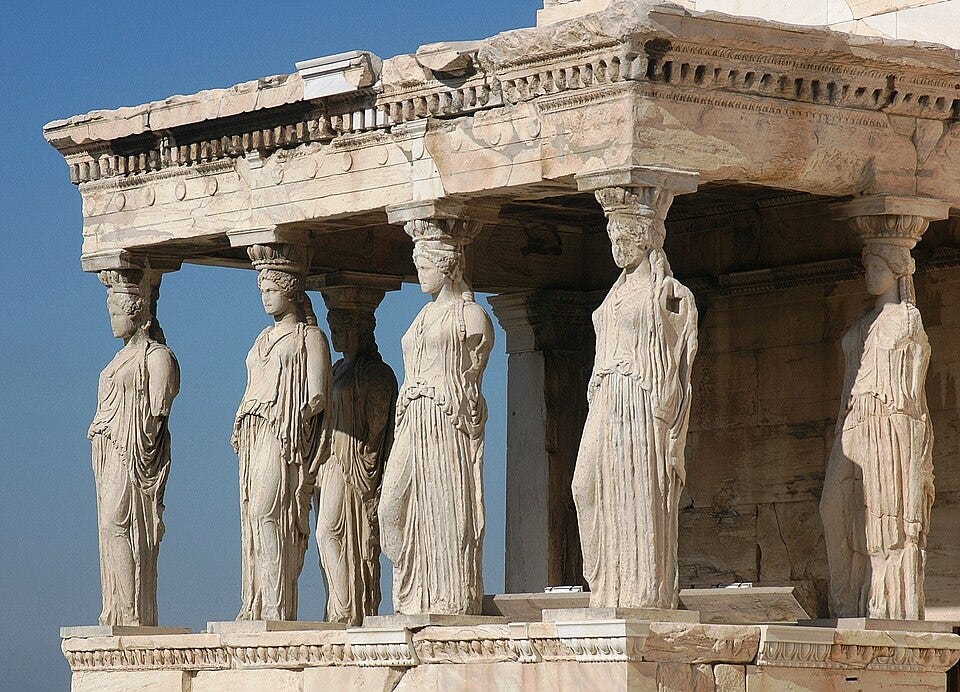
The roof of the Erechtheion, one of four ancient structures on the Acropolis of Athens, is held aloft by six Caryatids: statues of draped maidens standing over six feet tall. These marble figures are modern-day replicas (perhaps unsurprising given the originals were carved nearly 3,000 years ago, around 421–406 BCE). In 1979, Greek authorities removed the statues to protect them from pollution. Five now reside in the Acropolis Museum just down the hill; the sixth, stolen by Lord Elgin in the early 1800s, remains in the British Museum.
This effort to preserve an original is hardly original — countless ancient works have been relocated indoors as humans uncover and tend to the remnants of our own past. Yet the replica Caryatids exhibit none of the freshly-chiseled glory of the originals’ antiquity. Rather, they resemble the statues as they were at the moment of their removal: stained, damaged, and incomplete. Why reconstruct ruins rather than recreate what once was? Why enshrine monuments in our present to the ruins of our past?
The Acropolis has lived many lives. Today’s restorations prioritize structural safety over aesthetic wholeness, yet they still source marble from the same quarry used for millennia — a continuous vein of stone running through time. It’s a reminder that histories are not static repositories but active shapers of the present (just as the present actively shapes the past). Every restoration makes a choice about what kind of past to deliver into the present — whether a fantasy, a correction, or an obfuscation.
From museum vitrines to full-scale replicas (check out Nashville’s full-sized Parthenon), the ways we attend to these records of humanity reveal as much about us as they reveal about antiquity. In excavating and preserving what remains, we also reify the dynamics — sometimes reverent, sometimes extractive — of the attention with which we memorialize the past.
Practice in Practice
Reflections on experiments in Attention Activism
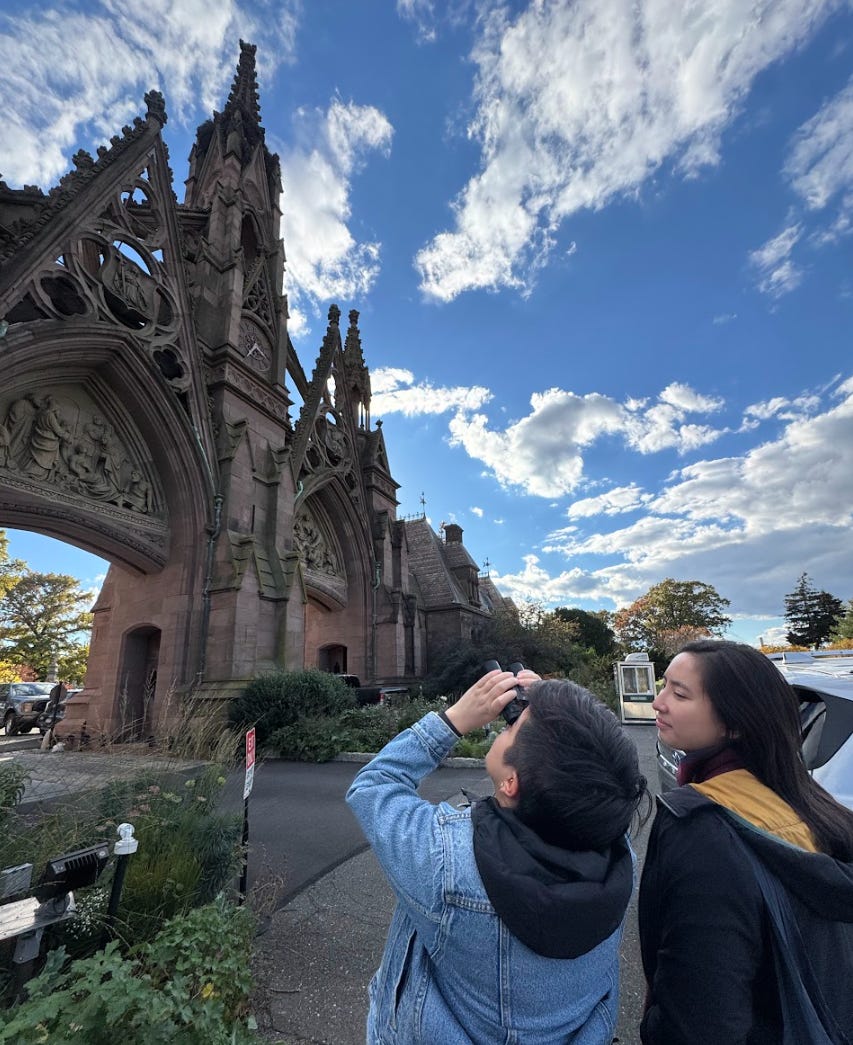
During a single week in October, the Cornell Lab of Ornithology’s satellite radar detected over two million migratory birds making their way over New York City en route to warmer climates. As the winged travelers crossed our sky, a group of twenty attention activists gathered at Greenwood Cemetery to study an excerpt of Ryan Goldberg’s new book Bird City — an account of New York’s history centering the birds that pass through the five boroughs each year. We were joined by the author himself. Surrounded by gravestones etched with odes to the dead, we turned our gazes toward a sky that teemed with life.
Inspired by Bird City, we walked through the cemetery attending to the sights, sounds, and sensations of movement around us. Many marvelled at the population of bright green monk parakeets greeting visitors from their adopted home in the spires of the gatehouse. Others observed that attention to the movement of birds revealed the migratory patterns of countless other species — a particularly salient insight, given the current administration’s ongoing mass detention of migrants.
The study reaffirmed my belief that the practice of birding can make the whole world a sanctuary of attention. Perhaps that’s what attention activism asks of us: not simply to notice more, but to transform every space into one where noticing matters.
— Marcela Mulholland, SoRA Study Corps
Stuff for Study: Timelines and Throughlines
Readings and other resources for continued learning on attention and politics
Can the inventor of the internet become its savior? — Julian Lucas for The New Yorker
Haven’t we always been distracted? — Joe Stadolnik for Aeon
Three thousand years of algorithmic rituals — Matteo Pasquinelli for e-flux
The histories told by rocks and water — Jenny Odell for emergence magazine
The art (and artifice?) of recovering the past — D. Graham Burnett for Cabinet
- Czarina Ramos
IRL
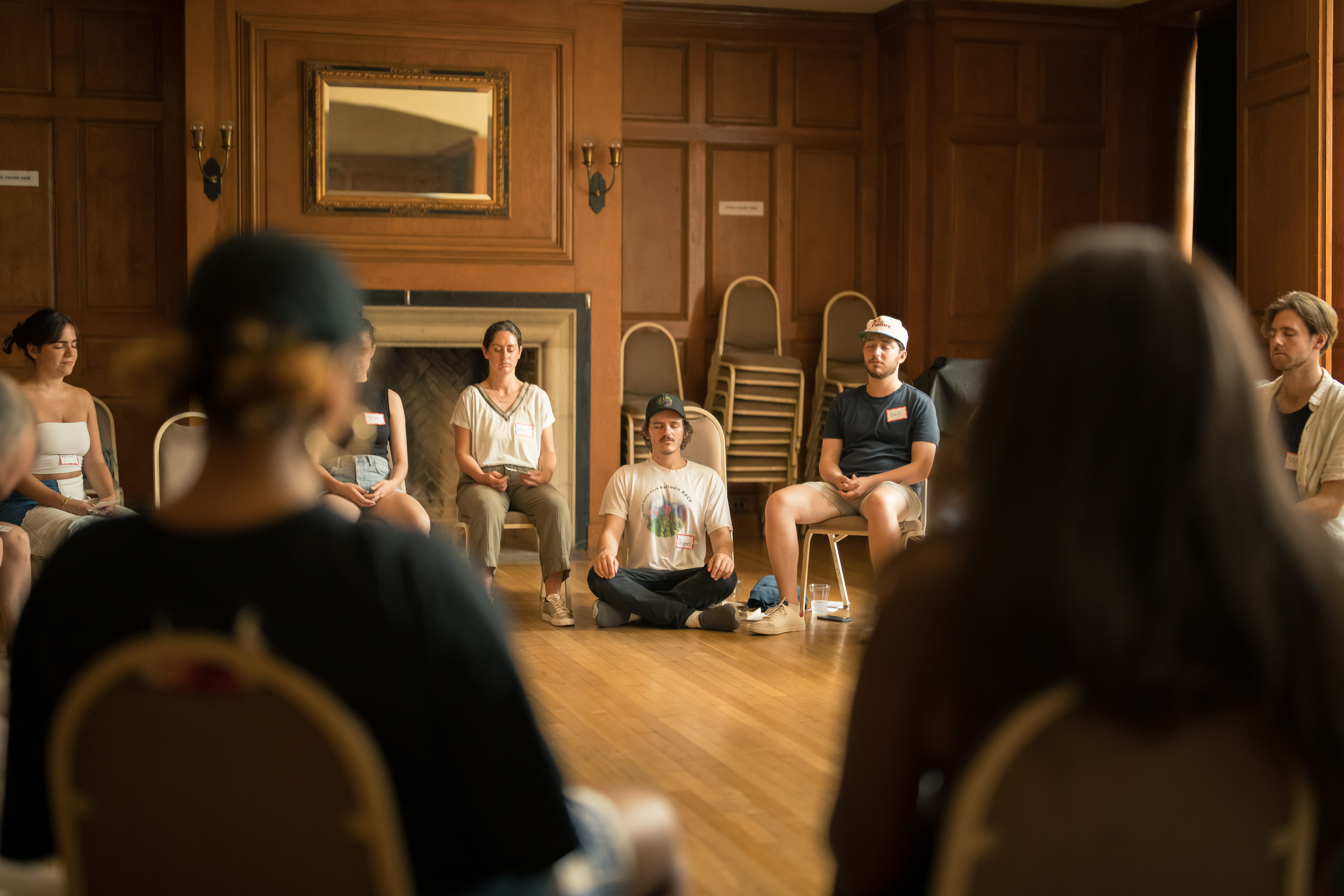
Wed, December 3rd: ATTENTION LAB: COALITION is an experiential, participatory workshop dedicated to the joint exploration of radical human attention with a focus on COALITION’s role in Attention Activism. Our FINAL Lab of the year!
Wed, December 3rd: in our virtual seminar on ATTENTION ACTIVISM 201, participants will focus on developing the organizing, facilitation, and movement-building skills required to build groups for ATTENTION ACTIVISM.
Find more workshops, events, and gatherings here!