

Friends!
In this week’s newsletter, we’re thinking about ambient media. From network television to YouTube to music streaming services, the stories and songs formerly meant to move and provoke and titillate us are now fine-tuned to create a vibe — to facilitate what critic Mitch Therieau calls a mode of “atmospheric” consumption.
This curious counterpoint to the frenzy of the attention economy even extends to literature. The listicle blogosphere is keen to recommend Gabriel Garcia Marquez’ masterpiece, One Hundred Years of Solitude, on the basis of its “Rainy Liminal Vibes.” (We can only hope a machine wrote that.)
Newsletters like this one are ill-suited to an ambient media ecology. Simply put, it’s hard to kick back and vibe out while reading. You can’t read “in the background”; your eyes need to be here, right now, doing the often hard and always deliberate work of plodding along the page.
So we will do our very best. We will trust that there is room for The Empty Cup in the vibe you are curating right now. Press play on your Spotify-curated Acoustic Reading Mix (No Lyrics) and project the lofi hip-hop study girl tab onto your apartment wall. If you insist on watching something more narrative, please ensure it's low-key enough that you can scroll through the following dispatch with minimal distraction. If we could bottle this publication and sell it as a diffuser oil, we would. But until such time, we appreciate you for meeting us halfway.
The point is: you can have it all! You can critically interrogate the co-optation of “good vibes” while enjoying them all the while!
At least for now. At least, we hope so…
Ambiently yours,
Peter Schmidt
Editor-in-Chief
Stuff for Study: Audiovisual ambiences and new forms of monoculture
Readings and other resources for continued learning on attention and politics
- Vitória Oliveira
Visions of Attention
An archive of images and mini-essays on the myriad modes of attention
Cathode Ray Mission (Videodrome, 1982).
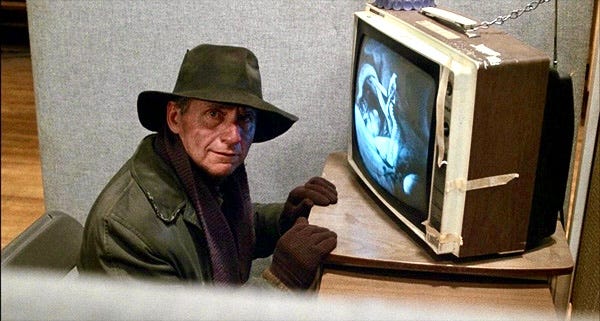
In an inner-city mission house, cubicles lining the floor from wall to wall emit the soft blue light and ambient buzz of a cathode-ray tube (CRT) television. This scene in David Cronenberg’s sci-fi body horror film, Videodrome (1982) depicts what is supposedly a site of refuge — the mission's humanitarian purpose is to reintegrate homeless individuals into society through the friendly glow of a screen. “Watching TV will help patch them back into the world’s mixing board,” explains Bianca O’Blivion, one of the film’s Dickensian protagonists.
But, in practice, this refuge becomes a sort of prison. The indigent viewers cannot tear their eyes from the displays that are meant to return them to the world.
Cronenberg’s Cathode Ray Mission presciently captures a present-day contradiction: that technology which is meant to bring people back into the company of others just as often pulls them into isolation. And who isn’t looking for a dose of oblivion? Still, the chill that runs through Videodrome reminds us that the double-edged nature of technology is ill-fitted to the demands of messianic projects.
- Haena Chu
From The Trove
Long-form recommendations from the Friends of Attention’s collaborative Attention Trove archive
How Does an Editor Think and Feel? 2016.
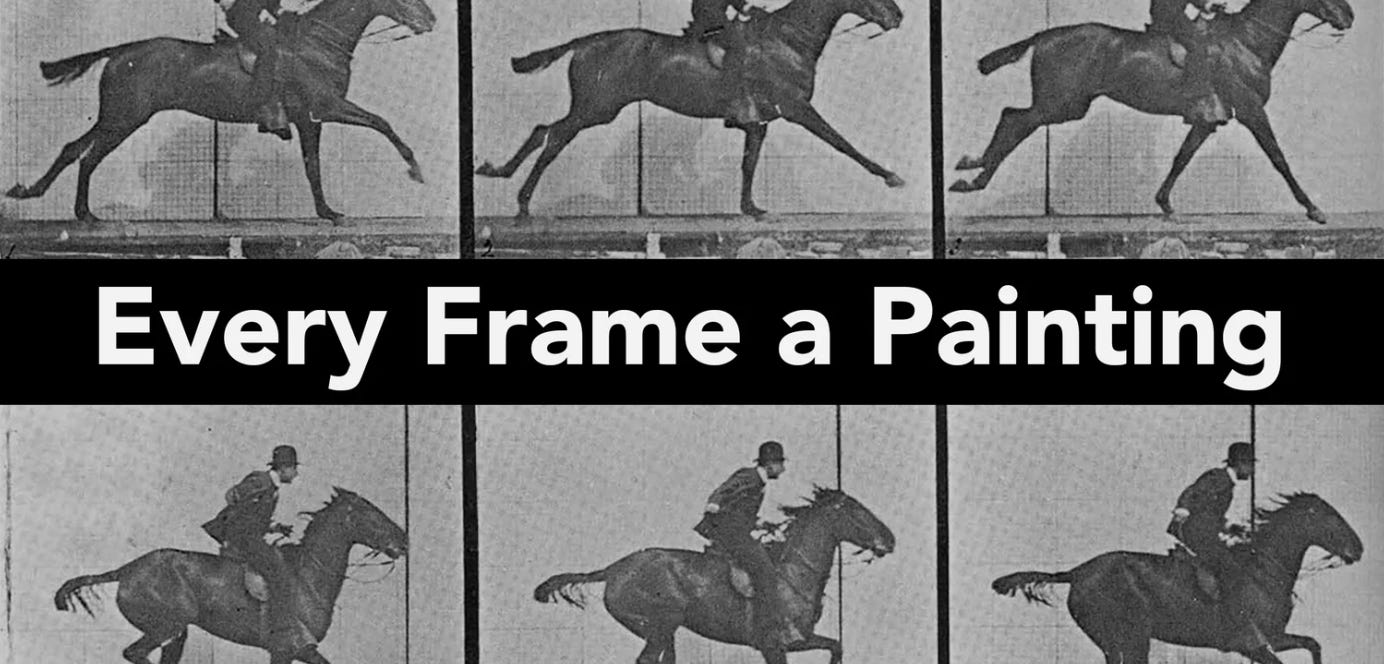
“How do you know when to cut?”
This excellent video essay insists that there are no rules or formulas to the art of film editing; the process (according to our editor-narrator) consists of hundreds of micro-decisions made on the basis of… instinct! Sensibility. Feel. (Of course, aspiring editors do get some tips. “When I’m watching footage, this is what I'm looking for: moments where I can see a change in the actor’s eyes.”)
What this means is that, in a time when politics, social life, and nearly every other face of human experience is primarily video-mediated, “film” editors stand in a curious and critical relation to the attention economy. Their sensibility is, to an ever-greater extent, shaped by the pressures of human fracking, while the stuff they make becomes a part of the very spectacle that claims our fractured attention. This surfaces a curious tension: ours is an economy of industrialized visual sensibilities, but those sensibilities are, at bottom, human.
- David Landes

IRL
A rundown of what’s up at the Strother School of Radical Attention in Brooklyn
Wed, April 30: ATTENTION ACTIVISM 101 virtual seminar begins!
Thur, May 1: Legal Imagination Studio: Attention & the Law
Wed, May 7: Attention Lab (Level 2)
This week in the New Yorker, SoRA’s D. Graham Burnett asks: Will the Humanities Survive Artificial Intelligence?
And looking ahead: SoRA’s second annual SUMMER YOUTH ACADEMY runs from June 23-27. To find out more, email [email protected] with the subject line SUMMER ACADEMY.
Find more workshops, events, and gatherings here!