

Friends,
Three weeks ago, I rode an elevator to the seventeenth floor of Boston University’s Duan Family Center for Computing and Data Sciences, a stack of shiny boxes known as the “Jenga Tower” that looms incongruously over the tidy row houses of Boston’s Fenway neighborhood. I was due for a conference on “The Need for Roots in a Digital Society.” There we mingled, a hundred or so artists, historians, organizers, and writers contemplating the perils of digital life in the gleaming home of BU’s artificial intelligence research. “The Need for Roots” is a nod to French philosopher Simone Weil; the humanists had stormed the tower.
In the opening panel, activist and sociologist Marshall Ganz offered a definition of hope that has stuck with me. He quoted the 13th century rabbi Moses Maimonides: “Hope is belief in the plausibility of the possible, not only the necessity of the probable.”
The possible; the probable. These two words seem pretty similar, but they are a world apart. The probable is the domain of calculation; it is the logic of predictive analytics and Large Language Models and the politics of Silicon Valley. Probability favors machines and the men who make them.
Possibility belongs to all of us. It opens onto wider horizons, but it makes no promises. It is, at its outer edges, little more than a dream. But when the planet’s most powerful men regularly assign percentage values to humanity’s survival in podcast interviews, these distant edges begin to seem like good places to pitch a tent, raise a flag, and circle up. Don’t restrict your attention only to what’s probable, Maimonides counsels us. Let the light shine in unlikely corners. Hope is what you do when the numbers are against you.
This week, we’re attending to hope. In Visions of Attention, Haena meditates on love and extinction (the Permian-Triassic extinction, that is). For Practice in Practice, Yasmine shares about a recent SoRA experiment with radical attention and masks. Jael shares readings on hope in Stuff for Study, and in IRL, we forecast our final seminar of the year — the one on CREATIVE MICROSCOPY.
In possibility,
Peter Schmidt
Editor-in-Chief
Visions of Attention
An archive of images and mini-essays on the myriad modes of attention
The Profound Comforts of #hopecore
Last year, I happened upon a meme that made me feel something. A mournful choral track accompanied an image of a 250 million-year-old fossil. Two fossils, actually: a Broomistega, an amphibian, and a Thrinaxodon, an ancestor of today’s mammals, tangled in a tender embrace. Originally discovered in 1975 in South Africa, the unlikely coupling of these creatures instantly attracted paleontologists’ attention. But what makes the Triassic Cuddle circulate on Instagram and reddit threads like “r/BeAmazed,” what has generated fan art, cartoon strips and tattoos is the romance of it all: scientists believe that the injured amphibian wandered into the Thrinaxodon’s burrow seeking refuge and clambered atop the furry slumbering creature. The two appear to have died “cuddling” amidst Earth’s deadliest extinction, aptly named The Great Dying (the Permian-Triassic extinction event, which killed 70% of terrestrial vertebrates).


The meme produced a tickle in my lower belly. I sent the post to my partner: “me and who?” I began thinking about all the things I had lost in the last decade, in a move across continents — the shapes of the sounds of my mother tongue, childhood friends, and past selves I can no longer feel in the first person. The tickle reminded me that I’ll continue to lose and to mourn, and end up romanticizing emblems of that loss, like my own personal fossils. Strangely, this thought made me more hopeful than I’ve been in a long time. I felt hope at the idea that the future exists with or without me, the same way that we exist, even though the Great Dying seemed like the end of the world.
The Triassic Cuddle may seem trivial, a scrap of #hopecore junk offering a fleeting dopamine hit. But I suspect this image lingers on the internet because there is hope inherent in an extinction event that we can look back on and tell stories about, in narratives that crossed unfathomable chasms to reach you.
— Haena Chu
Practice in Practice
Reflections on experiments in Attention Activism
“To be or not to be?” Is that still the question?
Maybe not. The four-hundred-year-old musing prompted laughter and confusion when I posed it to the attendants of a recent ATTENTION LAB that explored the theme of masks. Our goal was to create a new Attention SCORE — a “social choreography” of the minds and senses — that brought to life Hamlet’s famous question. “But what does any of this have to do with attention?” one participant asked me.
William Shakespeare might have been writing about life and death. But everything is a matter of life and death. We are forever in a spiral of beginnings and endings, arrivals and departures. As I reflected on the participants’ question, I found myself at a new one: At what point do we feel most ourselves? Is it when we’re being — when we take our masks off? Or when we’re not being — when we put them on?
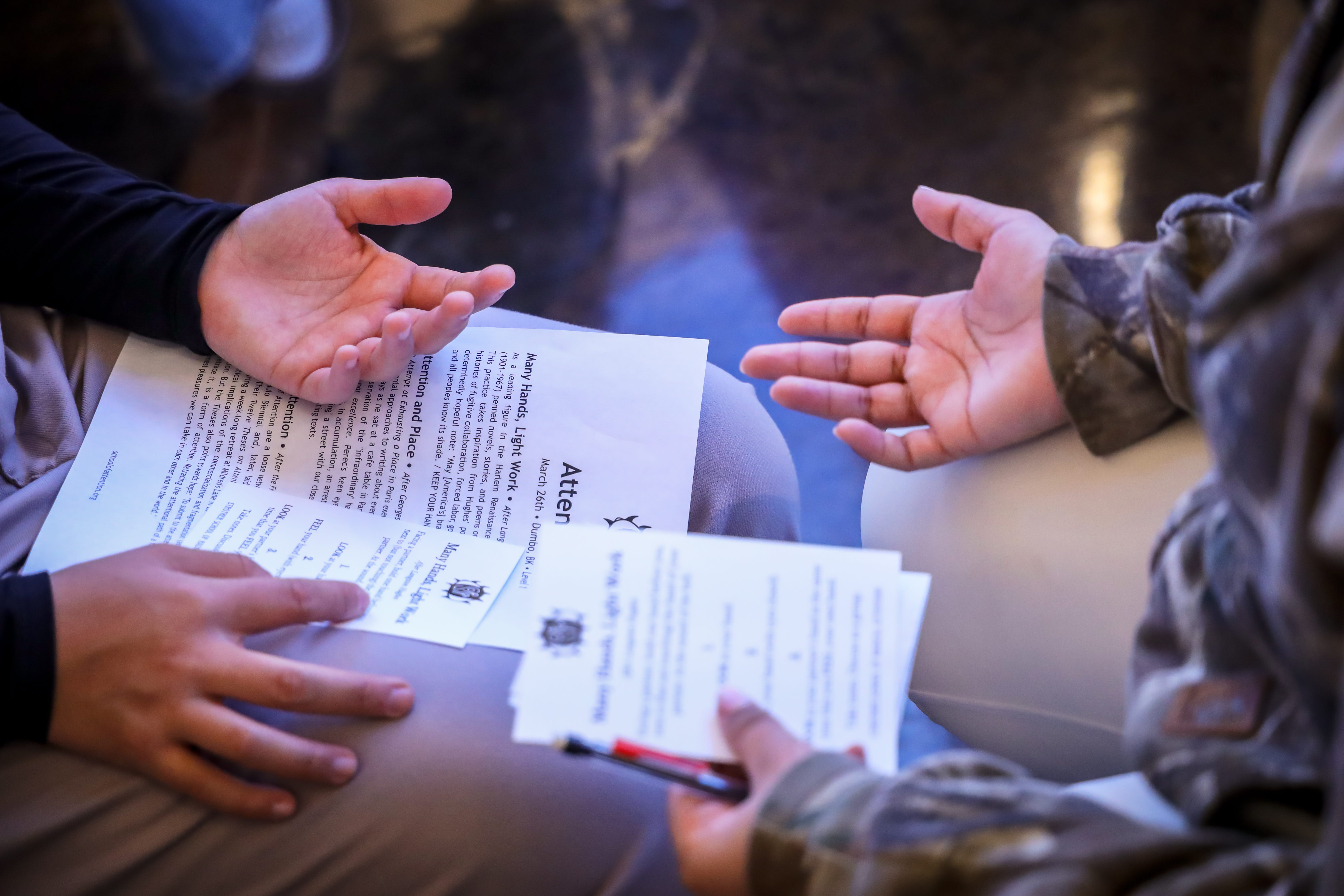
Oscar Wilde says “Man is least himself when he talks in his own person. Give him a mask, and he will tell you the truth.” In Black Skin, White Masks, Frantz Fanon says that in non-being, we become. Each of these thinkers is from a different tradition, and each speaks to the universal power of the mask to reveal truth.
Through Attention SCORES, we aim to produce the conditions for the freedom of human attention. As it happens, those same conditions conduce to revelation of the individuals, and of collectives, too. May we find truth in our arrivals and our departures.
— Yasmine Tiana Goring
Stuff for Study:
“Cruel Optimism” (2006) — Lauren Berlant first argued that optimism becomes cruel when we desire unattainable objects, like the American dream, in differences: A Journal of Feminist Culture Studies before publishing her brilliant book on the idea
“The Reality of Hope” (2025) — a short documentary by The New Yorker, filmed entirely inside the platform VRChat, about a member of the VR furry community whose online friends rallied around him to get him a new kidney
“Optimism Over Despair” (2017) — a series of interviews with Noam Chomsky first published in Truthout, later compiled into a book, centered around his tenet that “despair is not an option”
“‘Hope’ is the thing with feathers” (1861) — Emily Dickinson’s famous poem is one of literature’s most beloved descriptions of hope. The Guardian recently rounded up a few others by Virginia Woolf, Ali Smith, Miranda Ward, Stella Gibbons, and Sheenagh Pugh
— Jael Goldfine
IRL
A rundown of what’s up at the Strother School of Radical Attention in Brooklyn
Tue, December 1: Join us for our IRL seminar CREATIVE MICROSCOPY, where we’ll take a closer look at everyday objects through microscopes and macro lenses to bear witness to a world only non-humans can ordinarily see. Enroll HERE!
Thu, December 3: In this ATTENTION LAB: JUSTICE, we’ll think about the quality of our attention and the ways that attention translates to care. Sign up HERE!
Find more workshops, events, and gatherings HERE!