

Friends!
Our dispatch this week is on truth and fiction — and the boundary between the two that, when given close attention, can appear very fuzzy indeed.
Last Saturday, we published an interview with philosopher Justin Smith-Ruiu, whose carnivalesque experiments (with numerous collaborators) at the boundaries of fiction and historical writing challenge the reductive distinctions between truth and falsehood. Not in a too-cool, nihilistic, post-truth way. Far from it! Rather, Smith-Ruiu’s work reminds us that “truth” rarely fits into the tidy boxes of verifiable facts (and in those cases where truth is made to fit, it tends to come out looking lopsided). When your concern is with experience — with the shocking strangeness of how it feels to be human — sometimes getting it right requires getting a little messy.
The attention that distinguishes truth and fiction, the curiosity to test admixtures of the two, and the care to take responsibility for the consequences. This week, we’re rolling up our sleeves. In Visions of Attention, Haena studies the simulation in Rainer Fassbinder’s 1973 television series World on a Wire, while David surfaces From the Trove a close analysis of the post-truth ideologies of human fracking. In Stuff for Study, Czarina shares essays on the current status of truth, and in our newest section, Practice in Practice, Study Corps facilitator Eleanor reports on her latest experiment in organizing for Attention Activism.
For our NYC folks, enrollment is still open for our Art of Instruction seminar on the “score” and “action poem” in art, literature and politics — starting TONIGHT! On November 19th, anyone who has attended an Attention Lab is invited to join our FACILITATOR TRAINING in Dumbo: an introduction to facilitating practices of collective attention. And for our far-flung friends, our final ATTENTION ACTIVISM 101 of the year begins Wednesday evening.
Read on!
Verifiably yours,
Peter Schmidt
Editor-in-Chief
Visions of Attention
An archive of images and mini-essays on the myriad modes of attention
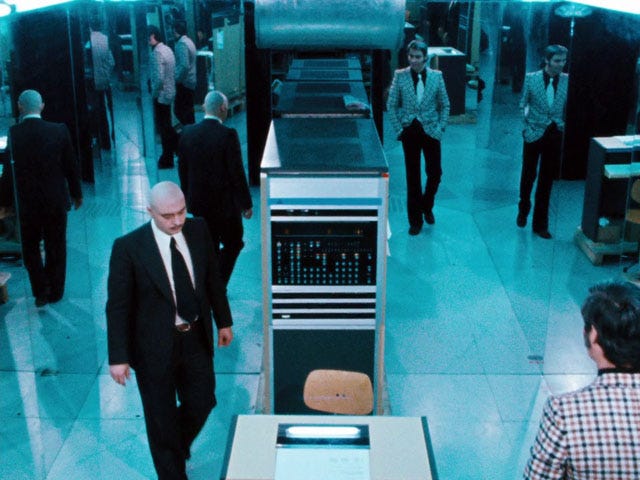
World on a Wire
You are driving a truck through the city, watching the blurred lights stretch past you like a sped-up video. The word zurückkommen (come back) is whispered into your ear, and you jolt awake on a plastic bed at the IKZ, the Institute for Cybernetics and Futurology, where you are watching your avatar on a television. Then there’s YOU (the reader!), watching this on a screen in Rainer Fassbinder’s tv series World on a Wire (1973)...
The simulation trope spans far and wide in science fiction. The novel that inspired Fassbinder’s film, Daniel F. Galouye’s Simulacron-3, dates to 1964. Now in 2025, in the shadow of Solaris, Ghost in the Shell, and The Matrix, a plot twist revealing some kind of dream or infra-reality is so familiar as to be expected. You know it’s coming; that’s how reality works.
Indeed, the genre itself has, in a funny, recursive move, come to resemble Jean Baudrillard’s notion of the simulacrum, which represents the very nature of a duplicated and alienated reality through mise en abyme, or an infinity mirror effect. In World on a Wire, mirrors and screens appear throughout the film, visualizing the behavior of simulacra that refract and dissipate our attention at the level of raw perception. Even the interior design of the film’s corporate office, dominated by glimmering metal and plastic surfaces, hovers indefinitely between the material and non-material. At the end of the first episode, World on a Wire discloses the disappointingly mundane truth that its simulacrum was built by a corporation to model consumer behavior and test new products. Sound familiar?
With more than 40 years of simulacral films behind us, the question feels increasingly urgent: can these films inspire new acts of resistance against manufactured truths, or do they rebrand our jaded acceptance as fantasies — and only fantasies — of escape?
- Haena Chu
From the Trove
Long-form recommendations from the Friends of Attention’s collaborative Attention Trove archive
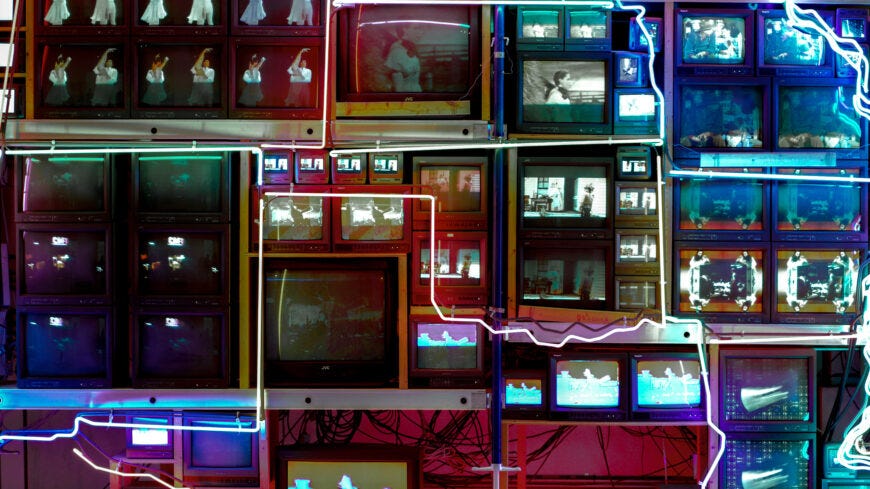
Silos & Spotlights
“Truthiness,” “post-truth,” and “fake news” arose from the digital attention economy. Wexler & Oberlander’s Ideology in the Attention Economy: A Portal to the Post-truth Era offers useful schematics of attention economy dynamics that facilitated the rise of the noxious post-truth phenomenon. The attention economy’s enabling mechanisms, they argue, correlate with a “collision ideology” that shrinks and intensifies groups into fractured silos. Contrast this with a “collusion ideology” where multiple publics compete for salience in centralized gatekept spotlights. Combine the two and you now have the media dynamics of a digital attention economy, with both collision and collusion supercharged by extraordinarily powerful AI processes of marking, measuring, and managing information. It’s a sobering view of the way that technology can teach us to think — but Wexler & Oberlander’s analysis raises the possibility of thinking otherwise: of fostering a non-zero-sum plurality of thought, and of creating the conditions (social, technological, political) to bring this practice into the public sphere.
- David Landes
Practice in Practice
Reflections on experiments in Attention Activism
Last Sunday, ten of my friends came over and sat on my floor. After grounding together with Dan Siegel’s Wheel of Awareness as our shared reference point, I passed out blindfolds and, one by one, placed random objects on the floor in front of each person — some soft, some strange, some belonging to my guests themselves. In the first round of practice, everyone sat blindfolded, touching their objects in silence for two minutes before jotting notes. In the second round, new objects circulated; still blindfolded, folks took turns describing their experience aloud for one minute. For the third round, we had a single participant experience and describe a new object while blindfolded as the rest of the group observed them, blindfolds off. It was my very first Independent Sensory Study, a small gathering that sought to explore the intricate tapestry of our eight senses (within Siegel’s frame) and the shifting “selves” that appear as we move from sensing to interpreting that sense to expressing that interpretation.
I hoped to explore how attention travels across thresholds between internal/external, private/public, listening/speaking, and conscious/unconscious. People’s attention diverged in fascinating ways — some stayed close to the physical texture of their object, while others spoke from the emotional or relational currents stirred by touch, presence, or the strangeness of being seen or unseen. The room held ten distinct inner landscapes, yet it also revealed (to borrow from labor activist Grace Lee Boggs) the exquisite connectedness of our experience.
I’m already imagining refinements to the practice (what if I placed the object upside down? What if participants didn’t get to touch their object before sharing?) and the discussion that followed. We asked: Where do “I” get involved in this process? Is every sense a “sense of self”? Would there be anything to sense without a self, however fluid, to perceive it? And would there be a “self” to sense without ever-changing streams of observable phenomena? There is so much possibility here: to clarify, to deepen, and to honor the elusive points of intersection where attention becomes experience and experience becomes us.
— eleanor jasmine lambert, SoRA Study Corps
Stuff for Study: We Hold These Truths
Readings and other resources for continued learning on attention and politics
What does a fact look like? — Adrian Nathan West for The Baffler
Here lies Fact: an obituary for an old friend — Jon Askonas for the New Atlantis
In lies begin responsibilities — D. Graham Burnett in More Real?: Art in the Age of Truthiness (2012)
What distinguishes fiction from non-fiction? — Hannah Kim for Aeon
Reading the internet as novel — Boris Groys for e-flux
Why are we so ready to believe that truth is over? — Nathan Jurgenson for Real Life
- Czarina Ramos
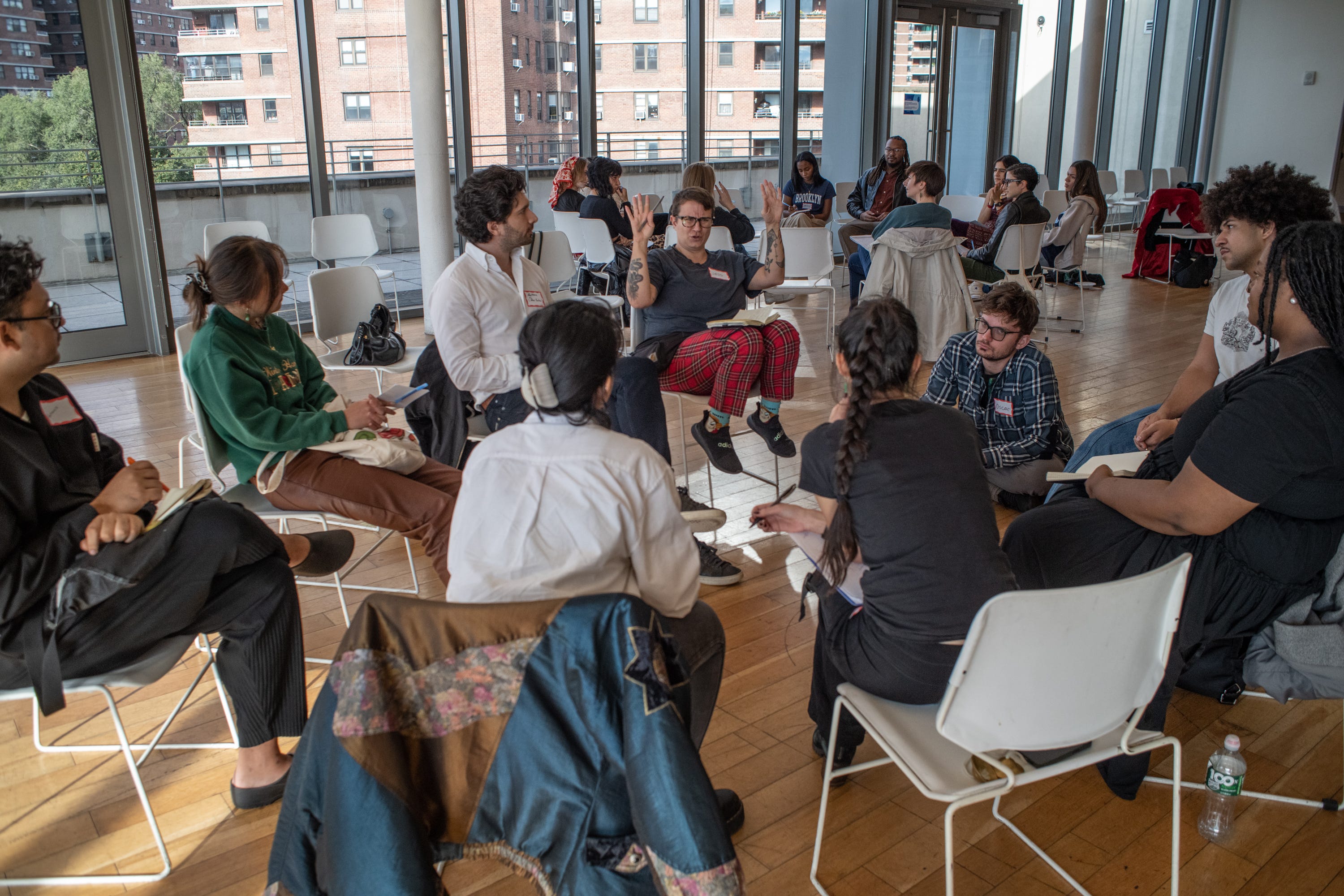
IRL
Wed, November 19th: in our FACILITATION WORKSHOP we’ll share tips, techniques, and resources for folks to lead practices of attention in their own communities and classrooms. Attention Lab experience required.
Thu, November 20th: ATTENTION LAB: SANCTUARY is a workshop dedicated to the joint exploration of radical human attention with a focus on COALITION’s role in Attention Activism.
Mon, November 24th: in our IRL seminar on REMEMBERING, FORGETTING, participants will bring together interdisciplinary studies of memory, from biological research and cognitive theory to portrayals in literature and visual art. Led by neuroscientist and writer Czarina Ramos.
Find more workshops, events, and gatherings here!