

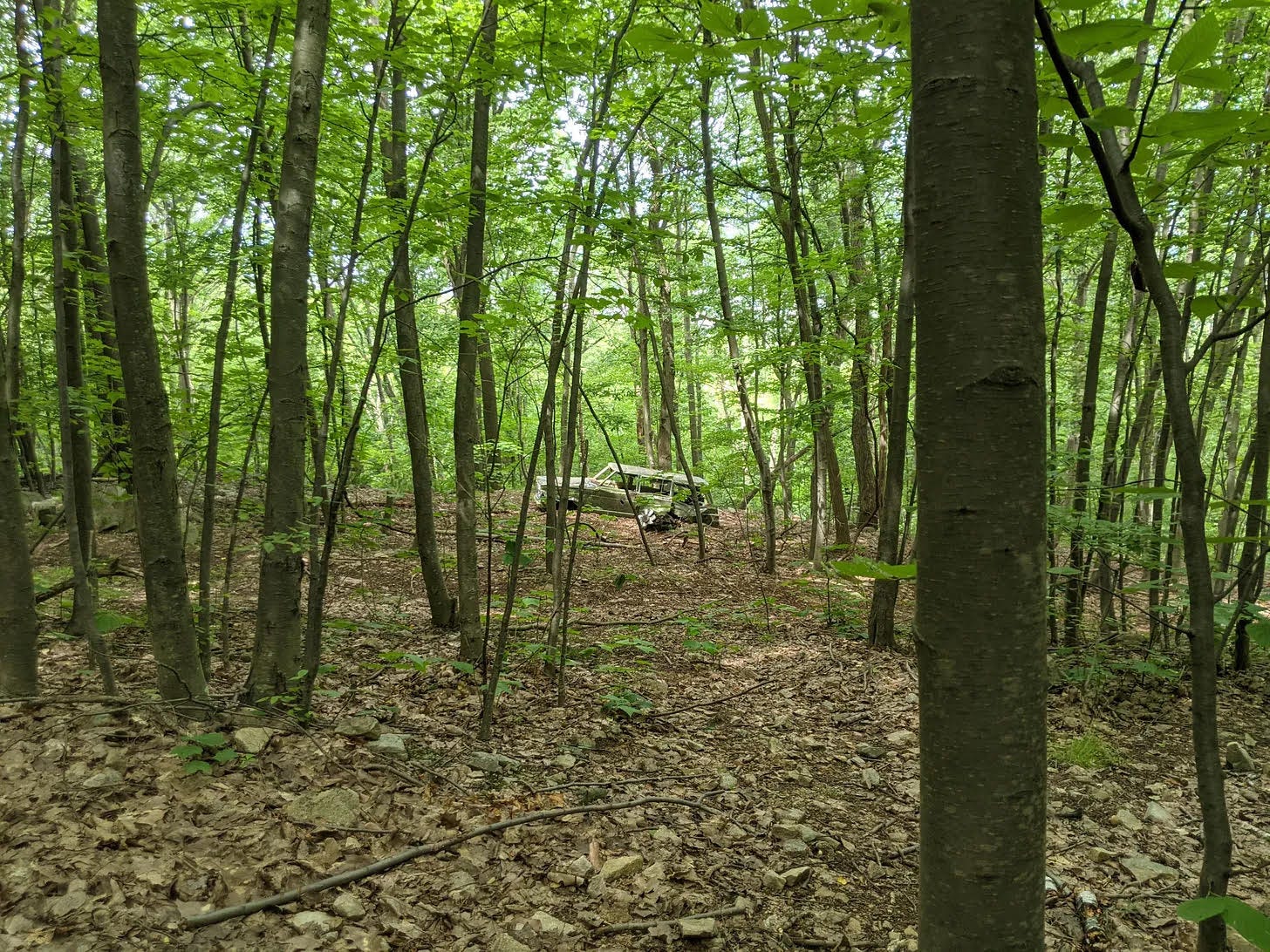
An assassin is waiting around the next corner. Your friend, out in front of you, is about to turn that corner. They are too far away to hear you shouting. What will you do?
The answer is obvious: try your best. Run towards them. Scream. Look for some other way to be noticed. Time feels different in this scenario: every second becomes the split root of two eternities, the difference between a future in which your friend is dead and one in which they survive.
This is a drama — one that is life-and-death. It is easy to grasp; it involves events we can witness in real-time. There is a clear tension between inner urgency (yours) and outer passivity (your friend’s). The action you must take — to transfer that urgency from the inner to the outer, even if you’re bound to fail — is straightforward.
Tragically, the existential drama we experience in relation to the climate (knowing what’s happening while being unable to stop it) feels different. Ecocide, cascading weather chaos, and rising sea-levels exhibit a diffuse complexity that makes our instinctively “right” response difficult to square with reality. What do we do — or rather, how does it feel — when an emergency is not a singular event at a specific point in time, but a gradually mounting death-heap of tragedies that will, in the end, have the same catastrophic results?
Sure, we all know things we could do; specific actions that might make a small difference. We could vote, call our senators, sign petitions, march in numbers, and make our voices heard.
But these actions feel at odds with that inner urgency. They feel almost nauseatingly insufficient: “Yes, hello sir. You know that looming existential threat against life as we know it? Yes, well, between my groceries and walking my dog, I just want to express my wish that this issue should move from sixth to fifth priority on your political platform. Thank you and have a great day!”
These more specific, short-term, and visibly urgent projects (cleaning beaches, protecting rainforests, de-polluting waterways) are real and important, but they require personal transformations many of us feel unprepared to make, or else they feel demoralizingly small. After all, viewed through a utilitarian lens, many of these clearly meaningful acts are a mere drop of clear water in a river rank with sewage.
There is, however, one climate action that I believe to be truly and universally effective. It is concrete and accessible. Not only can it make a real difference for the more-than-human world, but it can also act as a salve for the painful and paralyzing dissonance of the anguished position many of us have internalized. This action is familiar to all of us. It is deeply human, and is deeply real, even if — like the earth under our feet — we almost always take it for granted.
Yes, I’m talking about love.
Are you rolling your eyes? Good. That’s a fine place to start. Anything that reeks of an easy answer, especially a sentimental easy answer, should be met with sober skepticism. And I understand: “love” feels like a non-answer meant to put a neat bow on this depressing analysis so I can allow myself to end on an uplifting note.
But it’s not. Trust me a bit longer. Hear me out.
Dying well – dying held – is better than dying alone, both for the dead and for whoever is left behind. We know this of humans, so why would it not be true of the planet?
At the end of Don’t Look Up, a 2021 film that analogizes the climate crisis to a meteor hurtling towards Earth (a narrative move meant to eliminate that feeling of distended and ironic suspension), we find our main characters gathered around a dinner table. The US government’s half-hearted, short-sighted attempt to curtail the disaster in economically lucrative fashion (a reference to the insanity of geoengineering, and a coy subversion of techno-jubilant disaster movies from the ‘90s and early ‘00s) has predictably failed and impact is imminent. No one discusses the comet, but the quiet scene is not a portrait of denial. Everyone is aware of what is about to happen.
Rather, the doomed heroes’ response to impending disaster is simply — simply, that word’s important, and more radical than you’d think in a time of overwhelming complexity – to share a meal in love and gratitude.
There’s something real in this.
I’ll get the depressing part out of the way first: one reason love is so important is the same reason it matters to hold someone as they’re dying. Dying well — dying held — is better than dying alone, both for the dead and for whoever is left behind. We know this of humans, so why would it not be true of the planet? Why would it not be true of the trees in your neighborhood falling victim to an invasive beetle, or the currents in the increasingly polluted river outside your back door? Hospicing is not meant to defy death, but to dignify it. Love what is around you so that we all move more gracefully into oncoming tragedy. Be like the poet Rainer Maria Rilke, who, addressing the “Darkening Ground,” voices his desire “to love the things / as no one has thought to love them / until they are worthy of you and real.”
And yet: this consoling power of love is only the beginning. Love is the first step to caring and, most importantly, doing. Love (a word Erich Fromm defines as “the passionate affirmation of another”) transforms a relationship. It changes what actions and behaviors are easy or hard. It’s hard to dedicate a year of your life to a cause when it comes at the cost of so much that you value — but if it’s for someone you truly love? Suddenly, it becomes hard not to. Love is a rebellious act that, as bell hooks has observed, begets more (of the best kind of) rebellion. This is the rebellion we need against a society that has forgotten how to love.
Remember when I said that those concrete actions (riverkeeping, protesting, rewilding) are just drops in the bucket — that they are ultimately temporary in the face of the wicked problem of the climate crisis?
Instrumentalize your love so you can take real action. If you have a problem with that – if love seems to you too precious, too sacred on its own to become the object of a word like “instrumentalize” – go back and love more; you’ll get over it.
Well, when I said that, I was talking to the cost-benefit analysis you. The “rational actor” you. Can I just say it? To the comparatively loveless you. I was talking to you before you go out and do this — before you learn to love. Once you do, you’ll realize that all this talk of drops and buckets is bullshit. Your love won’t care about the ends nearly as much as the means, the act itself, and the absolute need to do all you can. Even in less tangible work — work like writing articles and grappling with these hyperobjects – you can summon up that love, staying grounded in it and guided by it.
Love is a prime mover (in some faiths, the prime mover). Instrumentalize your love so you can take real action. If you have a problem with that — if love seems to you too precious, too sacred on its own to become the object of a word like “instrumentalize” — go back and love more; you’ll get over it. You won’t care about minor differences, you won’t care what words anyone uses, you won’t care about your own alienation or your dissociative urgency or the inner, whirring tension of a distant impending crisis. Instead, you’ll just care.
To add a further layer to the importance of love: living in sincere community is, simply put, far more rewarding and honest to who we are than living in the detached isolation of despair or ironizing alienation. Love is connection and connection is life. So when I say this, I mean it: When in love with the world, it is impossible to be alone.
The river, the trees, the soil, other alienated people… the more time you spend with each, the more attention you give to each, and the more you love each, the less alone in all of this you will feel. It is from this place that others can be invited. Hearts may even change.
Taking action without love is difficult and perhaps insincere. Forcing others into action without first inviting them into love is, as a result, ineffective and (more often than not) obnoxious. Notice what arises in your body when you imagine me scolding you: “If you don’t spend every waking moment campaigning to save the Amazon then you are a terrible person. You’re part of the problem, and your personal struggles and obstacles are irrelevant.”
This is the inner voice some of us hear when we think of environmental action and alarmism. It’s a voice we implicitly trust as a moral authority, and thus the voice we hide from in our rush toward relentless distraction and rebellious nihilism. It’s the voice critics (often mistakenly) project onto vegans, or Greenpeace, or whomever, with Adam McKay (the director of Don’t Look Up) being another easy target.
But campaigning to save the Amazon is not what you should be doing… at least not at first. Learning to love is what you should be doing. That way, when you do head for the rainforest (or into your studio, or into your garden, or into your community hall), you mean it, you’re sure of it, and it’s easy.
Now here’s the best part: learning how to love the world is also easy. It’s easier than you’d think. In fact, we are made for it, and the more we love the more we receive. It just takes practice, like stretching muscles that have atrophied from injury to relearn how to walk.
We have not — not one of us — fallen out of love with our world. This is impossible. We have, instead, just forgotten how to be in love with it. There’s no way to get love out of us. Even the ten-thousand-year-old heartbreaking walls we’ve built between ourselves and the earth (most recently fortified by social media, virtual unreality, and xenophobic politics) are nothing against the Gordian-knot-cutting straightforwardness of a little bit of love.
Despite being easy, however, learning the skill of love is of critical importance. And not nearly enough of us are doing it.
Call this “tough love” — you’d better learn to do it. Our flourishing, the manner of our flourishing, and the flourishing of countless nonhumans depend on each of us learning.
So how do you do it? If love is a skill, and if it’s an easy skill, how does one develop it?
My skeleton key to loving absolutely anything (a bold claim, I know, but it really is okay for this to be simple) is a second inconspicuous and under-appreciated word, one I’ve used a few times already: attention.
Attention is miraculous on countless levels. We need only turn to Mary Oliver (“I do not know what a prayer is. But I do know how to pay attention”) to hear an echo of its sacred character. For one, there is no world without attention. No experience without it. No you without it. To “pay” attention (an odd phrase that diminishes attention to a mere resource rather than the fundamental and invisible ground of you) is to decide what is invited into your reality.
To look at is to apprehend a thing for a pre-determined purpose: how much lumber is in this three-hundred-year-old sequoia? To see, on the other hand, is to allow yourself to be surprised by the spontaneous expressiveness of the Other. It is only by seeing, and by allowing ourselves to be seen, that avenues for real connection become possible.
There is also no value without it. The rightly named Friends of Attention make this crystal clear in their upcoming book:
“It is attention itself that MAKES things valuable. It is by means of our attention that we constitute the values of this world: what we care about, what we give ourselves to, what we endow with time and touch and thought, what we stay with, what we circle back toward; these are the things that become valuable.”
What you attend to is what you say “yes” to, what you passionately affirm, so to attend is already a movement towards love. The more beings you witness, the more paths to love open before you. Watch that horrendously sad film with the albatross full of plastic (the one the director, maybe not so mysteriously, calls “a love story”) if you can stomach it. If you can’t, be kind to yourself; watch the birds outside. But just be there. For something. For someone.
To give other beings the gift of our attention is, to borrow Henry David Thoreau’s language, to see rather than merely look at them. To look at is to apprehend a thing for a pre-determined purpose: how much lumber is in this three-hundred-year-old sequoia? To see, on the other hand, is to allow yourself to be surprised by the spontaneous expressiveness of the Other. It is only by seeing, and by allowing ourselves to be seen, that avenues for real connection become possible.
For philosophers like Simone Weil and Martin Buber, this real attentive seeing is a moral act that shifts us out of an isolated world of objects into what, in the later words of eco-theologian Thomas Berry, becomes a “communion of subjects.” In other words: attention is nothing less than a deep magic that brings a deadened world to life, and in so doing, wraps you up with it in mutual relation.
How does this magic work? First, it works by revealing the inexhaustible depth already present in all that surrounds us. When you really attend to something — when you honestly look, smell, taste, hear, and feel it — that thing will never cease to reveal new parts of itself to you. That tree you pass each day and barely see, except to note that it’s there? Pay attention, now, and see the pale brown and white tones of the bark; the way the smooth paper layers feel under your fingers; the way the blue of the sky sits stark and biting against the forked cow-patterned fingers of this — you now know the name — sycamore.
In revealing the depth and quality of the world to us, attention also reveals us to us. The particular emotional stirring you notice in response to the tones and textures of this sycamore will be (if you pay close enough inner attention) a nuanced and layered feeling-world all its own. It will be of a kind you could never have known outside of this moment, with this Other. Attention is the key to the sort of poetic attunement which is synonymous with psychological richness.
When we are no longer attentive to the wild Others that surround us, our inner ecosystem suffers biodiversity loss. When we let the world back in, that ecosystem begins to repair its complex shape. Attention, then, begets loving action that is mirrored both within and outside us — as we act to reweave the world, we are at the same time reweaving ourselves (and knitting ourselves into the world).
In short: the more honest your attention, the more your capacity for surprise. The more your capacity for surprise, the greater your openness to wonder. The more wondrous your world, the fuller to the brim it will be with love.
This is a working strategy of mine — but it’s just a start. No doubt you have your own. There is (endlessly) more to say, but far more importantly, there is a hell of a lot to do. After all, it is your friend about to turn the corner as much as mine — and, in a sense we are now beginning to feel, it is you and me, too.
So: practice attention. Practice often. Practice constantly, obsessively. Mold your mind and senses, and thereby your heart, to the shape of the things around you. Choose one thing at a time, or choose several, or choose many. Learn to love, then learn to love more fiercely and more deeply — then follow your love as it moves swiftly and confidently towards action.
Henry R. Kramer is the new Academic Dean at SoRA. He is a Hudson Valley–based writer and educator whose work weaves imagination, deep attention, and experimental pedagogy to help repair our relationship with the more-than-human Earth. He holds MAs in Environmental Philosophy and Ecocritical Literature and a BA in the Psychological Dimensions of Religion. He teaches Religious Studies at Hunter College and also serves as Program Director at the Center at Stone Mountain.
I really resonate with this piece Henry!
I've been mulling over many of the themes in it this year myself.
One, I call "inherency"—the value something has when you are taking their perspective (i.e. what is the life of a river, rather than asking what purpose does the river serve).
And then this bit about the infinite depth of the world; I was at a "Guitarcraft" workshop in August. One morning we were asked to play 10,000 notes across 40 minutes (a lot of continuous picking!). I started to notice the most subtle differences and the way they affected the tone—the angle of the pick, the depth at which I was striking the string, the tension in my thumb, the differences in the down stroke and the up stroke. This is the magic of the world; there is no end to its richness. Magic is having the attention to see to a depth that no one has seen before. And as you say, the things (and beings) we will find surprise us!
Remembering our love with the more-than-human-world is at the core of my Hyperbeings project.
As Carol Sanford would say, it is naïve to think that taking an issue "head on" would result in the outcome we're looking with to begin with. To fall in love, and to follow where that love leads us, is actually a much more effective theory of change. In her second-to-last book, "Indirect Work," she articulates how a head-on approach assumes a world of objects, devoid of relationship or inner meaning. To work "indirectly," is to work with the implicate, to work systemically, holistically, nodally.
I love the linking of love and attention. Imagine claiming to care about something or love someone but never listening to, noticing, touching, smelling, or otherwise interacting with them. The reciprocal nature of loving and attending becomes so clear.
I’d be curious to think and read more about the connection between attention and (something like) reflection: how we account for our unconscious loves and values, the infrastructure and subliminal relationships that we take for granted, the crusty residues of loving and attending.