

Dear friends,
Another New York Fashion Week has ended; to those not in the know (like myself), it went largely unnoticed, save for an influencer post here and there. Haute couture is, in many ways, a closed universe. What could it possibly teach us fashion outsiders about attention?
The earliest fashion weeks consisted of stores inviting their clients to view the latest styles for purchase. The idea was for the audience, mostly consisting of loyal customers, to envision themselves in the modeled clothing before placing their orders with the shop. Today, the viewing is mediated by professional buyers, tastemakers, and, more recently, content creators. The actual works by the most famous designers and fashion houses reach only a small, privileged group; the images propagated by viewers create the wider-reaching trends. In one telling, our aesthetic preferences are the work of a select few — a phenomenon famously narrated in Miranda Priestly’s Cerulean blue monologue in The Devil Wears Prada.
But to attribute the creation of fashion to a trickle-down phenomenon is to tell an incomplete story. Vivienne Westwood’s signature punk aesthetic was brought to life by the punk subculture. Yves Saint Laurent took inspiration from the hippie movement. Balenciaga popularized “gorpcore,” transforming the technical attire of outdoor enthusiasts into exaggerated runway pieces. Attention to fashion is, at heart, attention to a state of relation through which a visual language emerges.
This week, we’re attending to FASHION. In Visions of Attention, Eleanor reflects on racialized scandal as an advertising strategy. In this week’s Practice in Practice, Peter reports from EYE-CATCH!, SoRA’s first fashion show. And in Stuff for Study, I explore the life cycle of trends and the wide appeal of “normcore.”
Read on!
Yours in style,
Czarina Ramos
Managing Editor
Visions of Attention
An archive of images and mini-essays on the myriad modes of attention
Notes on Apology
Scroll through any fashion-conscious feed in the past few weeks and you’ll have seen Converse’s disastrous ad campaign, which makes unmistakable references to the KKK and racial lynching. It’s the latest entry in a long line of brands trafficking in racialized imagery to sell their product, then retreating into an apology cobbled from some combination of “missed the mark,” “got this wrong,” “commitments to diversity,” and doing “better next time.”
Converse (owned by Nike) has issued the usual statement, adding that they are working to “remove it everywhere it appeared.” First, they didn’t see it, and now that they have, their answer seems to be to make sure no one else can, either. I’m not sure that re-circulating the image here is the right move either, but when the brand responsible for harm is also the one deciding, unilaterally, to erase evidence of it, we’re left with the same gesture twice: absence standing in for accountability.
This image (and another featuring someone on a ladder reaching for the black high-tops dangling from a tree) were produced by choices — in styling, lighting, staging — made by people whose job is to notice what an image evokes. In 2019 it was Gucci, naming their commitment to “increasing diversity” after pulling a balaclava that unmistakably resembled blackface. In 2018, it was Prada’s Pradamalia keychains. That same year, H&M dressed a Black child in a hoodie reading “Coolest Monkey in the Jungle.”
There’s a wide gulf between apology and repair, and what corporations do is almost always the former dressed as the latter. The industry term for it — “image restoration” — tells you plainly what’s being restored. We are, as a culture, more fluent in renaming a street than rewriting policy; is it any surprise the focus remains on retiring an image rather than reckoning with the actual violence it depicts?
Practice in Practice
Reflections on experiments in Attention Activism
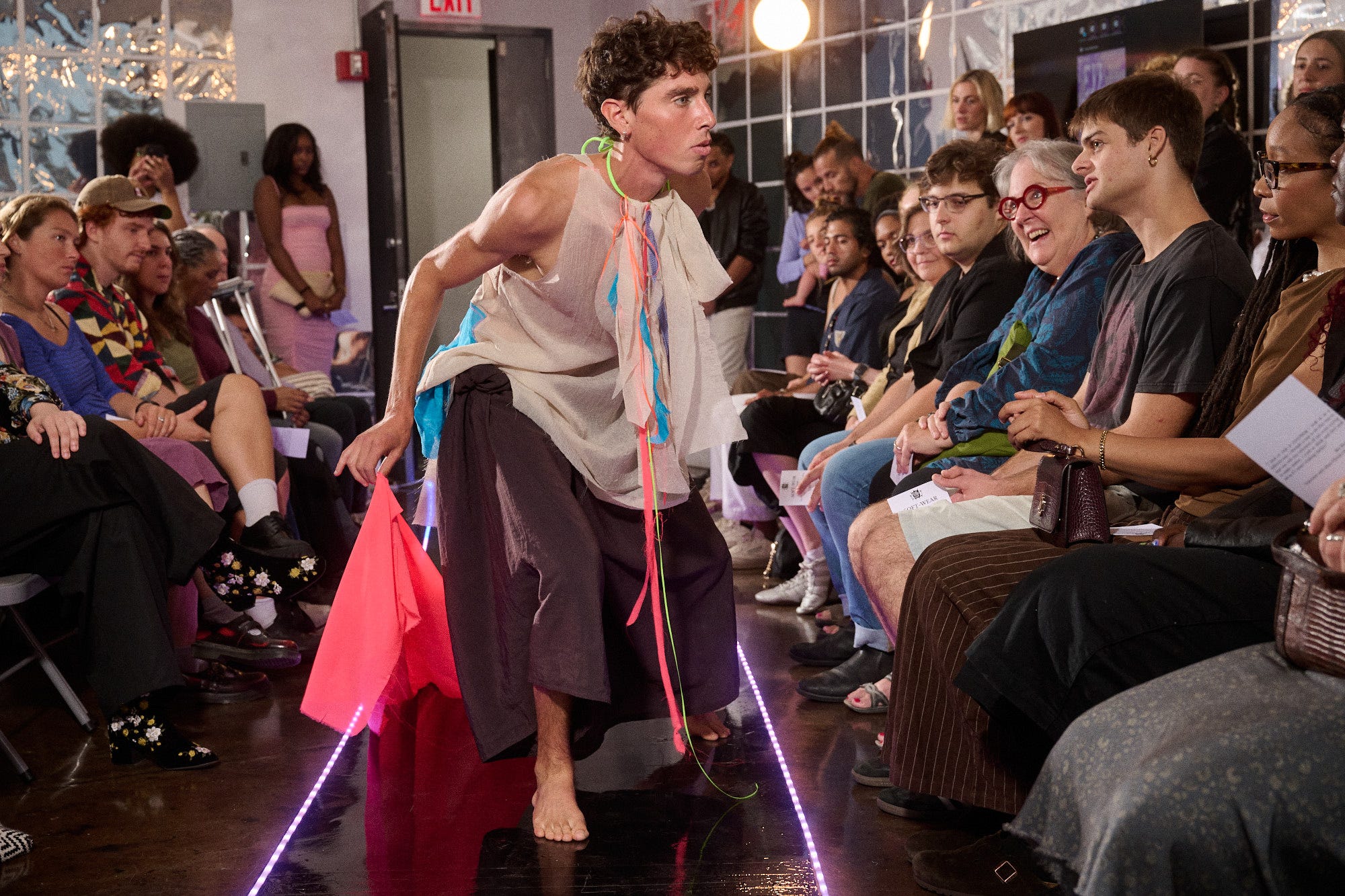
No one’s immune to creative blocks — not even Rei Kawakubo, the famed fashion designer and founder of Tokyo house Commes des Garçons. In a 2013 interview with Hans Ulrich Obrist, she gave us mere mortals a glimpse into how she has kept her work fresh: “I [try] to think and feel and see as if I wasn’t making clothes.”
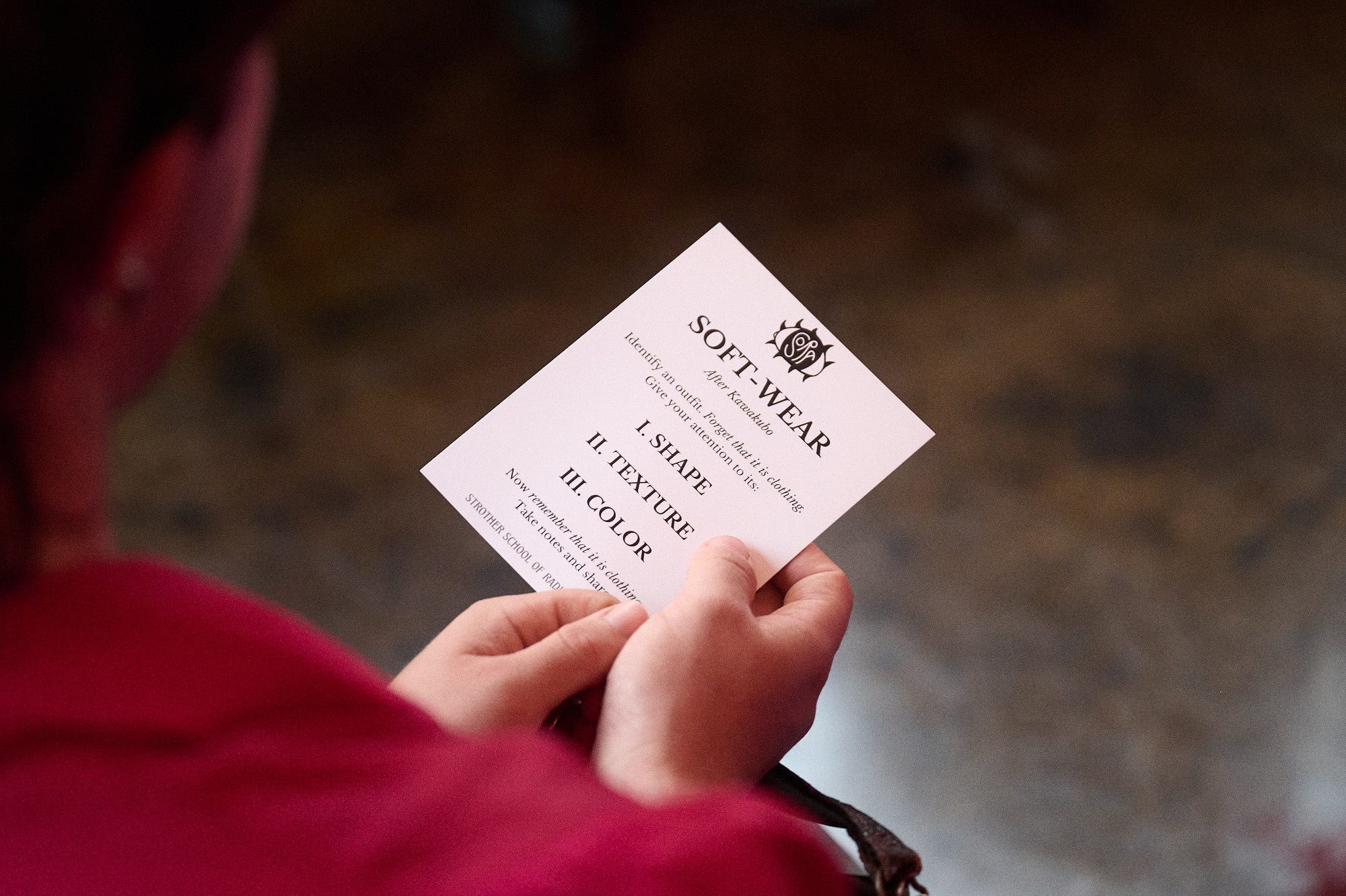
To make clothes you must make… not-clothes? At SoRA’s inaugural EYE-CATCH! fashion show, we took this koan-like instruction to heart. The house was packed, standing room, and a roster of five stylists were on the program. Twenty models would walk, each displaying an outfit designed in response to the aesthetics and/or “counter-aesthetics” of the Attention Economy. The lights dimmed and the room hushed. The swish of waves on sand issued from the speakers.
Our first model walked through the door: tall and elegant, like someone moving through water. All fifty onlookers eyed the sea-net drapings and did our damnedest to forget that this was clothing. It was… what, then? Some combination of shape, texture, and color. A wearable object? An extension of the body? A thesis statement in hemp and tulle?
I, for one, had expected cheering and chatter. But the room was silent, almost solemn in its joint attention. When the final model exited, applause erupted, and DJ Simisola began to spin. Then the discussion began: which look you liked the most, what model (she’s my friend!) surprised us.
After drinks and dancing, people filtered out in twos and threes. The late-summer night was laced with the faintest hint of autumn. We paused at the door to savor the air then dispersed into the city, grateful that the strange objects wrapped about our bodies would shield us from the chill.
— Peter Schmidt
Editor-in-Chief
Stuff for Study: Fashion School
Readings and other resources for continued learning on attention and politics
How textiles repeatedly revolutionized human technology — Virginia Postrel for Aeon
Why are pants so big again? — Jonah Weiner for The New York Times Magazine
The essay to read if you ever think about wearing clothes — Troy Patterson for The New Yorker
Normcore: fashion for those who realize they’re one in seven billion — Fiona Duncan for New York Magazine
What does it mean for fashion to look human? — Vanessa Friedman for The New York Times
— Czarina Ramos
IRL
Wed, October 7: Join our IRL seminar THROUGH THE MICROSCOPE, where we will take a closer look at everyday objects through microscopes and macro lenses to bear witness to a surprisingly structured world only non-humans can ordinarily see. Sign up HERE!
Thu, October 8: In this ATTENTION LAB: WORLDBUILDING, we’ll investigate the worldbuilding powers of human attention. Sign up HERE!
Find more workshops, events, and gatherings HERE!