

Last month, President Trump issued an executive order Prosecuting Burning of the American Flag. It reads:
Our great American Flag is the most sacred and cherished symbol of the United States of America, and of American freedom, identity, and strength. Over nearly two-and-a-half centuries, many thousands of American patriots have fought, bled, and died to keep the Stars and Stripes waving proudly. The American Flag is a special symbol in our national life that should unite and represent all Americans of every background and walk of life. Desecrating it is uniquely offensive and provocative. It is a statement of contempt, hostility, and violence.
As it happens, flag burning is protected by the First Amendment. The legal logic of Trump’s chest-thumping order relies on the sole carveout of this Constitutional protection, a legacy of the landmark case Texas v. Johnson (1989) in which the Supreme Court ruled that an act of flag desecration was not protected if it could be shown to incite violence. The implication in the final line quoted above — that flag burning is intrinsically violent — hints at Trump’s eagerness to interpret this exception as broadly and punitively as possible. (To no one’s surprise, his order takes extra pains to threaten immigrants and foreign nationals with blocked or revoked visas, and even deportation.) Hours after the ink dried on the order, a 54-year-old Army veteran named Jan Carey was arrested for burning an American flag in protest near the White House. Carey was served two federal criminal charges; he has pleaded not guilty to both.
Anyone even modestly familiar with American history will know that Trump’s order and Carey’s response stand in a long line of legal and cultural battles over the sanctity of the Stars and Stripes. Though this fact may seem obvious, it is not unreasonable to wonder at all the fuss over a patch of fabric. Why is the flag such a big deal?
In my eyes, the flag is defined by this “should” — by the gap between what it is and what it ought to be. At times, that gap has seemed so wide that I forgot it could be crossed. I forgot, in other words, that the flag could serve political futures other than the one it’s currently serving.
Trump’s order offers one answer: the flag symbolizes the nation and its most important principles. Because Americans have fought and died under the flag, it is a uniquely sanctified object and any act that desecrates it is “uniquely offensive.” This is standard fare. But let’s pause where Trump’s declarative mode gives way to a more open-ended prescriptiveness: “The American Flag is a special symbol in our national life that should unite and represent all Americans…”
Should unite and represent. Why “should”? That word prompts all kinds of questions. Does the flag not unite and represent all Americans? Why not? Is this a failure of the flag, or of the people to whom it belongs? What is the gap between how things should be and how things are? And who decided that the flag should be uniting and representing in the first place?
I am not accustomed to seeing myself in President Trump’s pronouncements, but I’ll admit that this line occasioned a weird shiver of recognition. In my eyes, the flag is defined by this “should” — by the gap between what it is and what it ought to be. At times, that gap has seemed so wide that I forgot it could be crossed. I forgot, in other words, that the flag could serve political futures other than the one it’s currently serving.
For better or for worse, the future of the United States is going to be imagined and brought to pass in the idiom of the United States, using the symbols and the stories that have been handed to us from a complex past.
This is a shame, but it’s true. During the ten-or-so years during which I became a politically minded person, I have seen enthusiasm for the Stars and Stripes more or less cornered by a vision of the US that I flatly reject: imperialistic, xenophobic, reflexively anti-intellectual, and mired in what looks to me like white supremacist nostalgia. At some point, I concluded that the flag really did stand for that vision of the country, and that the flag was not for me — that I was even, in some vague way, against it. I suspect this story applies to lots of folks of my political bent, especially the ones my age. At some of the parties I go to in Brooklyn, it is not exactly cool to wear an American flag pin on your shirt. You are going to get some uneasy looks.
Here’s the problem: that vision, the one I reject, appears increasingly cozy in the seat of power, and its claim to the flag seems increasingly secure. What’s even harder to stomach is that my irreverence has played into that fact, since accepting as inevitable that the flag represents a political project I can’t abide is nothing less than an act of surrender. For better or for worse, the future of the United States is going to be imagined and brought to pass in the idiom of the United States, using the symbols and the stories that have been handed to us from a complex past. By rejecting these symbols, I excuse myself from the conversation. By neglecting to insist upon a vision of the country that I can love, I’ve forfeited any claim to its future.
The solution is not to create new symbols; it’s a willingness to imagine our old symbols anew. That means reimagining how those symbols work — how they convey meaning, and how we stake a claim to that meaning. To create a livable future without abandoning our past, we need to rethink what the flag is for.
Let’s start with flags in general, and with their more straightforward functions as an attentional signal par excellence: for centuries, they have served as a signaling technology on the battlefield, or at sea. In the chaos of war, before militaries put eyes in the sky, flying standards were a way of marking territory and orienting soldiers across contested terrain. On the open ocean, yellow flags came to signal quarantined passengers, and white flags came to signal a truce. In 1857, the British Commercial Code of Signals became the first internationally adapted flag alphabet, with a set of 18 pennants that combined to express over 70,000 symbols — a sophisticated system of attentional semiotics that is still in use today. This kind of flag is useful precisely to the extent that it is unambiguous; you do not want to end up on the wrong side of a trench war, or to confuse an onboard smallpox outbreak with an invitation to parlay. Clarity is king.
National flags work differently: their function arises from a sort of charismatic ambiguity. When the point is to bring people together, the most powerful flag is the one that can rally the most people. This requires a meaning so diffuse it is effectively in the eye of the beholder. Or, even better, in the “I” of the beholder — since the best way to rally someone around a flag is to claim that it represents them.
Historian George L. Mosse tells the story of how this distinctly modern behavior emerged. By his account, the rise of the nation-state replaced the will of the king with the “general will” of the people. The novel notion of popular sovereignty became the object of the “secular religion” of nationalism — in which the people of a nation worshiped themselves.
Mosse is a historian of Germany (and a refugee of the Nazi regime) whose work traces the rise of the nationalist energies that culminated in the Third Reich. He argues that the rise of fascism can be understood as the rise of a new “political style” that drew upon myths and symbols to enchant and unite a fragmented nation. “Symbols were visible, concrete objectifications of the myths in which people could participate,” he writes, and fascism was “a theology which provided the framework for national worship.” A brief tour through Nazi rally footage will show how important a role flags played in these theatrics, and how intoxicating the overall effect seemed to be. We know the dangers, too.
A symbol may supposedly represent the will of the people, but that’s no guarantee that the people will be interested in it. For nearly a century following the conception of the United States, the American flag was the object of remarkably little attention, much less devotion. In fact, few could agree on what, exactly, the flag was supposed to look like: how many stripes, with what colors, in what configuration. (In 1847, a representative of the Dutch government reportedly inquired, “What is the American flag?”) Before the Civil War you were unlikely to find a flag displayed in a state or local government building, and you wouldn’t find one in a private home. From its adoption in 1777, a full sixty-three years passed before the flag appeared in a presidential campaign (William Henry Harrison’s), and seventy-seven years passed before it was used as dissent (by Boston Abolitions, who flew it upside down to protest the Fugitive Slave Act).
It was only in 1861, when Confederate troops fired on the flag-bedecked Fort Sumter, that Americans (the unionist ones, at least) rushed to fly it from their windows. “When the stars and stripes went down at Sumter, they went up in every town and county in the loyal states” and developed a “new and strange significance,” writes historian George Preble. Curiously, the symbol of American unity went mainstream on the occasion of the country tearing itself apart.
The decades following the Civil War saw the rise of a flag protection movement (FPM) whose members exhibited a nationalist zeal of near-theological intensity. In the words of pamphleteer and FPM leader Charles Kingsbury Miller, the United States “must develop, define and protect the cult of her flag, and the symbol of that cult — the Star Spangled Banner — must be kept inviolate as are the emblems of all religions.” This movement, mostly composed of union veterans and patriotic-hereditary organizations like the Sons and Daughter of the American Revolution, went about pushing anti-desecration laws in every state of the war-weary union. The legal battles they set in motion persist today at the gates of the White House.
It’s little surprise that a flag whose supposed sacredness came from its ability to represent “true” Americans would fly over a blatantly nativist project: in 1890, an FPM leader urged flag rituals in schools as a way to resist the “evils and dangers” posed by the “human scum cast on our shores by the tidal wave of a vast immigration.” By Miller’s complaint: “We observe our flag no longer protected by the sentiment of a century ago, but treated with open disrespect… [by] the multitude of uneducated foreigners who land on our friendly shores.” Trump was hardly the first to use the flagpole as a nativist cudgel.
And then there was the Ku Klux Klan. In August of 1925, forty thousand Klansmen hoisted the red, white, and blue aloft as they processed down Pennsylvania Avenue in Washington, D.C. This sort of spectacle is hard to unsee.
What the flag demands is that we rise above the weight of our past and the tug of contrary evidence and insist on its meaning.
It’s striking, then, to heed how proudly civil rights activists displayed the flag in their March on Washington thirty-eight years later. As Rev. Dr. Martin Luther King claimed to make good on the “promissory note” of the nation’s founders, one could suppose that the uncashed check was fluttering, right there, between some 250,000 human bodies and a sweltering March sky.
This was, to put it mildly, an unreasonable claim on the symbol. There’s little doubt that, at that time, the flag had a deeper history as a symbol for white supremacist ends than it did as a symbol of racial plurality. As Frederick Douglass noted in his famous July 4th address, the power of slaveholders “is co-extensive with the star-spangled banner.” But Douglass knew (or else he would not have bothered with his address) that symbols like the flag are not about reason. King and the marchers understood that they were flying in the face of history; that was precisely the point. Their example has plenty to teach us.
What the flag demands is that we rise above the weight of our past and the tug of contrary evidence and insist on its meaning. This is a creative act. There’s a reason we call the US a national project; everybody gets to say what the symbol of America means, and then to make it so. Theorists of democracy have long observed the funny paradox that plurality produces unity: if you and I have different ideas about what the flag stands for, then we have different ideas. But we have the same flag.
The trick is to see the flag just right: as an object with a history to be weighed, a power to be tempered, and a future to be determined.
The shortcomings of the interpretive approach are especially evident on the political Left. In 2024, the Guardian ran an essay by Derecka Purnell criticizing Beyoncé’s deployment of the flag in her Cowboy Carter country album, arguing that the artist’s “pride in the flag is misplaced.” Purnell details the long abuses inflicted on Black Americans, sometimes in the name of the flag itself. She is right on all counts, except for the assumption that the flag is identical to those abuses. Symbols are meant to be reclaimed and reappropriated. They will always have a history, but we can decide that they have a future, too. The first step toward making a symbol (indeed, a country) belong to you is by insisting that it does. To conflate a symbol with its past is to entomb it – and as Beyoncé demonstrates, flags are meant to fly.
This requires care. On one hand, we look at the flag and see only its brutal history. On the other, we look at the flag and see nothing at all. Michael Billig, an academic, argues that the function of the American flag is to be so common as to become invisible. The real sign of national power is not a passionately waved banner, he argues, but one that hangs, unnoticed, above a post office. Placing flags everywhere – what he calls “flagging the homeland” – is a strategy by which established states like the US assert a “banal nationalism” that hides in plain sight. Once we stop seeing the Stars and Stripes, they become unquestionable, and the state power that they represent appears inevitable. Beware the extremes: whether we worship the flag (in Mosse’s account) or ignore it (Billig’s), the perils of nationalism are never far off.
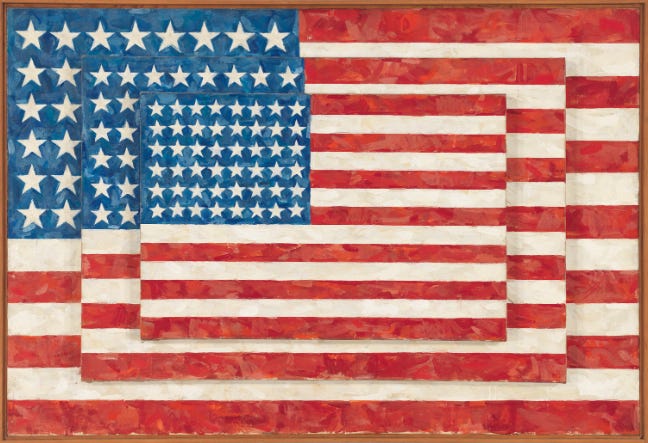
The trick is to see the flag just right: as an object with a history to be weighed, a power to be tempered, and a future to be determined. Artists can help us in this respect: the paintings of Jasper Johns and David Hammons and the performances of Beyoncé or Kendrick Lamar insist upon the flag as an object of close attention. Johns calls attention to the flag’s formal contradictions (as both image and object) while Beyoncé and Lamar make claims to the flag in the name of Black Americans; Hammons does both. These works model how to suspend certainty and inhabit the gap between what the flag is and what it could be. To see the should not as a failure but as an invitation. To accept the terrain of contestation that opens up, and to understand that terrain as a kind of homeland – possibly one worth loving. This is a useful way to think about a symbol. For that matter, it’s not a bad way to think about a country.
Peter Schmidt is the Program Director at the Strother School of Radical Attention in Brooklyn and the editor-in-chief of the Empty Cup.
I appreciate the reminder that meaning is a creative act.