

Friends!
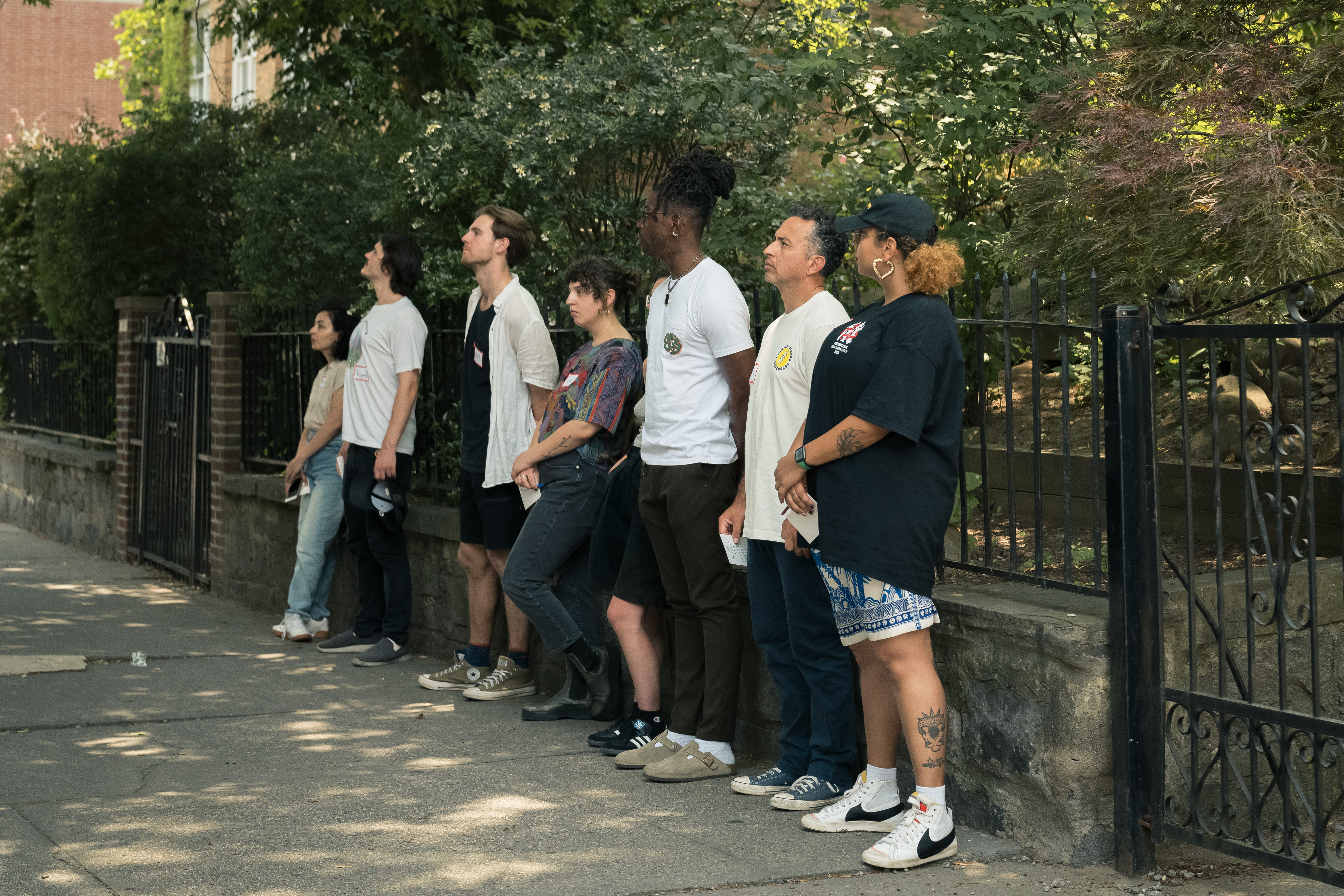
On a sunny Saturday this past August, twenty-or-so friends of SoRA gathered near our Dumbo headquarters with shoes tightly laced and backpacks full of snacks. We were to walk over the Brooklyn Bridge, through the heart of Manhattan, all the way to Fort Tryon Park at the island's northern tip – a distance of some thirteen miles. Our goal? To explore the embodied nature of thinking, to theorize and practice modes of collective study that take place on the move, and to consider the role of walking & thinking, together, in Attention Activism.
We set out in the company of several footloose thinkers: Rebecca Solnit, James Baldwin, Guy Debord, and Virginia Woolf. Over the course of eight or so hours, we read excerpts from their writing and tested their ideas out on the street. Can one suspend one's ordinary relations (as Debord advises) while forging north through Flatiron? How do the flashing screens and bollards and throngs of Times Square mechanize (in Solnit's terms) our movement – and everything else? Eight and a half hours later, we arrived, footsore but deeply moved, at the Cloisters Lawn, high above the streets of Inwood. Despite aching legs, several participants, flush with the gravity of our pilgrimage, imagined repeating the journey. Walking leads to walking; thinking begets further thinking.
In this Empty Cup, we think about walking as perhaps the oldest practice of attention. In Visions of Attention, Haena ponders the paradox of the kora, the Nepalese Buddhist practice of circumambulation. David surfaces From the Trove two key thinkers who discern the transformative powers of mere mobility: Guy Debord and Michel de Certeau. And in Stuff for Study, Vitória shares essays on retracing grief, mobility justice, and the wanderings of Simone de Beauvoir.
Attention Activism is a movement. We mean this in literal terms. So walk with us – or roll, or pedal along. And if you're in Brooklyn, join us for an upcoming seminar on BIRDSONG or THE SCIENCE OF LAUGHTER. What's that old proverb? We go fast alone and far together. But if we take walking to be an end in itself, there's no fuss about fast nor far: on the move, we're already here.
Ramblingly yours,
Peter Schmidt
Editor-in-Chief
Visions of Attention
An archive of images and mini-essays on the myriad modes of attention
Circling Back
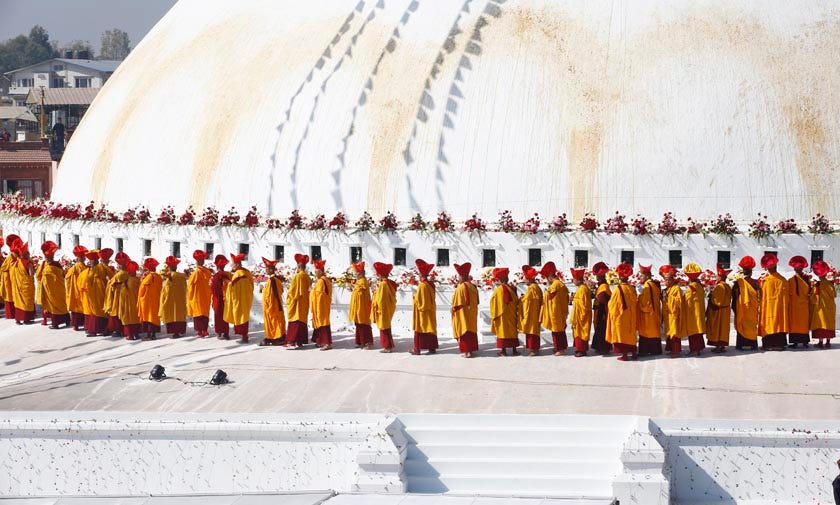
Does repetition sharpen or dull our attention? Circumambulation, called kora (བསྐོར་བ།) in Tibetan and practiced by Buddhists across wider regions of East and Central Asia, is an old practice of circling a stupa or sacred object. Outside observers may ask: if the goal of Buddhism is to escape the karmic cycle (known as samsara), why would believers choose to reenact this cyclical repetition?

To ponder this without taking to circumambulation yourself, walk with the reptiles in the hypnotic engravings of M.C. Escher. You might find discrete objects in your surroundings disappearing from the scope of your attention through repeated exposure. But this same repetition can also allow for something entirely new to emerge — like a phrase that grows strange because you’ve said it too many times, or the wooden grain on your elementary school desk that gradually reveals the likeness of trees and creatures. In these moments, the unexpected erupts from our usual framework of perception, transfigured like Escher's reptiles from ink to flesh and blood. The familiar discloses the new; the ordinary becomes a portal to the extraordinary. Perhaps therein is an explanation for the puzzle of kora: that a purposeful, endless circling permits one's attention to be still, and to rise above the dizzying loops of daily life.
- Haena Chu
From the Trove
Long-form recommendations from the Friends of Attention’s collaborative Attention Trove archive
Wherever You Walk, There You Are
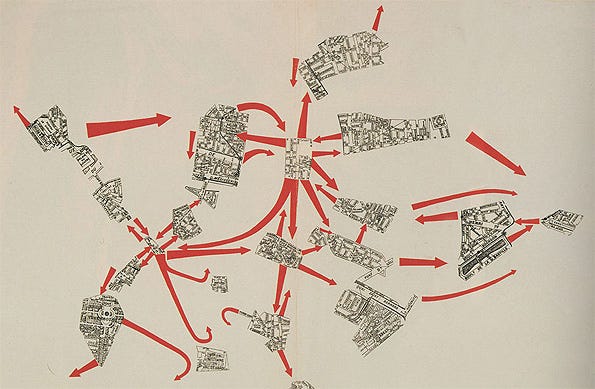
Walking has long been an attentional practice, from the peripatetic philosophers to Buddhistic slow walking, catwalks and holy pilgrimage. Two famous texts are used by SoRA in our wandering, footloose studies. Guy Debord’s Theory of the Dérive (1956) and Michel de Certeau’s Walking the City (1984) offer attentional techniques to disautomate walking, suspend familiar relationships, and create new possibilities for everyday life. Debord proposes drifting away from established patterns and surrendering, instead, to zones of affective allure as a way of mapping the psychogeography of urban space. De Certeau recommends walking with tactical maneuvers that resist the imposed logic of city planning. Walking “enunciates” the “language” of city infrastructure, and walking creatively re-deploys that language — a spatial detourn-of-phrase, if you like.
- David Landes
Stuff for Study: Walking & Thinking
Readings and other resources for continued learning on attention and politics
We walk in the city because we don't want to forget — Garnette Cadogan for Literary Hub
The walking body for the thinking mind — Ferris Jabr for The New Yorker
Crossing passages through our grief — Kristin Dombek for n+1
Americans are losing the right to walk — Antonia Malchik for Aeon
To know New York City's inner life, you must walk — Teju Cole for Aeon
Walking the path of Simone de Beauvoir — Alice Kaplan for The Paris Review
- Vitòria Oliveira
IRL
Tue, Sept 23rd: in our IRL seminar on BIRDSONG, we'll attune our senses to birds — not as objects of study, but as guides in the practice of attention. Led by poet and science educator Melody Serra.
Sat, Sept 27th: ATTENTION LAB: SANCTUARY is an experiential, participatory workshop dedicated to the joint exploration of radical human attention with a focus on SANCTUARY's role in Attention Activism.
Wed, Oct 1st: in our IRL seminar on THE SCIENCE OF LAUGHTER, we'll attend to the peculiar yet overlooked behavior of laughter — and what it reveals about our shared lives. Led by Prof. Maia Pujara of Sarah Lawrence College.
Find more workshops, events, and gatherings here!