

Friends!
If we know anything about life these days, it’s that one can know just about anything at all. Need to check the stats of your recent run? Surely you’d like to know the PR of everyone who has ever taken that exact route. Maybe you’d like to buy a toaster – here are fifty different articles reviewing every make and model for sale at the big box stores. Want to stay updated on current events? Great! Please see the top five ongoing threats to democracy as of this Tuesday.
Information is everywhere, and its propagation has never been more frictionless. Having easy access to social networks with billions of users means you don’t have to check a media outlet for the news: your Aunt Mary, your old Bumble date, or X user @someonlineperson has already reshared the story (regardless of its veracity). As articles circulate, they become reduced to headlines, soundbites, or other TLDR forms of their former informational units. This compression makes messages easier to consume, though it tends to compromise the source material’s complexity and richness, and can even change the meaning of the message itself.
We’re living in the Age of Information – but it’s hard to say whether we are better informed. How can we have too much information and also not enough? In the blast of the proverbial firehose, why are we still thirsty?
This issue of the Empty Cup is a study of information: its generation, consumption, propagation, and influence on our behaviors. In Visions of Attention, Haena listens to Metastasis, Iannis Xenakis’s mystifying microtonal composition. From the Trove, David surfaces Richard Lanham’s The Economics of Attention: Style and Substance in the Age of Information, which examines the paradoxical relationship between non-material information and material commodities (style and substance, respectively). And in Stuff for Study, I’ve shared an analysis of W.G. Sebald’s subversion of historical archives, and the story of our “searchable” Internet.
What does all that information mean once it’s converted from 1’s and 0’s back into… well, real life? Find out by joining us in our Brooklyn Sanctuary, where we’re hosting an upcoming three-week seminar on the SCIENCE of LAUGHTER with Sarah Lawrence College Professor of Psychology Maia Pujara.
Informedly yours,
Czarina Ramos
Managing Editor
Visions of Attention
An archive of images and mini-essays on the myriad modes of attention
Beyond Stability
If you have an audiophile in your life, you may have been subjected to a rant (or several) about how digital formats “flatten sound.” Your beloved sound snob is not wrong — the palpable warmth of analog sounds arises from the inclusion of “noise” in the auditory profile of the music — meaning it is transmitting more sounds than what we would identify as strictly the music itself.
Long before record collectors were agents of cultural nostalgia, composers like Iannis Xenakis were experimenting with sounds beyond and in between notes. In the pictured Metastasis (1953–54), which translates from the Greek as “after or beyond stability,” Xenakis’ graphical composition takes lines instead of points (notes) as its basic notational elements, charting the distance between notes (intervals) with pitch on the y axis and time on the x axis. Motion occurs not between serial notes, but in degrees of density, mass, and rate of change.

Using glissandos (a technique of gliding from one note to the other) for each of more than sixty parts of the orchestra, Xenakis brings attention to the microtones between conventional notes and gestures to music’s cross-pollination with architecture, math, and sonic experiences outside the category of “music.” Within this single piece, he referenced the Einsteinian theory of relative time, Le Corbusier’s architectural theory that motivated Xenakis to translate the experience of seeing a building from different angles into music, and his own wartime experience of the emergent “sound-mass” of gunfire, in which the auditory effect exceeded the sum of any individual detonation. Metastasis was the basis for the Philips Pavillion, constructed by Le Corbusier entirely from parabolic surfaces.
Too much information? The key to sitting with Metastasis is to let raw experience well up, slosh back and forth, and overflow the boundaries of what you call music. But is it music? Or noise? Or information? These categories are useful. But as Xenakis shows us, it’s in the infinite gradations between them that the magic of mystification happens.
- Haena Chu
From the Trove
Long-form recommendations from the Friends of Attention’s collaborative Attention Trove archive
Stuff/Non-Stuff

The information abundance of the past few decades has transformed our attention, especially in the case of how we navigate info-rich spaces. Richard Lanham’s The Economics of Attention: Style and Substance in the Age of Information illuminates how pervasively many domains of life shape themselves to prevailing dynamics of attentional value. With examples from Antiques Roadshow, naturalist observation, organizational management, and tourism, Lanham discerns a paradoxical relation between “stuff and nonstuff,” where “nonstuff” like information and attention co-operate with “stuff” like commodities and physical resources. One result: style predominates over substance. Style and appeal become critical in creating salience, helping information that would be otherwise buried in abundance or abandoned for easy alternatives. Updating Lanham’s thesis closer to our present time, Anna Kornbluh’s Immediacy, or The Style of Too Late Capitalism continues charting this attentional stylistic, where instantaneity, transparency, and immersion are the chief values serving economic imperatives to intensify circulation.
- David Landes
Stuff for Study: the Age of Information
Readings and other resources for continued learning on attention and politics
W.G. Sebald and the manipulation of the archive — Colin Dickey for Real Life
The “little data” of our human experience — New Cartographies by Nicholas Carr on Substack
How a weekend gathering birthed the searchable internet — Monica Westin for Aeon
Are we living in the Age of “Info-determinism”? — Joshua Rothman for The New Yorker
Rediscovering mystery when everything is information — Karl Ove Knausgaard for Harper’s Magazine
The digital age has brought us the age of the paper shredder — D. Graham Burnett and Sal Randolph for Cabinet
- Czarina Ramos
IRL
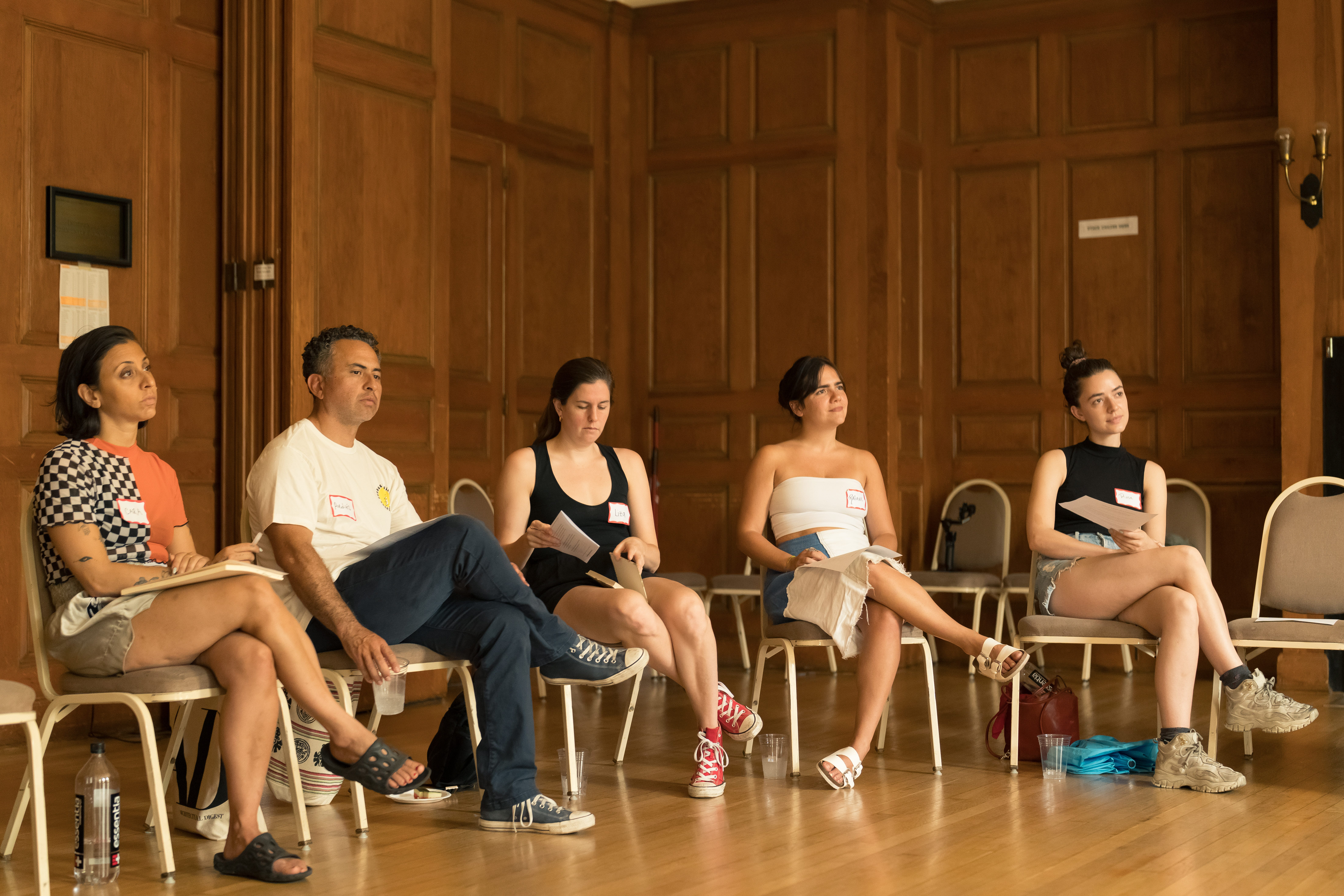
Wed, October 1st: in our IRL seminar on THE SCIENCE OF LAUGHTER, we’ll attend to the peculiar yet overlooked behavior of laughter — and what it reveals about our shared lives. Led by Prof. Maia Pujara of Sarah Lawrence College.
Mon, October 6th: ATTENTION LAB: TRAIN-the-TRAINER, our workshop to introduce friends of SoRA to the fundamentals of facilitating for Attention Activism. We’ll share tips, techniques, and resources for folks to lead practices of attention in their own communities and classrooms.
Tue, October 7th: ATTENTION LAB: COALITION is an experiential, participatory workshop dedicated to the joint exploration of radical human attention with a focus on COALITION’s role in Attention Activism.
Thu, October 16th: in our ONLINE ATTENTION ACTIVISM 101 seminar, we’ll study the intellectual and practical foundations of the Attention Activism movement.
Find more workshops, events, and gatherings here!