

A woman in a Knicks jersey climbs a traffic signal to twerk for a sea of iPhones. Sweat-slicked bodies pummel each other on the south lawn of the White House. And in Tompkins Square Park, Lord Byron dons fishnets while narrating the story of the 19th-century Luddite movement. Between Knicks madness, the Summer of Ludd, America’s 250th anniversary celebrations, and a World Cup on home turf, festivals dominated this past summer and filled it with strange rituals. We wore costumes. We sang songs. If you’re like me, you sported the same tattered orange socks every time your team played.
The festival is not a place, though it may take place at a fairground or stadium. It’s a way of experiencing time, a discrete break or ritual, often one that recurs, leaving us wanting more even as we await its return — in the next season, year, lunar eclipse. This is what Michel Foucault had in mind when he claimed festivals present time in “its most fleeting, transitory, precarious aspect.”
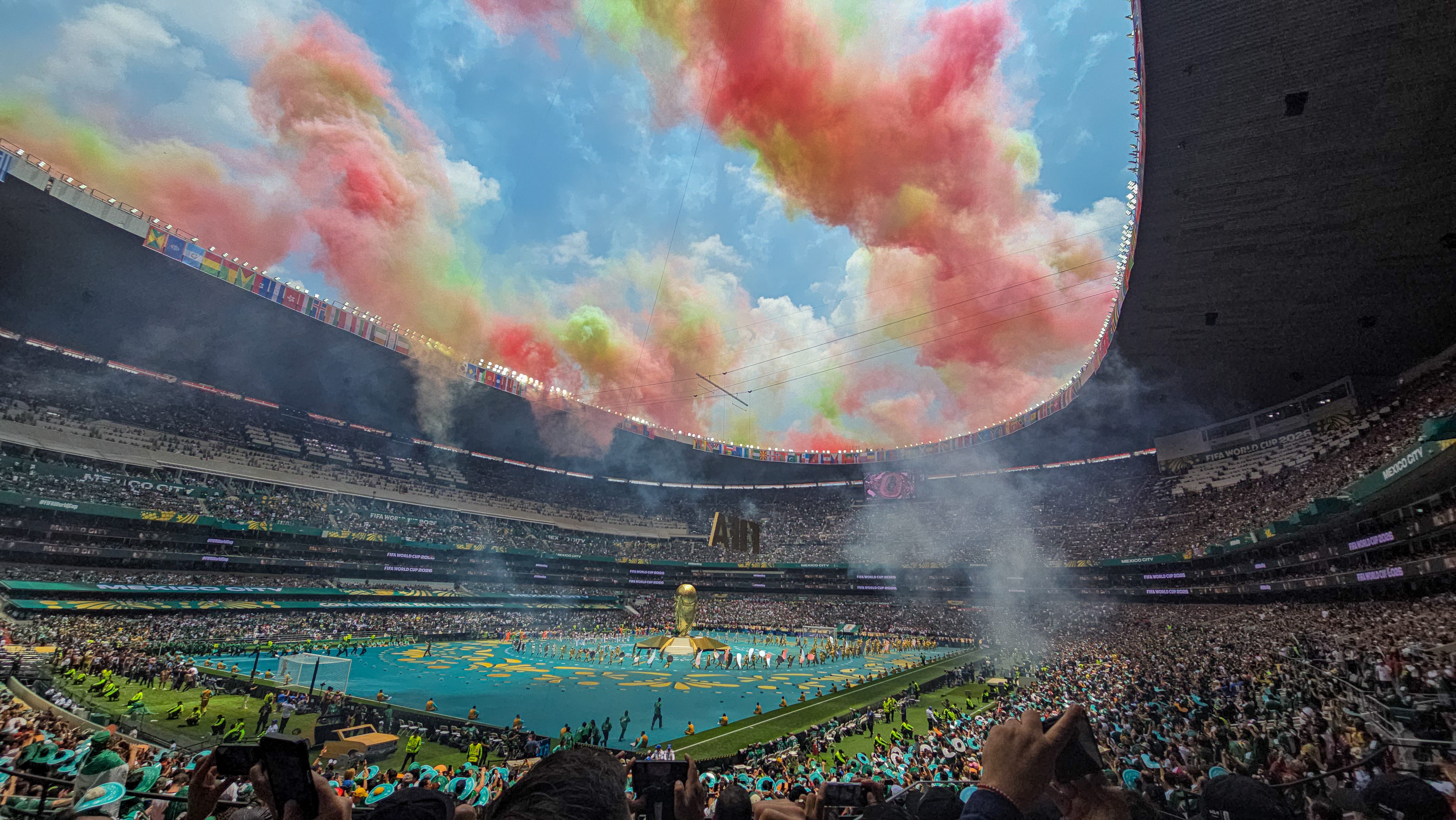
By renewing our sense of temporal brevity, festivals rescue us from what the critic Jonathan Crary has called life “beyond clock time.” In his 2013 book 24/7: Late Capitalism and the Ends of Sleep, Crary argues that the incursion of tech platforms into our most private moments has transformed “human life into duration without breaks” and destabilized boundaries between sleep and wakefulness, work and leisure. Since Crary identified this phenomenon, a buffet of products and hacks has emerged, promising to help us sleep better, scroll less and reclaim our time. But these are shallow fixes. If this past summer is any indication, it’s shared, in-person experiences that people seek out as an escape from our endless screen-lit present. Festivals allow us to experience the uncommodifiable time that Crary associates with sleep, and to do it in the company of fellow revelers. Recall that the word “rave” derives from the Old French resver, one meaning of which is to dream.
Social events, however, require social infrastructure. The party needs a host, the wedding reception an emcee. The complex logistics and high overhead of festivals have given institutions a privileged position as “festival keepers.” Many of these festival keepers are for-profit entities, concerned with commodifying such events and cashing in on our desire for festive time. When festival hosts include institutions as notoriously corrupt as FIFA and the Trump Administration, our task as participants becomes one of rescue and recovery. How can we liberate festival time from its corrupt container? One response is to boycott. When my gaze generates profit, and profit normalizes institutions, turning off the TV can seem like a moral imperative. But in the long view, there's more to be gained from using these gatherings to subversive ends. By choreographing the attention of millions of viewers, festivals offer attention activists extraordinary opportunities to create experiences of time that resist commodification.
When festival hosts include institutions as notoriously corrupt as FIFA and the Trump Administration, our task as participants becomes one of rescue and recovery.
Theorists call the act of interrogating a system or institution using its own standards “immanent critique.” The art critic Hal Foster likens it to a “biting from the inside,” in which an art object emulates its subject’s flawed logic in order to expose its excesses and abuses. This critique does not attempt, per Audre Lorde’s famous formulation, to dismantle the “master’s house” with the “master’s tools.” Instead, it embodies and exaggerates the content of its critique, fashioning itself after the gaudy excesses of the master’s house — from its faux-Venetian drapes to its crumbling cupid fountain. Foster termed this move, in the context of Dadaism, “mimetic exacerbation:” to critique the mega-mansion, build a mega-mega-mega mansion.
During the World Cup, we saw a version of this technique exhibited by Michel Kuka Mboladinga, a Congolese football fan and performance artist who has staged pitch-side demonstrations for years. He was a fixture at the Democratic Republic of the Congo’s World Cup matches this summer. Standing motionless for all ninety minutes of the game in brightly colored suits, Mboladinga created a living tribute to Patrice Lumumba, the DRC’s first prime minister, who was assassinated by Belgian-led forces in 1961 and whom Malcom X once called “the greatest Black man who ever walked the African continent.” (His stance resembles a famous statue of Lumumba in Kinshasa, the DRC’s capital). Coverage of Mboladinga’s performance has seldom moved beyond some version of “fan shows colonialism isn’t dead.” Fair. But Mboladinga deserves more credit. His tribute is a cleverly disguised critique of the festival, posed from inside its container, reminding us of the ghosts that haunt spectacles of one-world unity like the World Cup.
Mboladinga’s medium is his message. By reading his performance solely as a generalized nod to history, we overlook how it temporally plays with the event, interpolating a form of non-commodified time — he stands still, he does nothing — into a space defined by commercial encroachment.
We also risk forgetting that Mboladinga’s critique comes at a time when “time” at the World Cup is up for grabs. Under normal conditions, the clock of a soccer game only stops at halftime. Out of bounds, fouls, and injuries are tacked to the end of halves as extra time. The resultant effect is one of inertia, of time’s refusal to pause or submit to human manipulation. Hence the controversy over FIFA’s 2026 policy, mandating a three-minute “hydration break” during each half. These stoppages of play have brought the game closer to the four-quarter structure of basketball or football and opened up more space for broadcasters to ply viewers with advertisements. Moreover, review by video assistant referee (VAR) has made it possible to freeze any moment in a game for scrutiny. The illusion of the running clock remains intact. But the temporality of today’s game is more fragmented than ever before, and increasingly suffused with the relentless techno-logics of 24/7 capitalism.
As we look to recover festival time from the institutions seeking to control it, I suggest we take Mboladinga as our model. His immanent critique reminds us why we value this precarious, elusive experience of time, and how we can use even corrupt containers for higher ends. When the opportunity arises to subvert the commodified festival, one must seize it. Bite from the inside, tear a hole in time, see what emerges from the gash.
Nick Manetas is a student at Princeton University who writes about art, education, and artificial intelligence.
I really loved this essay, Nick! Festival time/festive time will now be in heavy rotation in the group chat.