

How do you imagine the route between, say, a friend’s apartment and your favorite park?
Is it a single, fixed path? Does it change from day to day? Do you picture it from a bird’s eye view? Is it oriented with north at the top?
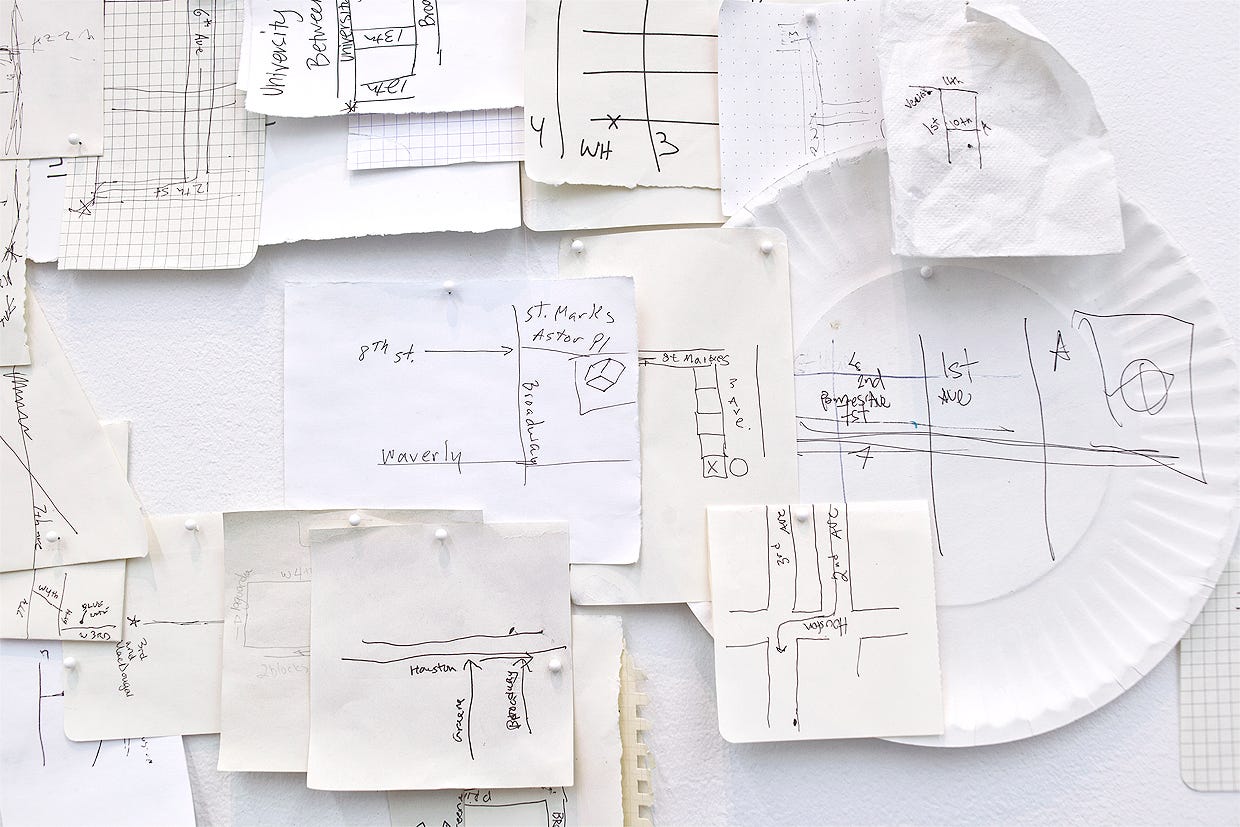
Artist Nobuta Aozaki explored this question in his performance piece From Here to There (2012 - 2014). He asked strangers for directions — “How do I get to Astor Place from here?” — and collected their sketches on scraps of paper, receipts, and napkins. He then stitched this collection into a composite map: a patchwork journey from Wall Street, to Alphabet City, to Central Park, to Washington Heights, drawn entirely through other people’s eyes. The resulting route is a long and meandering city re-imagined through hundreds of hands. Streets were bent and warped — not a display of a failed or erroneous geography, but of personal geographies, shaped by everyday experience. Every sketch was a small act of generosity. Someone paused in their day, thought about where they were, and translated that knowledge into a line. Aozaki mapped connection and relation to reveal that finding your way takes more than knowing the coordinates of your destination. Moving through space, in other words, isn’t just about space: it’s also about who helps you move through it, and what they point out as they bring you along.
The idea that mapping begins with attention has always been core to my creative practice. Cartography isn’t just about precision, but also about curation and composition and subjectivity: each of these choices are deliberate, not neutral. To attend differently is to orient differently to the world.
Moving through space, in other words, isn’t just about space: it’s also about who helps you move through it, and what they point out as they bring you along.
The maps we are familiar with today are oriented north-up, a convention borne from histories of Eurocentric navigation and colonial expansion. But this convention is relatively recent, and variations in the way we orient our maps have subtle but significant psychological and political implications. The global north developed a visual hierarchy and disguised it as a cartographic norm. Many maps, including millennia worth of indigenous and non-western cartography, orient maps downstream of river paths, communicating how communities document their knowledge and relationships. Urban pedestrian maps may be oriented “heads-up” so that the direction you’re facing in real life maps to the top of the sign, improving usability rather than enforcing cartographic convention. Reorienting our maps can reveal new relationships. These choices are philosophical: they tell us which way is “forward.” Orientation is a quiet but decisive act of storytelling.
Research shows that when we construct cognitive maps, we tend not to place north at the top of our visualizations. In one study participants navigating a campus environment oriented themselves relative to the road grid, not true cardinal north. When a map is oriented to show your path toward your favourite park rather than true north, it’s a map of your lived knowledge, just like the maps that Aozaki quilted into a larger cartographic consciousness.
Maps like to promise objectivity: they flatten our world to a threshold of “agreed upon” truths. But they hardly match the embodied knowledge we carry when navigating familiarity and unfamiliarity. Cartography, at its best, and when done with others, as in Aozaki’s participatory artwork, reminds us that mapping is relational; that relation and attention determine what direction we orient as forward. Forget latitude and longitude: let the persons and places that sustain you be your North Star and let attention be your compass.
Queenie Wu is a creative technologist & educator using cartography to playfully interrogate spatial data, and how they inform our relationships and memories of shared surroundings. Equipped with the medium of maps as a research process, she grows her practice as a current Steve Jobs Archive fellow, past member of NEW INC, and soon IMA Low-Residency grad at NYU.