


GREEN light filled the harbor and intensified with the opening chords of a song sounding from Sydney’s Opera House steps.
I stood with a couple of colleagues from Appstinence, an advocacy group that helps communities quit technologies designed to be addictive. We visited Sydney the week that Australia’s new social media age restriction went into effect and met with civil society organizers, government staffers, and youth founders. On December 10th, we were invited to a celebration with some of the advocates who helped push the policy through. This group was composed mostly of parents, some of whom lost children to online harms, and others who have worked to raise their children away from attention-fracking products.
“Free concert,” mused one of the fathers. Turning to us Americans, he explained, “This guy is an Australian rock legend.”
It was 8 p.m. The celebration of the new law had begun right on time. A message was projected onto both bases of the bridge:
“LET THEM BE KIDS”
As a light, springtime rain fell, I observed the children standing beside us: five siblings from elementary school-age to sixteen, all being raised without smartphones. Then I drifted back to my colleagues. One of them was teary eyed, and the other leaned over the barricade, looking pensive. I let my mind wander, too, to my teenage self, to my friends, what we didn’t know as we bounced between screens, to the skills we missed out on and the discontent we grew into. Then back to where we are now — off all social media, and more peaceful at present, but certainly still carrying the weight of my digital adolescence.
A better path stood before us. Those five little ones, now huddled closely in a circle, prefigured a different kind of upbringing that had, with this win, become far more attainable — at least for a few million young Australians.
EVERY day for a week on that trip, my two colleagues and I stopped locals in public space to ask their thoughts on the new Online Safety Amendment. This groundbreaking law, which went into effect on December 10th, prohibits minors under 16 from owning accounts on major social media platforms.
We questioned Aussies of all ages about this policy, which is the first of its kind in the world. When primed to think about the law itself, some locals questioned the efficacy or flagged certain details; their minor misgivings have been covered pretty extensively in the press to date. But that’s far from the full story.
The ban came up in conversation with an Uber driver early on in our trip. At the first mention of the law, our car was filled with an uncertain silence before we explained that we were in support of the legislation. He sighed and said, “Oh, good. Me too. I was scared to say it first.” He continued, “I’m glad that they’re doing this.”
Over the next few days, it became clear that this was a common sentiment. Despite the media’s critical coverage so far, we kept seeing expressions of pride — pride for their country’s status as the first to make such a bold move against social media companies. We saw cautious optimism, too: that plenty of kids will actually wait until later to create accounts, and that many may decide against it altogether by the time they’re of age.
Naturally, our discussions covered people’s personal relationships to apps like Instagram, TikTok, and Snapchat. Having spoken to at least a hundred strangers, I saw a common thread. Like in the States, Sydney’s young people and parents are weary of attention-stealing feeds, and they’re concerned about emerging tech like AI chatbots. We met high school and college-aged Aussies who’ve already quit Instagram, Twitter, and TikTok, for all sorts of reasons. A woman in her early 20s shared that she was groomed as a minor; a 17-year-old boy just “didn’t like what the apps were doing” to his brain.
We met far more who hadn’t quite pulled the trigger, but wanted to — like a young schoolteacher who had just moved to the city from Italy; she stayed on Instagram begrudgingly to find events, but she questioned whether the few she found justified the use. Still, people like her were eager for a world where they didn’t need to rely on “enshittified” networks to make plans with friends or flirt with each other. I’m 25 myself, and I know that many in our generation wish some platforms never existed in the first place.
Over the course of the trip, I came to understand the ban in a new light: above all, it is an emphatic stance against products designed to exploit users for profit. Having such an explicit societal standard can motivate further forms of activism: lawsuits, sure, but also collective agreements about the proper use of tech, and new forms of social togetherness as well.
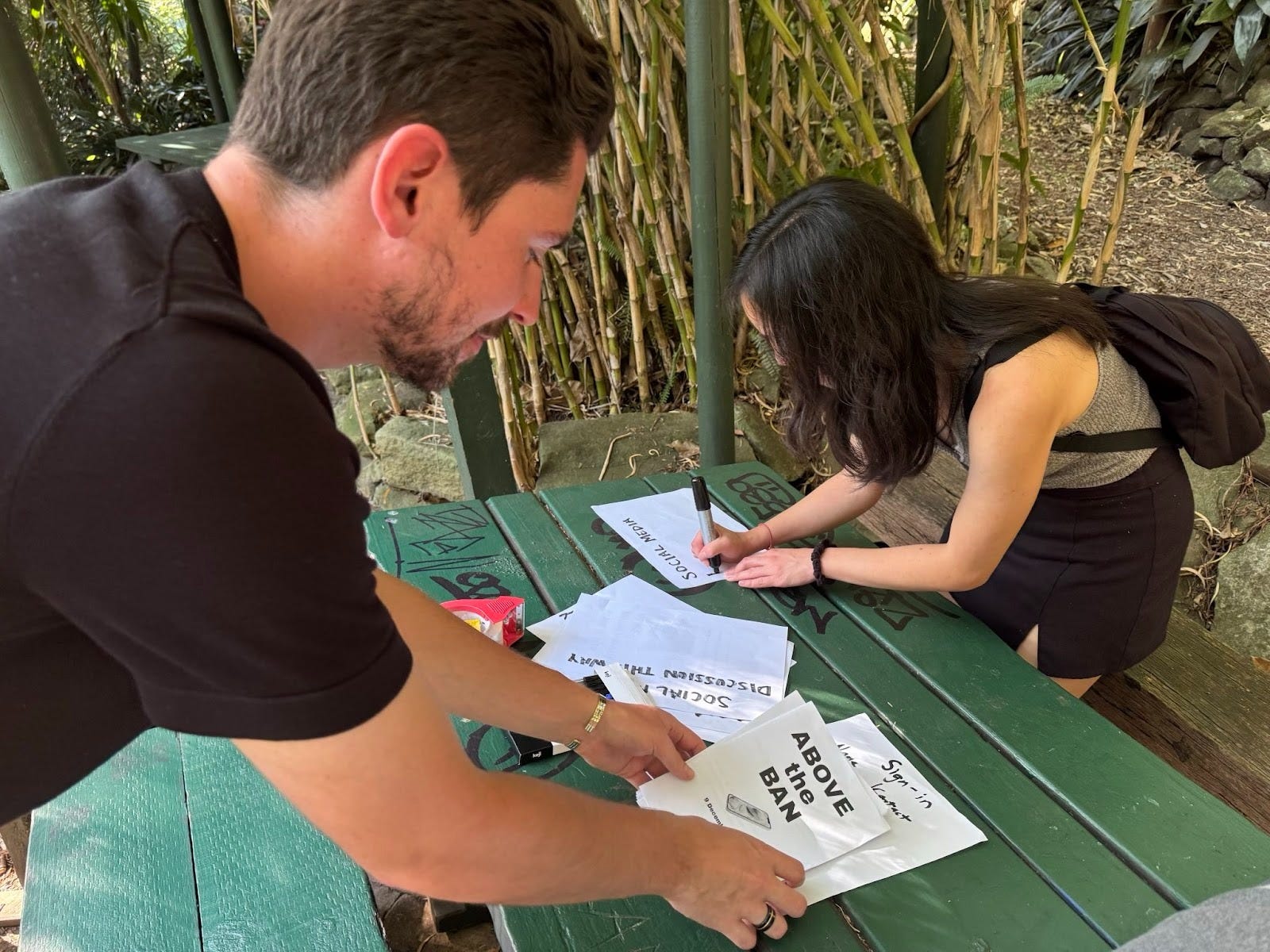
Towards the end of our trip, we hosted a small public workshop in which we discussed ways to make the most of this opportunity. What structures, we wondered, can we build to sustain richer social lives offline, where attention can flourish? A few of the ideas I jotted down: having groups of parents commit to delaying access to coercive tech; teaching kids about digital spaces earlier so they can make more informed, intentional decisions; public campaigns that encourage people to leave their smartphones at home (Australia has a free phone system); and free play initiatives that make the most of carefully designed physical space.
FLYING back to the season’s first snowfall in New York, I was eager to keep moving with the tech resistance scene we’ve been growing here at home. The situation in Australia underscores the importance of a multipronged approach: policy alone, or education alone, or culture alone will never be enough. It’s the mutual reinforcement of these intersecting initiatives and organizations that will make a difference at the necessary scale. The task before us is to weave together diverse efforts so we all may leap into a powerful, unified global movement.
Nick Plante is a Brooklyn-based organizer and community educator. He advocates for social infrastructure free from Big Tech and hosts events around the country to foster deeper agency and connection. His column, On the Ground, follows current activist efforts against extractive technology.