

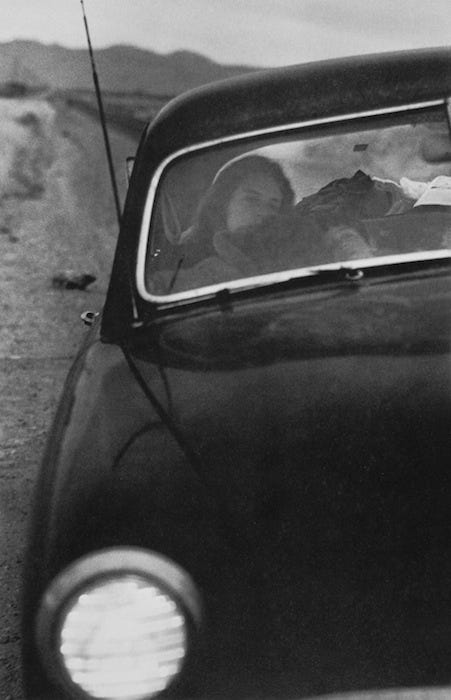
The photograph on the last page shows a car at the side of the road. In the backseat, a woman reclines with the cheek of a boy pressed against her shoulder, their faces misted with sleep. Outside the window, a flat and dusty desert stretches to a mountainous horizon, but mother and child pay no mind to the wide-open country. They are enclosed in their cabin, swaddled in quiet, unsuspecting of cameras, dreaming unknowable dreams.
In 1955, a 31-year-old photographer named Robert Frank won a Guggenheim Fellowship to photograph the United States. Setting out from New York, he crisscrossed the continent with a camera in the passenger seat of his black Ford Business Coupe, pulling over long enough to capture what he saw and then keep moving, a restless, taciturn Swiss immigrant composing his adoptive country exposure by exposure: Philadelphia, Detroit, Savannah, Houston, Reno, San Francisco, and the long, lonely stretches of road in between. On some legs of the trip, his wife, Mary, and their young children, Andrea and Pablo, travelled with him. Cops eyed him with suspicion: a foreigner with a camera, and Jewish too. He was thrown in jail in Arkansas and chased out of a small town in Tennessee. In total, he took some 28,000 pictures. Of these, a selection of 83 were published as The Americans, which became one of the most celebrated photo collections of the twentieth century.
The Americans shows a people in motion, the grimacing, blinking, half-obscured contradictions of democratic life in its mottled glory.
But not all at once; it took years for The Americans to find a receptive audience. A Parisian press was the first to print it, and when the book was finally released in the United States (with an introduction by the novelist Jack Kerouac), sales were poor and critics were unimpressed. They derided Frank’s photos as sloppy and blurry, with “drunken horizons.” They supposed that he hated this place – so why didn’t he leave?
In time, though, his glowing jukeboxes and blond starlets and leather-clad bikers came to be recognized as prescient visions of America’s self-ascribed mythos. The Americans shows a people in motion, the grimacing, blinking, half-obscured contradictions of democratic life in its mottled glory.
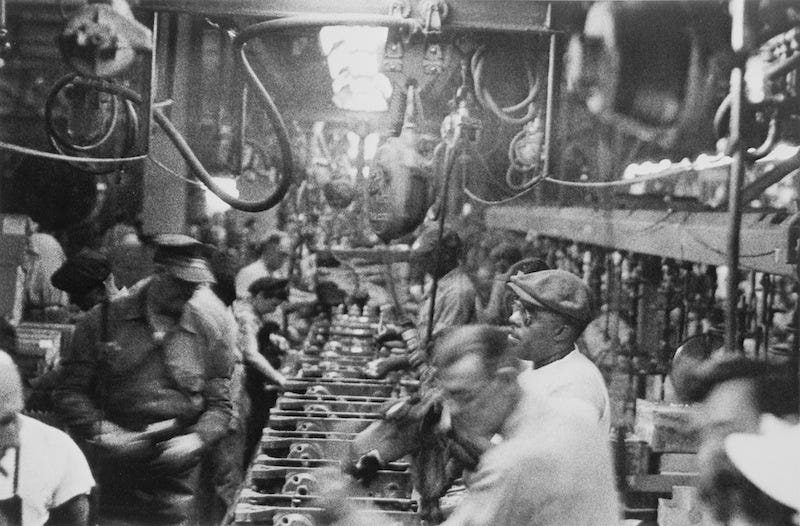
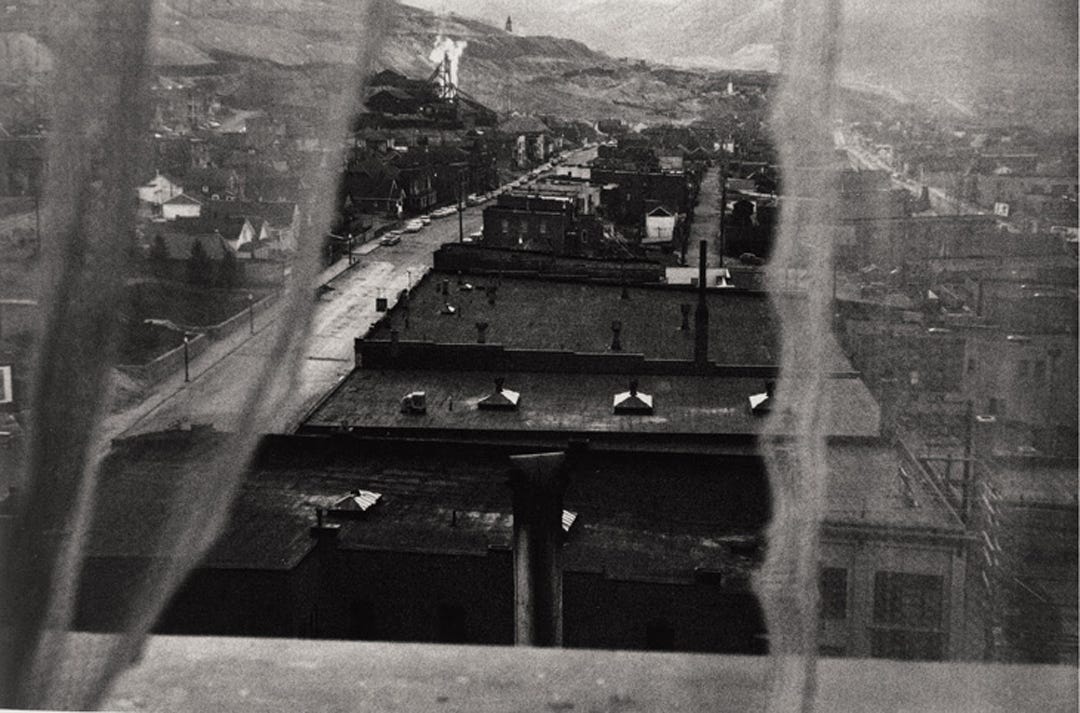
The nation is a simplifying fiction; it blankets vast and varied maps with a single identity. In doing so, it purports to tell us the essence of places we have never been. This is what Frank did with his pictures: by setting them together, he made us believe we could see beyond the edge of each frame. He fashioned his American fiction from close attention to the world past his windshield, and then he taught us how to do it for ourselves. Frank never went to Biloxi, Mississippi, but after seeing his work, one can imagine how Biloxi might have looked through his Leica. His photos suggest that America is a way of seeing as much as it is a thing to be seen.
Yet one image – the last in the collection – rubs against this unifying vision: a woman and a child sleeping in the backseat of a car. The woman, of course, is Mary Frank. The boy is her son, Pablo. One suspects little Andrea is in there, snoozing somewhere out of view. They are accustomed by now to these frequent stops; they have spent plenty of time waiting at the side of the road, watching the artist point that little box of his at the parade, the burial ground, the motorcycle show, the baptism. Do they sense a thing called America coming into view? Do they see what he sees? Do they care?
U.S. 90, en route to Del Rio, Texas, the image caption reads: just another stop. But this time, the artist has turned his camera toward the car. He lets us see who’s been sitting in the backseat all the while. They are, perhaps, the only people in this entire collection of photographs who know the name of the man who took their picture. Yet here they are, on equal footing with everyone else in these pages – as democracy would have it. They must be the Americans, too.
The forms of attention that conjure the identity of a people are not the forms of attention that honor the specificity of a person. Problem is, we need both.
The Americans was published in 1959. In 1969, Robert and Mary divorced. In 1974, Andrea died in a plane crash in Guatemala. Pablo, who suffered from schizophrenia, died by suicide in 1994. It’s possible the factory worker in Detroit and the priest in Baton Rouge met tragic ends, too, though Frank would know as well as we do – which is not at all. He needed his subjects to be anonymous. The forms of attention that conjure the identity of a people are not the forms of attention that honor the specificity of a person. Problem is, we need both. A people without persons is a dangerous abstraction. A person without a people lacks the fastenings of obligation that make us whole. Both tend, in their extremes, toward violence.
The challenge of democracy is to reconcile these ways of seeing. Can free, self-governing individuals make up a nation? Can we exist fully unto ourselves and also fully unto others? The Americans does not resolve the question, but it does put us behind the viewfinder of a man who embodied its contradictions. Immigrant, artist, husband, father. Frank went searching for America, and that’s what his photos portray: a determined, possibly interminable, searching. It’s why they feel so sad, and so full of hope.
It’s also why they seem, half a century later, to capture the truth of this place. Insofar as America exists, it exists in our will to find it. It is a mode of attention that dares to encounter divergent realities without collapsing them – an attention that is the thing it seeks. Frank made no exclusive claim to this kind of vision. His crooked angles and fuzzy focus disavow technical expertise and signal that his pursuit is ours, too. Take a page from Frank’s book. Go looking for America, and you’re already there.
Peter Schmidt is the Program Director at the Strother School of Radical Attention in Brooklyn.
I came of age in the 60s, graduating from high school in 1970. For me and my friends interested in photography and poetry, Robert Frank's "Americans" was a touchstone, along with things like John Cage's "Silence", Gary Snyder's "Earth House Hold", and Jerry Uelsmann's photomontage. 1959 was a watershed, going from Eisenhower to Kennedy, expressionism to pop. In those days, boys had newspaper routes and thought about the draft. Today, I heard that John and Paul first met in 1957. They were 17 and 14. It is interesting to recollect, how intergenerational tides of culture shape our impressions of life.
So resonant. Frank's photography, in its spontaneous, in-the-moment and almost reckless dynamism, looks to me like a photographic companion to action painting. It captures time as well as it does space.