

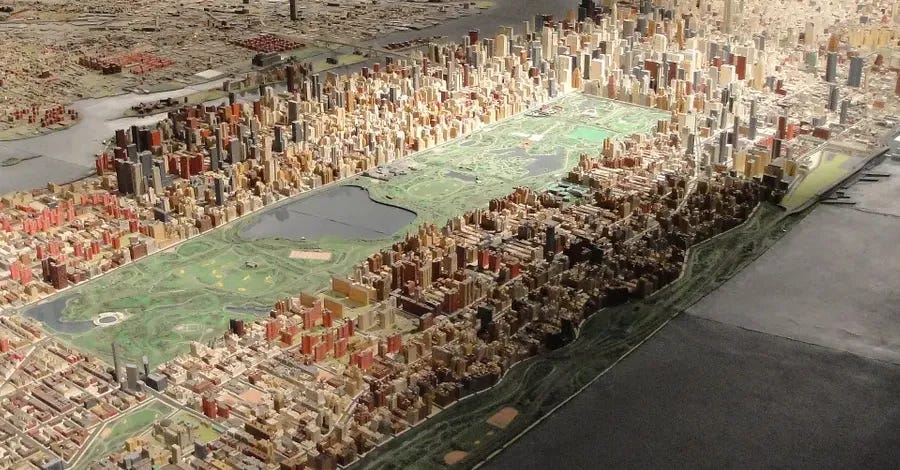

On a sunny Saturday in August, twenty or so New Yorkers (strangers, lovers, friends; one person was from Jersey) gathered to walk the length of Manhattan. We met across the river in downtown Brooklyn, on a grassy corner nestled in the curve of a BQE off-ramp, then crossed the bridge and headed north: through Chinatown and SoHo, past Washington Square Park and Madison Square Park and Times Square and Columbus Circle and Central Park and Morningside Park, up past the elevated trains of 125th Street, through a West Harlem sunset, into Washington Heights and then deeper into Washington Heights, right down to the entrance of Fort Tryon Park, from which point we processed, in a stately, spontaneous, and slightly awed silence, through the falling darkness, past the pitched lamps of open-air bingo and the tail end of a fifth birthday party, up the worn stone stairs along the curve of the hill as the shadowy undergrowth gave view to the wide, black Hudson and the moonlit paleness of the Palisades, and up and around, and up and around to what is very nearly the highest point on the island of Manhattan: a patch of grass known as the Cloisters Lawn. This is a total distance of some thirteen miles. It took us eight and a half hours. The weather was favorable; I doubt we would have made it had the day been even a few degrees hotter. Our assignment was to walk, and to think about the relationship between walking and thinking. A sort of moving seminar. A “study.” On foot.
Readers with a nose for stunts may sniff. “Walking and thinking” is a neat enough premise, but why not meet in a park? Or at the beach? And did we really have to go thirteen miles?
Right around 96th Street, as I loosened the laces on my creaking boots, I, too, began to wonder.
But we had come for an investigation that merited 260 city blocks worth of rigor: What is the role of the academic traditions (reading, asking questions, thinking systematically, etc.; what you might call “study”) in our rapidly changing world?

This question, and the peculiar streetwise trajectory with which we approached it, began with the hypothesis that creating the conditions for an intellectual life at the present moment means looking beyond the sluggish structures of traditional schooling. Ubiquitous AI technologies, rampant anti-intellectualism, the pillorying of legacy institutions from all quarters, and the perverse economics of higher education (ICE recruitment ads now offer student-loan relief) are driving a phase shift in the relationship between inherited practices of study and the world of everyday life, between the inside and the outside of the classroom. In view of such changes, new configurations of these two zones must be tested. Have you ever read Guy Debord while skirting bus-tour hawkers and breakdancing buskers at 42nd and Broadway? It is hard to get more “outside of the classroom” than that.
As Program Director of the experimental non-profit School of Radical Attention, I have a vocational commitment to this very question. Over the past few years, I’ve talked to artists, organizers and old-fashioned educators across the country who are testing new and known ways of bringing school out of the classroom and into everyday life. What these scattered, scrappy, and spirited efforts evince is a powerful desire to see the embattled traditions of collective study (from the sandal-clad Peripatetics circling the Acropolis to the Black Panther Liberation Schools) find their footing in a historical moment that has proven largely unfriendly to contemplative pursuits. You might say that study itself is searching for a new home. It, too, is on the move.
Study: the word wants context. On one level, its meaning is perfectly self-evident. If I tell you to study a poem, you’ll look at the poem, hard, for a while. You may not enjoy yourself, and you may not “get” anything from the text, but you certainly know how to go through the motions. The problem is that for most people, this version of study (solitary, compulsory, graded) conjures unhappy memories of No. 2 pencils and hand cramps and the ritual shame of standardized testing. Which, if we are interested in a future that people actually want, does not do us much good.
But there is another, increasingly popular, use of the word, one commonly associated with philosophers Fred Moten and Stefano Harney. In Moten’s words, “Study is what you do with other people. It’s talking and walking around with other people, working, dancing, suffering, some irreducible convergence of all three, held under the name of speculative practice. The notion of a rehearsal – being in a kind of workshop, playing in a band, in a jam session, or old men sitting on a porch, or people working together in a factory – these are the various modes of activity. The point of calling it ‘study’ is to mark that the incessant and irreversible intellectuality of these activities is already present.”

This sketch is a touchstone for many of the organizers I know, and captures nicely the spirit of a busy field of creative thinking that has opened up on this topic. It casts study as what happens when you lift the spirit of school (inquiry, community, intellectuality) from its corporeal form (budgets, hierarchy, standardization). No longer is a life of the mind limited to close readings of Levinas; shooting the shit on the factory floor can be just as deep.
That’s an attractive idea, especially for the many people who have felt their own intelligence belittled or neglected by formal school systems. Indeed, it seems obviously wrong that academic institutions should have an exclusive claim to serious thought. But Moten’s gloss is also undeniably slippery. If “study” is a way of indexing latent intellectuality, and if any activity is potentially intellectual, then study can mean anything at all – which is to say it means nothing. In this light, does study have anything to do with school? And does school have anything special to offer?
The key, I think, is in that phrase, “speculative practice.” It’s a way of characterizing study that only begs further questions. What, after all, is speculative practice? One must speculate, practically. In other words, if you want to know what study is good for, don’t try to theorize it – just get down to business! Study is what you do with other people…
The week before our trek, I sent a handful of readings to the twenty-ish participants who had signed up online: excerpts from Rebecca Solnit’s brilliant cultural history of walking, James Baldwin’s meditation on the streets of Harlem, Guy Debord’s theory of the dérive, and Virginia Woolf’s tale of wandering through crepuscular London in search of a lead pencil. These are four authors who wrote about walking and who walked in order to think. I asked folks to read the full essays in advance, although I paired short passages with discussion prompts, each of which we would consider at one of the nine or so stops along our route: Do you believe that knowledge or truth is mobile? What are some ways that walking has been rationalized, mechanized, and disembodied? What is the relationship between movement and narrative?
On Saturday at 2pm, we gathered in Brooklyn. People arrived in pairs or alone, with backpacks or, in a few mystifying cases, appearing to carry absolutely nothing at all. I had a cooler bag full of sandwiches and a pile of packets. Folks formed a loose circle on the grassy slope, in the shade of a tree. When nearly everybody was present, I launched with a question: What sorts of activity can walking be? A friendly professor from the New School started us off: Walking can be pilgrimage. Walking can be therapy, said another. Trespassing. Protest, someone offered. A way to get around. A way to socialize. Entertainment. Exercise. Exodus.
That seemed like a good place to start. With a capacious sense of the task before us, we formed buddy pairs, distributed maps, identified our first rendezvous point, and set out. Across the street and up a flight of crowded stairs that opened onto the magnificent expanse of the Brooklyn Bridge. There, ahead, rose Manhattan.
Yet whatever naïve hopes I had for a smooth synthesis of seminar and ramble were promptly dispelled. Within minutes, the lead pair had disappeared into the tourist throngs ahead, and two other pairs had fallen behind our designated sweep. It appeared my job for the day would not be preceptor, but crowd control. I hustled to the front to check on the speed-demons, then doubled back to herd the stragglers. A pair of friends from Bed-Stuy asked if I had planned out our bathroom stops. I had not thought to do so. By the time we made it over the bridge, twenty-five minutes had elapsed, and I was sweating through my socks.
We regrouped beside a kiosk near City Hall, then switched partners and forged north along Centre Street. Three participants split off to pee. Two latecomers called to coordinate a meetup at Bleecker. When we circled up to read a passage from Virginia Woolf, my attempts at framing were nearly extinguished by pounding hip-hop from a passing Jeep Wrangler.
And so on.
Studying in the street turned out to be a messier affair than I had anticipated. In Times Square, our group dissolved completely, and it seemed a minor miracle when everyone converged on the fountain at Columbus Circle, bubble teas in hand. The comparative tranquility of a subsequent straight-shot up Central Park West was aggravated by the fact that everyone’s feet were beginning to ache. My lower back was sore. And we were only halfway there.
It was then, as I have said, that doubt overtook me. We had been walking for three and a half hours, and our pace was flagging. As the Natural History Museum sailed by, I felt a mounting suspicion that nobody wanted to be there, that at some point, one or two and then five or six and then all of these people would peel off with some perfectly reasonable excuse and slip with relief into the subway. They wouldn’t make it to Fort Tryon – and why should they? – when what was promised (French Marxists! Baldwin! a methodical inquiry into the rationalization of movement! school stuff!) was a far cry from what we were actually talking about.

Which begs the question: What were we actually talking about? For each leg of the journey, my packets provided a text and a set of questions to be read aloud. But no sooner had the pairs shouldered their bags and set out for the next stretch than they left the prompt behind. In response to Virginia Woolf’s reflection that a stroll dissolves one’s sense of self (“The shell-like covering which our souls have excreted to house themselves, to make for themselves a shape distinct from others, is broken”), I heard one participant recounting her recent cross-country move. To Rebecca Solnit’s close reading of the treadmill (“A corollary to the suburb and the autotropolis: a device with which to go nowhere in places where there is now nowhere to go”), a charismatic young academic extolled his newfound love for tennis. And in the icy heat of James Baldwin’s moral censure (“Walk through the streets of Harlem and see what we, this nation, have become”), a gregarious Gen-Z was overheard describing her involvement with a radical puppet troupe.
Admittedly, my perspective was incomplete. I was bouncing from pair to pair and catching only a fragmentary impression of any single conversation, with little sense of how they had gotten from the autotropolis to the tennis court. Still, I felt I had failed to transpose a meaningful academic conversation from the seminar table to the sidewalk. This was a disappointment. But what was I to do? People were still hanging around, and I was responsible for the route.
Onward!
We struck west at 96th and then continued north via Amsterdam. As we passed into Harlem, the rose-gold light of the waning day climbed fire escapes to kiss the paint-flecked cornices. At 125th, we caught a view of the sunset through the demi-lune arches of the 1 train viaduct. The Hudson twinkled. The mood shifted. Perhaps, I considered, the breadth of our conversations wasn’t a failure. We were walking, after all. Why shouldn’t our thinking travel, too?

Still, our so-called “study” was proving less bookish than I had expected. Which redoubled my confused response to Moten’s formula: if everything is intellectual, then what is the point of reading and thinking? Why do school stuff at all? The day’s events suggested that these people (nearly all of whom, I might add, were college-educated, and a few of whom were academics) would just as soon shake off the texts and the prompts. If that were the case, was there any point to calling it a seminar? Any point to assigning readings? Would we have done just as well simply walking? And if a mere walk qualified as its own way of exploring a question, then what, exactly, was the question?
I wondered.
Meanwhile, as we made our way up, improbably up, into the lively dusk of Washington Heights, a subtle change began to be felt. Our loose line of twenty mostly-strangers had compacted; we were walking as a group. Night fell. The pizza parlors and barber shops cast their yellow light onto the sidewalk. Stoop-sitters eyed us over the rims of beer bottles and our gait quickened with purpose. My doubt began to crystallize into disbelief. We were going to finish.
A word of context: When you get right down to it, my job is to persuade people to go to events that they have no obligation to attend. This is difficult anywhere; it is especially difficult in New York City. I have learned to enroll exactly double the number of available spots for a given event to account for the inevitable 50% attrition, and I have contemplated many an empty circle of chairs. Getting people to show up to anything on a Saturday afternoon is a tall order. Getting them to show up to a 13-mile walk is inadvisable. Getting them to actually finish? In my line of work, that’s a downright miracle.
Indeed, “miracle” is the word; at a certain point, I wasn’t getting people to do anything at all. I may have cued us into motion back in Brooklyn, but by the time we had left Harlem, the movement of the group ceased to reflect any single person’s urging. Some other force was moving us: not coercion, certainly (anyone could leave at any time), nor even curiosity (there would be no reveal at our destination, no pat resolution to our guiding questions), nor promise of gain. Nobody was counting steps. Nobody was taking selfies for clout. Yet here we were, each of us growing perceptibly giddy as the island of Manhattan shrunk beneath our feet.

The hum of the hospital at 165th. The dazzle of the United Palace theater. Ducking under the Cross-Bronx Expressway and cresting the heights of 181st. Then a long, smooth descent toward Fort Tryon Park. We paused to regroup before a stone gated entrance. Is this it? a few folks asked, as if arriving came as a surprise. As if they had expected to walk forever.
We resolved from this point onward to walk in silence. The path beyond the gate was dappled by the sodium orange glow of the nearby streetlamps. Somewhere on Dyckman Street, a subwoofer was thumping; at this distance, it was soft as a heartbeat. We passed through the park and wound our way up toward the top of the hill. After a day of incessant chatter, the absence of conversation gave way to the presence of everything else: the far-off hum of traffic, cricket song, our own footsteps. In a way, stepping forward into the darkness helped me understand what our task had been all along: not to ask, much less to answer, but to inhabit a question. To walk toward what we could not see. No wonder I had been mystified by the group’s progress; I didn’t know what had moved us across thirteen miles of pavement because what had moved us was precisely what we did not know.
It is a simple fact of social existence that we organize ourselves around what we believe. This instinct is the basis of affinity groups, of sports fans and political parties and countless online subcultures. Shared conviction is the base upon which we build a legible world. But to avoid the paralysis of dogma, or the bone-breaking weight of absolute truths, the gravitational tug of conviction requires an equal and opposite force – one that is often denigrated by our culture’s fetish of limitless information and the eradication of uncertainty.
What moved our unlikely cohort was this opposite force: the contrary impulse to organize ourselves around what we do not know, around what we cannot fathom, and possibly cannot name. That may sound mystical, but it is plain as day. Most of life looks like this. The basic work of a plural existence, of a national project, of stepping into an unknown future is the work of organizing around the limits of our own understanding – limits that tend to reveal themselves as a sort of absence. Silence is the sound of whatever’s beyond language and emptiness is the mark of whatever’s beyond sight. It is easy to trivialize these uncharted zones, to confuse them with nothing at all, but precisely the opposite is true. Ask any astrophysicist and they’ll tell you: the universe is held together by the gravity of what we cannot see. People want to be held together in this way, too.

Do the inheritances of schooling (reading, writing, asking questions, testing ideas) play any special role in this process? These activities can seem terribly contrived, not to mention laborious, now that machines can do them for us. But saying so is to confuse these practices with the kinds of knowledge they can produce. Scholastic traditions are not output functions; they are maps for configuring ourselves in relation to what we do not know. They can teach us, if we will learn, how to live a question together. And living a question together – consciously, willingly – is the task before us. Study is a name for this.
A dogwalker in Fort Tryon Park around 10:30pm on a recent summer Saturday would have harbored modest unease to hear noises – a mixture of pleasured sighs and pained groans – issuing from the dimness of the Cloisters Lawn. Twenty people sprawled there who had formed a similar circle, hours prior and miles away, on the far side of a wide river. We had gathered to read and found ourselves at a loss for words. We had gathered for school and found ourselves elsewhere. We had, to my own surprise, gone the distance, with nothing to see us onward but a shared desire to assemble around what we could not name. Some concluding talk was had, some applause was offered (for whom, we did not specify), and then we picked ourselves up and made our way toward sleep.
Like Virginia Woolf, who returned home with a single lead pencil, we carried an artifact of our own excursion, a trace of the purpose we had found, at great length, atop a moonlit hill. It was there, in the simple geometry of a ring of bodies about a grassy center: the empty space, the absence that joined us to each other. •
Peter Schmidt is Program Director at the Strother School of Radical Attention in Brooklyn. His next seminar at SoRA on the symbolism of the STARS & STRIPES begins October 22nd.
The best travel writing can be about one's home turf - and this is an excellent account of such a journey.